



Buying gold in Malaysia no longer means walking into a bullion dealer or a jewelry store. Those options still exist, but they’re only part of today’s market. Gold investment in Malaysia also includes bank-issued gold accounts, ETFs, digital products, and other investment solutions. Some people buy gold to protect purchasing power during inflation, while others use it to diversify or reduce exposure to currency swings.
Anyone looking into how to invest in gold will find that every option works a little differently. Physical bullion, exchange-traded funds, bank products, and online trading platforms all provide access to the market, but they differ in liquidity, costs, and the amount of risk involved.
Before deciding to invest in gold in Malaysia, it helps to answer one question: is the goal long-term wealth preservation or active trading? The answer determines which products make sense and how a practical gold trading strategy should be built.
Why Invest in Gold?
Few people talk about gold when stock markets are setting new highs. The conversation usually starts after inflation jumps, interest-rate expectations change, or geopolitical risks make investors uncomfortable.
That has happened several times in recent years. Central banks bought more gold, defensive positioning increased, and demand for gold strengthened. None of those factors guarantees higher prices, yet together they help explain why investing in gold becomes a recurring topic whenever uncertainty returns.
Gold follows different rules than company shares. It has no profits, no dividends, and no executive team trying to impress investors. Supply, monetary policy, sentiment, and physical demand matter much more.
That is exactly why many investors continue treating gold as a hedge. The label “excellent hedge against inflation” has survived for decades because gold has often held its value when purchasing power came under pressure.
Beyond that, there is the question of diversification. Long-term gold investing is supported by continued demand for gold from central banks, manufacturers, ETFs, and private buyers. For many portfolios, protecting your wealth matters more than maximizing the return from a single investment.
(“If You Don’t Own Gold, You Know Neither History Nor Economics.”
American billionaire investor and hedge fund manager—Ray Dalio
Excerpt from interview with CFR, June 1, 2018)
Gold Trading for Beginners

Buying gold and trading gold are different activities. Someone purchasing bullion may ignore the market for months. A trader often reacts within hours.
Every trading day produces fresh opinions about where gold is heading. Most of them are forgotten within hours. What keeps influencing market prices is far more consistent: inflation data, Federal Reserve meetings, employment reports, central-bank purchases, and geopolitical developments.
That is why how to trade gold is largely a matter of recognizing what the market is already doing. Support and resistance, volatility, trend direction, and trading volume give traders a framework for decisions, while those who regularly track the price of gold spend less time chasing predictions and more time interpreting price action.
Today’s trading platforms make it easy to gain exposure and maintain exposure to gold without buying bullion or arranging storage. That flexibility has turned gold into a widely used modern investment, alongside stocks, currencies, and commodities.
Knowing what moves the market is only part of the equation. Having a platform that lets you react when opportunities appear matters just as much.
Types of Gold Investments Available in Malaysia
There is no single “best” way to invest in gold. Some investors value direct ownership, and others prioritize liquidity, while active traders often focus on accessibility and transaction costs. Comparing storage, spreads, liquidity, and exit options usually matters more than comparing prices alone.
Physical Gold Bars and Coins
For those who want to own the metal outright, physical gold remains the most traditional choice. Investors can buy gold bullion, gold bars, or gold coins produced by internationally recognized mints.
The most common formats include:
- gold bars from one gram to 1 kg;
- gold bullion coins and other bullion coins;
- physical gold bars refined to 99.9% purity.
The choice between bars or coins is usually a practical one. Larger bars usually come with lower premiums per gram, while coins are often easier to resell in smaller amounts. Anyone planning to buy gold bars should look beyond the sticker price. Dealer spreads, buyback terms, storage costs, and authenticity certificates can have just as much impact on the overall investment.
Many investors build a position gradually by buying a few grams of gold whenever prices or their budget allows. Whether a portfolio contains bars and coins or only bullion, physical ownership means the metal remains under the owner’s direct control.
Gold Investment Accounts
Not everyone wants to keep bullion at home or pay for secure storage. A gold investment account removes those practical concerns while still providing exposure to gold prices.
Malaysian banks take different approaches. Maybank Gold Investment Account, Public Bank, and UOB all offer gold-linked products, but the details vary. Minimum purchases, spreads, account fees, and redemption rules are worth comparing before opening an account.
Anyone considering a gold account should also check whether physical redemption is available and how the product fits long-term gold savings goals. Those details often have a greater impact than the bank’s name.
Gold ETFs and Digital Gold
Owning gold no longer requires buying bullion. Gold ETFs provide exposure through an exchange, making them one of the most liquid investment vehicles available.
Global investors are generally familiar with SPDR Gold, while Malaysian investors have access to TradePlus Shariah Gold Tracker, a gold ETF listed on Bursa Malaysia. Performance figures tell only part of the story. Management fees, liquidity, tracking error, and assets under management are just as important when comparing ETFs.
Digital gold offers another route. Investors can invest in gold online without storing the metal themselves. Before opening an account, check who holds the underlying gold, whether redemption is possible, and if the platform is licensed to operate online in Malaysia.
What Drives Gold Prices?
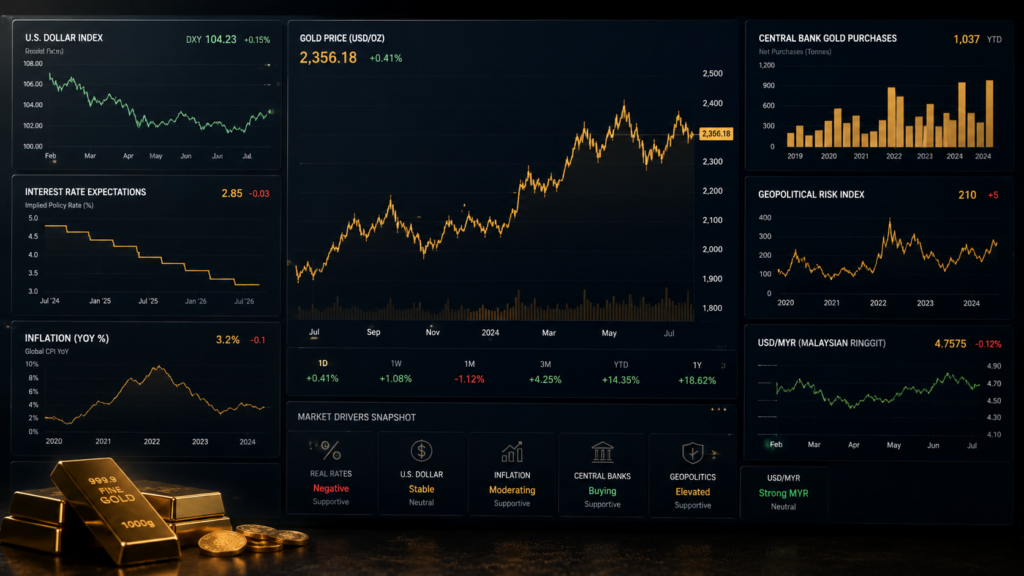
Anyone searching for why the gold price is increasing is usually hoping for one clear answer. In reality, the gold price reflects several forces working together.
Interest-rate expectations remain one of the biggest drivers. Because gold pays no income, falling rates tend to improve its appeal relative to bonds or cash. The U.S. dollar matters as well. Since gold is priced globally in dollars, currency moves often influence the price of gold, even before supply or demand changes.
Uncertain markets often bring in new buyers. Central banks, institutional funds, ETFs, and retail investors typically increase demand for gold, and that buying can keep prices elevated even after the initial shock fades.
Local investors should watch more than international headlines. The global gold market sets the benchmark, but exchange-rate movements affect Malaysia’s domestic prices. A weaker ringgit can push local prices higher even when global markets barely move.
Looking at one news story in isolation rarely explains what gold is doing. Traders who track the price of gold usually keep an eye on interest rates, inflation, central-bank buying, and currency markets at the same time.
How to Buy Gold in Malaysia
Researching how to buy gold in Malaysia quickly reveals one thing: there is no shortage of choices. The challenge is deciding which option matches the way the investment will actually be used.
Price should never be the only comparison. Premiums, buyback spreads, transaction fees, storage costs, and liquidity all influence the final return. A reputable dealer should explain the entire purchase and sale process clearly, including how clients can buy and sell gold, arrange the sale of gold, or purchase or sell gold later.
Public Gold
Public Gold has become one of Malaysia’s best-known bullion companies. Besides selling physical bullion, it offers savings programs and buyback services, making it easier for investors to build positions gradually instead of committing a large amount at once.
Banks and Bullion Dealers
Many buyers still turn to banks when they want to buy physical gold. Specialist dealers, however, usually stock a broader range of gold bullion, gold bars, and gold coins. Price matters, but so do purity certificates, dealer spreads, storage options, and buyback conditions.
Online Investment Platforms
More investors now choose to buy gold online instead of visiting a bank or bullion dealer. Regulated investment platforms make it possible to invest in gold online, monitor holdings, and manage transactions from anywhere online in Malaysia. The platform itself matters just as much as convenience. Storage arrangements, redemption options, and fees can differ considerably from one provider to another.
Gold Trading Strategy
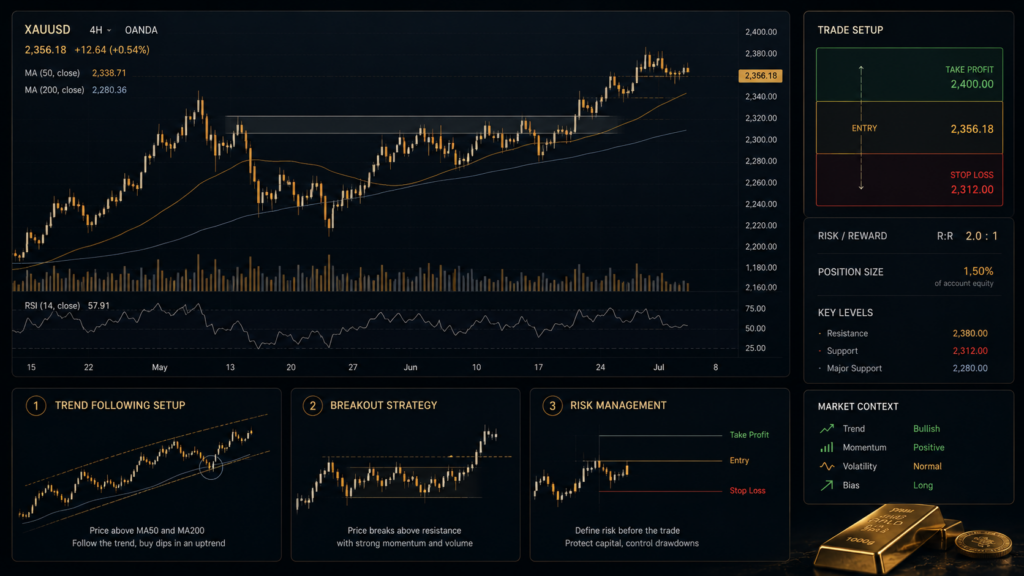
Every gold trading strategy performs better in some market conditions than in others. Interest rates, inflation, geopolitical developments, and investor sentiment all influence how gold behaves, which is why traders often adjust their approach as market conditions change.
The choice of instrument matters as well. Some traders prefer direct exposure, while others use gold shares, gold options, or other investment vehicles to gain exposure to gold with different levels of leverage and risk.
Trend-Following Strategy
Trend-following works best when gold is making higher highs or lower lows over an extended period. Many traders combine moving averages with support and resistance levels to avoid trading against established momentum.
Breakout Strategy
Breakouts often appear after the market has spent time moving sideways. Stronger trading volume and sustained price action usually provide a clearer signal than the first sharp move, which is why many traders wait before opening a position.
Risk Management
Even a well-designed strategy can produce losing trades. Position size, stop-loss placement, and realistic risk-to-reward ratios often have as much influence on long-term results as market analysis itself. Staying in the gold market is ultimately more important than winning every trade, regardless of short-term market prices or the modern investment product being used.
(“Trading is not quantum mechanics; it’s not quantum physics. You don’t have to spend five years learning on that.”
Versus Trade’s CEO—Vitalii Bulynin
FinanceFeeds interview, June 12, 2026. )
Long-Term vs Short-Term Gold Investing
Not everyone buys gold for the same reason. Long-term gold investing is often associated with steady holding, diversification, and preserving purchasing power through different market cycles. Short-term participants focus more on volatility and timing, using investment in gold to capture shorter price movements.
Many portfolios combine both approaches. Physical gold provides stability, while other investment vehicles allow investors to respond to changing market conditions without selling long-term holdings. The right investment in gold depends on what the portfolio is expected to achieve rather than on the latest market trend.
Conclusion
Inflation, financial crises, and changing interest-rate cycles have all come and gone, yet gold has remained part of many portfolios. The market looks different today because investors can choose from far more products than in the past.
Physical bullion, bank gold accounts, ETFs, digital products, and active trading are designed for different needs. Instead of searching for the “best” option, it usually makes more sense to decide what role gold should play in a portfolio first.
Once the strategy is clear, execution becomes much simpler. Versus Trade gives traders access to the markets, tools, and flexibility needed to put that strategy into action.