Sell in May and Go Away: Does This Market Timing Rule Still Work in 2026?


- The “Myth Is Dead” Camp
- The “Data Supports It” Camp
- What the Academic Research Found
- Turning It Into (or Against) a Strategy
- Common Mistakes with Seasonal Market Timing
- How to Think About Seasonality and Market Timing
- Is the Sell in May Effect Worth Trading? Weighing It Honestly
- Conclusion: A Real Debate, Not a Settled One
This is the rare market timing debate where the disagreement isn’t implied; it’s in the title. Some of the videos ranking for “sell in May and go away” declare the rule dead. Others claim 25 years of data prove it. Both sides can point to real evidence, because the academic research on seasonality is more contested than either camp’s thumbnail suggests.
The “Myth Is Dead” Camp
“Myth vs. Market: Why ‘Sell in May’ Is Outdated Advice in 2026” (AP Archive, YouTube), “Sell in May and Go Away is DEAD” (Michael Ruger – Greenbush Financial Group, YouTube), “Wall Street’s ‘Sell In May’ Rule Just Got Debunked” (Benzinga, YouTube), and “Sell in May and Go Away? The Data Says Otherwise” (Wise Money Show, YouTube) all argue against treating the seasonal pattern as a reliable modern-market rule, often pointing to changed market structure, more algorithmic trading, and a global investor base that doesn’t take the same summer holiday as European traders once did.
The “Data Supports It” Camp
“Sell in May and Go Away: Stocks, Commodities, and 25 Years of Data” (Seasonax, YouTube) takes the opposite position, using a multi-decade backtest to show a persistent gap between summer and winter returns.
What the Academic Research Found
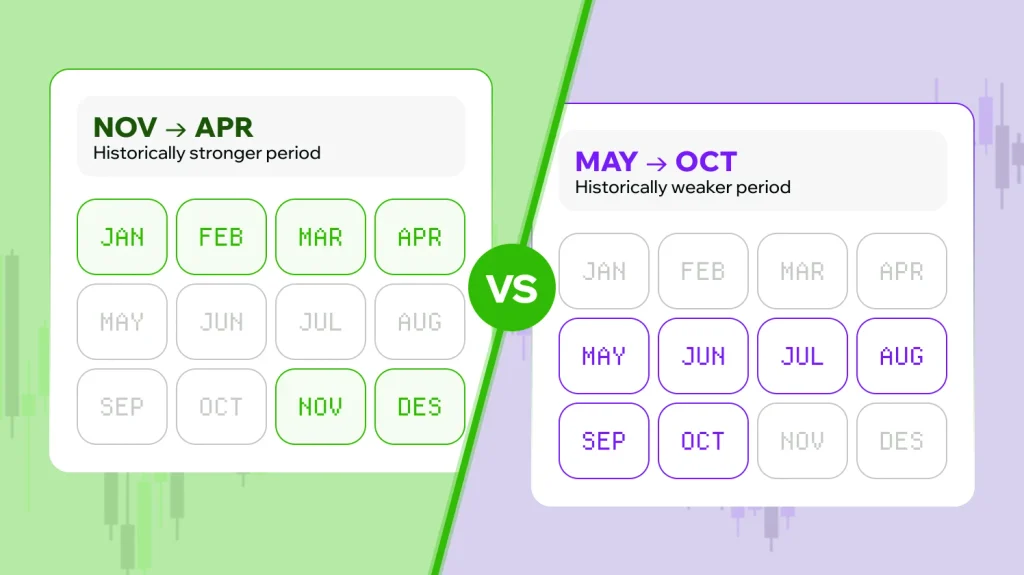
Both camps have real academic work to point to. The landmark study is Bouman and Jacobsen’s “The Halloween Indicator, ‘Sell in May and Go Away’: Another Puzzle,” published in the American Economic Review in 2002. They tested 37 developed and emerging markets and found higher average returns from November through April than from May through October in 36 of the 37 countries studied. The difference was statistically significant in 20 countries, including 10 at the 1% level (Bouman & Jacobsen, American Economic Review, 2002). That’s not a small sample.
A later follow-up, “The Halloween Indicator, ‘Sell in May and Go Away’: Everywhere and All the Time,” examined 62,962 monthly observations across 114 countries and 323 years of available data. Average November–April returns were 4.2 percentage points higher than May–October returns. The winter return was higher in 89 of the 114 countries and statistically significant in 42 of them (Zhang & Jacobsen, Journal of International Money and Finance, 2021). That’s the “data supports it” camp’s strongest citation.
But the “myth is dead” camp also has one. Economists Maberly and Pierce re-examined the U.S. evidence specifically and argued that the original result was heavily influenced by two outlier months: the October 1987 crash and the August 1998 collapse linked to Long-Term Capital Management. Once they controlled for those months, the U.S. effect became statistically insignificant. They also found no exploitable effect in S&P 500 futures from April 1982 to April 2003 (Maberly & Pierce, Econ Journal Watch, 2004).
That critique did not settle the argument. A 2010 response by H. Douglas Witte called the treatment of those two outliers arbitrary and found that robust regression methods still produced a statistically significant U.S. Halloween effect.
Now here’s where it gets interesting. The global, multi-decade version of the effect is one of the better-documented oddities in finance. But whether it survives as a standalone, tradeable U.S. strategy once extreme months and implementation choices are accounted for remains seriously disputed. This isn’t a case of one side having data and the other having none.
Turning It Into (or Against) a Strategy
“Sell In May And Go Away Strategy,” from Indonesian finance channel Cuap Cuap Cuan (Cuap Cuap Cuan, YouTube), treats the adage as an actionable rule, not a debate topic. “Don’t sell in May and go away! Make these moves instead” (InvestmentNews TV, YouTube) takes the opposite practical stance, suggesting portfolio adjustments other than an outright seasonal exit.
Common Mistakes with Seasonal Market Timing
The most common mistake is treating a statistically real historical pattern as a guaranteed annual event. Even the strongest version of the Halloween effect is a probabilistic tilt across decades. It does not guarantee a particular result in any single year. And the costs can add up: exiting and re-entering a portfolio twice a year may create bid-ask spreads and other transaction costs, while sales in a taxable account can realize capital gains. Those frictions eat into whatever seasonal edge might exist.
There’s also a framing problem. The original Bouman and Jacobsen study covered 37 countries. The more U.S.-specific critique from Maberly and Pierce found the effect far less robust after controlling for two extreme months, although that treatment was challenged by later research. Applying the global, multi-market finding as if it were a precise U.S.-only rule mixes up two different claims.
One more thing worth noting for anyone researching seasonality online: a lot of unrelated content ranks for generic month-based searches, from piano pieces to travel guides. If you’re looking into the “in May” effect specifically, filter those out before drawing any conclusions about the data.
How to Think About Seasonality and Market Timing
Let’s be practical about this. Start by treating “Sell in May” as one input, not a standalone strategy. Combine it with the broader trend and valuation context rather than trading the calendar alone. Then check if the specific market you trade (developed, emerging, or a single sector) resembles the broad international sample or the more contested U.S.-specific case.
And account for costs before assuming a seasonal edge is worth acting on twice a year. Read the studies’ caveats alongside the headline finding. Both sides of this debate are citing published academic work with real limitations. The seasonality data is worth knowing. The question is how much weight it deserves next to everything else on your screen.
Is the Sell in May Effect Worth Trading? Weighing It Honestly
The Advantages: The broad, multi-country version of this seasonal pattern is one of the more extensively documented oddities in academic finance, supported by the 2002 study and a 2021 follow-up spanning 114 markets and more than three centuries of available observations.
The Limitations: The U.S.-specific version of the effect has been challenged in the academic literature as sensitive to two extreme months, although later research disputed that methodology and recovered a significant effect using robust regression. That means “25 years of data” and “this has been debunked” can both reflect real findings while still presenting an incomplete picture of the wider literature.
CEO & Co-Founder, Versus Trade – Vitalii Bulynin
(paraphrased from FXStreet interview, July 15, 2026)
Conclusion: A Real Debate, Not a Settled One
“Sell in May and go away” is that rare finance adage where both the believers and the skeptics can cite real academic research. The global, long-run version of the pattern is well documented. The U.S.-specific, standalone-strategy version remains contested by the economists who’ve re-tested it.
Treat it as one seasonal data point worth knowing, not a market timing rule to trade blind. And if you’re researching it, filter out the unrelated “in May” results that have nothing to do with markets at all. The pattern might be real. But “real” and “tradeable” aren’t the same thing.
CFDs are complex instruments and come with a high risk of losing money due to leverage. This content is educational and should not be treated as financial advice.
Go from registration to trading with Versus Trade in 5 minutes.

- The “Myth Is Dead” Camp
- The “Data Supports It” Camp
- What the Academic Research Found
- Turning It Into (or Against) a Strategy
- Common Mistakes with Seasonal Market Timing
- How to Think About Seasonality and Market Timing
- Is the Sell in May Effect Worth Trading? Weighing It Honestly
- Conclusion: A Real Debate, Not a Settled One