


- What Are the Different Types of Stock?
- The 4 Types of Stocks Based on Market Expectations
- How Many Types of Stocks Are There?
- Stock Types Based on the Business Cycle
- Blue-Chip, Penny and IPO Stocks
- Types of stocks
- Domestic, international and ESG stocks
- Stocks to buy and stocks to trade
- Different types of trades in the stock market
- Stock selection for beginners
- Stock categories change, but the underlying risk remains
A technology company reporting rapid revenue growth, a mature bank distributing regular dividends and a small mining business waiting for drilling results may all appear under the same “stocks” tab. Their prices rarely behave alike.
Shares are influenced by interest rates, commodities, consumer spending and corporate announcements. Voting rights and dividends vary between stocks within the same industry.
These distinctions matter for market selection, holding period planning and volatility estimation. The main types of stocks describe more than company size or reputation. They also reveal what the market expects from the business. They show where disappointment may emerge.
What Are the Different Types of Stock?
A stock represents an equity interest in a company. Direct shareholders have voting rights, dividend payments and a claim on residual assets, depending on the class of stock.
Classification gets less tidy once market behaviour enters the picture. The same company may be described as:
- A common stock based on its legal structure
- A large-cap stock based on market value
- A growth stock based on earnings expectations
- A cyclical stock based on its sensitivity to the economy
- A domestic or international stock based on geography
- An ESG stock based on screening criteria
These categories overlap. A large-cap technology company can be a common stock, growth stock, international stock and blue-chip stock at the same time. Labels give you a framework for analysis, not a permanent identity.
Traders also face a practical distinction between buying shares and speculating on price movement through derivatives. With CFD trading, a position follows the underlying share price without giving the trader ownership in a company. That means no shareholder vote or direct entitlement to dividends. Cash adjustments may apply depending on the instrument and position direction.
Common Stock and Preferred Stock
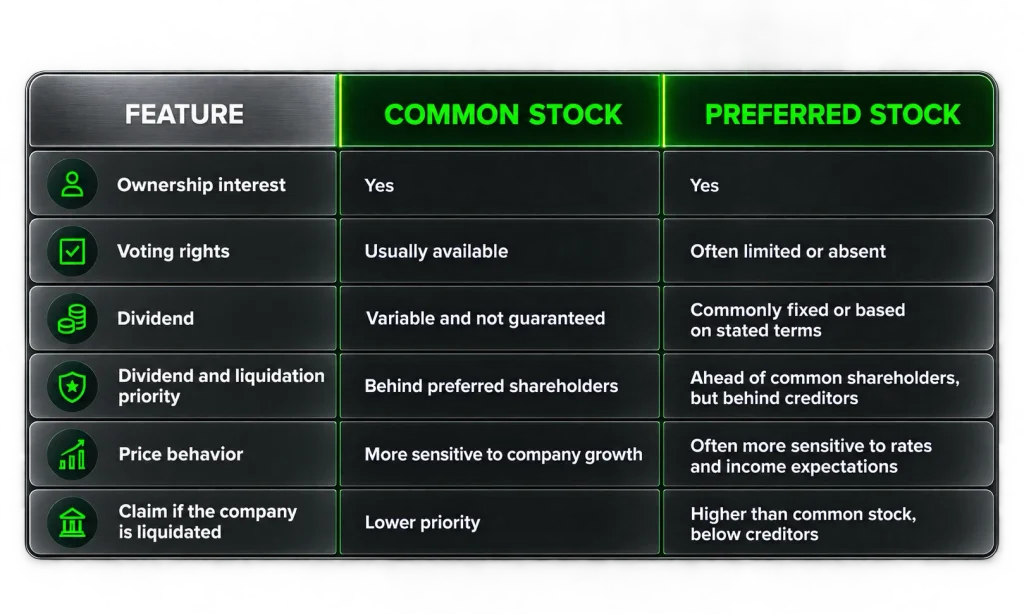
Common and preferred stock are the two principal ownership classes found across equity markets. Both can provide exposure to a company, but the rights attached to them differ.
Common Stock
Common stock is the most traded type of stock. Stocks are shares in a company, but do not guarantee influence over decisions. Voting arrangements differ with multiple share classes.
Common shareholders benefit when earnings and stock prices rise. They may also receive a dividend, which the board can change. If a company fails, creditors and preferred shareholders are paid before common holders.
Preferred Stock
Preferred stock combines equity ownership with characteristics of bonds, often paying a stated dividend. Its earnings growth participation is usually less direct than common shares, though the terms vary. Interest-rate expectations impact its market price strongly.
Preferred shareholders usually receive dividend payments before those holding common stock. This means less voting power and participation in a major rise in a firm’s market value. The terms of a security are often more informative than the preferred label alone.
The 4 Types of Stocks Based on Market Expectations

Stocks are often divided into growth, value, income and speculative. This is not official. It reflects buyers’ expectations and possible stock price changes.
1. Growth Stocks
Growth stocks are businesses expected to increase earnings quickly. Tech, digital services and emerging consumer brands often fall into this category, but a growth stock can be found in any sector. Chip stocks, for example, often sit in this category when demand for semiconductors is growing.
These companies reinvest cash in development, hiring, acquisitions or expansion. Dividend payments may therefore be small or absent. Much of the stock’s market value rests on future earnings rather than current income.
That creates a particular sensitivity to expectations. A business can report higher revenue and still fall if its results miss an ambitious forecast. Higher interest rates may also pressure richly valued growth stocks because future cash flows become less valuable when discounted at a higher rate.
2. Value Stocks
Value stocks are trading at low valuations. A weak industry cycle, temporary operational problem or unfashionable business model may have pushed the stock out of favour.
Low valuation does not automatically mean mispricing. Some companies look inexpensive because their earnings are deteriorating or their industry is losing relevance. The distinction between a value opportunity and a value trap often becomes visible only after studying debt, cash flow, and the source of the company’s difficulties.
Peter Lynch’s approach connected stock selection with areas an investor could understand through direct experience:
The point travels beyond long-term investment. Familiarity with a sector can make earnings reports, competitive threats, and unusual price reactions easier to interpret. It does not remove market risk, but it can improve the quality of the questions behind a trade.
3. Income Stocks
Income stocks are associated with regular cash distributions. Utilities, telecommunications groups, banks, and mature consumer companies commonly appear in this category, though dividend stocks exist throughout the market. These dividend-paying stocks are popular with investors seeking a steady cash flow.
When bond yields fall or investors become defensive, a high dividend yield can attract attention. It can also signal trouble. If a stock price declines while the stated dividend remains unchanged, the yield rises mathematically, even when the company may soon need to reduce the payment.
Several factors shape the durability of an income stock:
- Cash flow available after operating and capital expenses
- Dividend payout ratio
- Debt and refinancing costs
- History of dividend increases or reductions
- Sensitivity of earnings to the business cycle
- Management’s stated capital-allocation priorities
Income stocks tend to be less dependent on rapid expansion, but they are not cash substitutes. Dividend payments are never guaranteed, and a falling share price can exceed the income received.
4. Speculative Stocks
Value in speculative stocks comes from future events, such as clinical trials, mineral discoveries and technology.
These stocks may have limited earnings and unstable cash flow. Price movement can be fast because valuation depends on changing probabilities rather than a long operating record. Penny stocks and some IPO stocks frequently sit in this group, though neither category is automatically speculative.
Position size and liquidity become especially visible here. A thin order book can widen the spread, while a sudden announcement may move the market beyond an intended exit level. A demo trading account gives you a place to observe order behaviour and test a process without risking real capital, although simulated execution cannot reproduce every live market condition.
How Many Types of Stocks Are There?
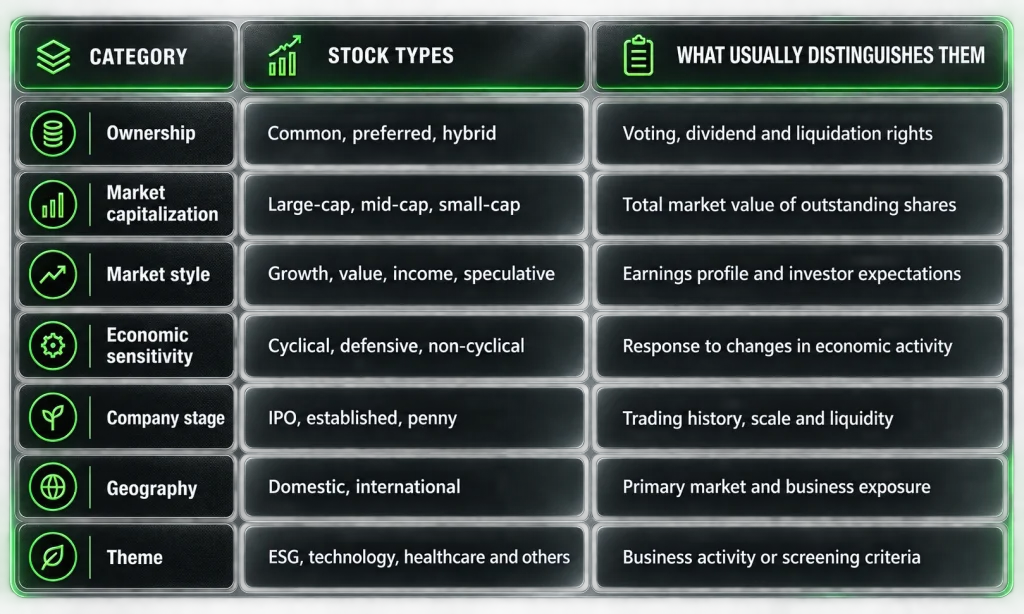
There’s no fixed answer because you can categorise stocks in loads of different ways. You’ve got ownership rights, market cap, geography, business cycle, dividend policy, and investment theme.
A trader studying liquidity may separate large-cap stocks from mid-cap stocks and small-cap stocks. Someone preparing for an economic slowdown may focus on defensive and cyclical stocks. A portfolio built across countries introduces domestic stocks and international stocks.
The table below brings the most common categories of stocks together.
Large-Cap, Mid-Cap, and Small-Cap Stocks
Market cap = stock price x no. of shares. It measures equity market value, not revenue, assets or cash balance.
Thresholds vary by index provider and market. A large-cap company in Indonesia may be modest beside the largest US groups, while a mid-cap stock can move into a higher category after a sustained rally.
Large-Cap Stocks
Large-cap stocks generally belong to well-established, large companies with high market values and active trading. Analysts usually cover them more extensively, and liquidity is generally higher. Large size can reduce certain company-specific risks, but it does not prevent sharp losses.
A lot of examples of blue-chip stocks are also large-cap companies. The two terms are not identical. The market cap is a numerical value, while the term ‘blue chip’ is an informal way of judging scale, reputation, financial resilience and operating history.
Mid-Cap Stocks
Mid-cap stocks are between mature market leaders and smaller companies, and some are expanding, so they have more potential for growth. However, access to resources and financing may still be limited.
This position can result in a mixed profile: stronger operations than many small-cap businesses, but more growth uncertainty than industry leaders.
Small-Cap Stocks
Small-cap stocks may offer greater exposure to new products, local markets, or corporate turnaround. Their prices can also be affected by funding costs, customer concentration, and changes in market conditions.
Liquidity varies widely. Investors generally trade fewer mid-cap and small-cap stocks than the most heavily traded large-cap names. In stressed markets, that difference may widen spreads and reduce predictability.
Explore the Versus Trade platform and discover the tools traders use to analyze markets, manage risk, and improve performance.

Stock Types Based on the Business Cycle
Economic growth does not lift every company equally. Household spending can support travel and retail, but margins may be pressured by rising costs.
Cyclical Stocks
Cyclical stocks, including those of car makers, airlines, hotels and construction companies, tend to do well when the economy improves.
Their earnings can weaken quickly when demand contracts. Traders, therefore, watch economic data, commodity inputs, and management forecasts alongside company results.
Defensive and Non-Cyclical Stocks
Defensive stocks sell products or services that remain necessary across much of the economic cycle. Food, household goods, healthcare, and utilities are familiar examples.
Non-cyclical stocks may perform better during a slowdown, but defensive stocks may still be vulnerable due to regulation, debt, valuation and execution. A company’s financial health can be affected by factors other than demand.
Blue-Chip, Penny and IPO Stocks
Market labels often compress several characteristics into one phrase. They can be useful shorthand, but the boundaries remain loose.
Types of stocks
What are blue-chip stocks?
What are blue-chip stocks? This term usually refers to long-established companies with well-known brands and a large market share. Blue-chip stocks are usually liquid and well-followed.
But good reputation can create a false sense of permanence. Market leadership changes. A company that was once stable may face problems. The label describes status, not protection.
Penny stocks
Penny stocks are low-priced and often issued by small companies. The definition varies, so price alone doesn’t describe the category.
And low-priced stock may look accessible. But the number printed beside one share says little about valuation. Despite a low stock price, a company with billions of shares outstanding can have a high market cap. Beware of limited disclosure and price-manipulation risk with penny stocks.
IPO stocks
An IPO stock begins public trading after an initial public offering. Its early price reflects both the company’s prospects and the balance between newly available supply and market demand.
Of course, short trading histories leave fewer public results and price patterns to examine. Lock-up expirations, new analyst coverage, and the first earnings reports after listing can create additional volatility. Some IPO stocks develop into large, profitable businesses. Others fall once initial enthusiasm meets slower growth or higher costs.
Domestic, international and ESG stocks
Geography and investment themes add another layer to stock classification.
Domestic stocks are issued by companies based primarily in the trader’s home country. International stocks provide exposure to companies based abroad. And a company’s listing location doesn’t always match its economic exposure. An Indonesian issuer earning substantial revenue abroad may react to global demand and exchange rates as much as to conditions at home.
ESG stocks are selected using environmental, social and governance criteria. Methodologies differ across rating providers and funds. A company included in one ESG index may be excluded from another because the screens, weightings, and data sources are not uniform.
Hybrid stocks also resist simple labels. Convertible preferred shares, for example, can combine an income stream with the possibility of conversion into common stock. The stock offers a different balance of income, rate sensitivity, and upside depending on its terms.
Stocks to buy and stocks to trade
The same share can serve different purposes. A long-term buyer may focus on cash generation, balance-sheet strength, earnings durability and dividend history. A short-term trader may care more about liquidity, volatility, a scheduled announcement and the distance between support and resistance.
That separation matters when discussing stocks to buy. A strong company can be a poor entry at an excessive valuation. A weak company can produce a short-lived rally around news without becoming a sound long-term holding.
For people investing in stocks, the analysis often includes:
- Revenue and earnings history
- Free cash flow and debt
- Competitive position
- Valuation against peers or past ranges
- Dividend policy
- Exposure to economic and industry risks
When trading stocks, the immediate focus may shift toward:
- Daily volume and bid-ask spread
- Price momentum
- Earnings dates and corporate announcements
- Volatility
- Entry, invalidation and exit levels
- Overnight gap risk
This is where stock trading differs from selecting a company solely because its products are familiar. Market timing, instrument terms and risk controls affect the outcome alongside the business itself.
Versus Trade’s own product thinking applies that focus on recognizable businesses to paired market narratives:
Co-Founder and COO, Versus Trade — Yurii Matkovskiy.
The rivalry provides context. But price still responds to earnings, valuation, costs, and market expectations. “Versus Trade” describes the wider company approach in Versus Trade Builds a High-Performance Fintech Culture: How Company Values Directly Drive Team Growth and Business Results.
Different types of trades in the stock market
Stock types describe the instrument. Different types of trades describe how market exposure is managed.
A position may follow several formats:
- Day trade: Opened and closed within the same session
- Swing trade: Held across several days or weeks
- Position trade: Maintained for a longer market move
- Long position: Benefits if the quoted price rises
- Short position: Benefits if the quoted price falls, subject to the instrument used
- Event trade: Built around earnings, an IPO, a corporate action or another catalyst
The most active stocks to trade are often liquid companies with clear catalysts and sufficient intraday movement. Volatility alone is less useful when the spread is wide or execution is thin.
CFDs add leverage and the ability to take long or short exposure without buying the underlying share. Leverage magnifies losses as well as gains. Overnight financing, spreads, commissions, and dividend adjustments can also affect the result.
Stock selection for beginners
Stock classification is most useful for beginners when it reduces confusion rather than creating a longer list of labels. A simple process can separate the company, the stock, and the planned trade.
A four-part classification
- Identify the security. Is it common stock, preferred stock, or a derivative linked to a share?
- Place the company by size and stage. A large-cap market leader behaves differently from a thinly traded IPO stock.
- Find the main earnings driver. Growth, dividends, commodity exposure, or the economic cycle may dominate.
- Match the position to the market behaviour. Liquidity, volatility, the holding period, and execution speed shape execution risk.
Questions behind the classification
The phrase “What are the types of stocks?” becomes more useful when followed by narrower questions. Does the stock pay a sustainable dividend? Are earnings cyclical? Is the market pricing years of growth into the shares? Could a single announcement change the valuation?
Peter Lynch’s emphasis on specialised knowledge fits this process. Familiarity can narrow the research field, but an investment case still depends on evidence. Brand recognition cannot substitute for understanding valuation, debt and earnings.
Stock categories change, but the underlying risk remains
A company can move from small-cap to large-cap, from growth stock to income stock or from market favourite to value candidate. Classification follows the business and the price. It doesn’t stay fixed.
The useful distinction lies in what the label reveals. Growth stocks carry expectation risk. Income stocks depend on cash flow. Cyclical stocks respond to economic conditions. Penny stocks may add severe liquidity and disclosure risks. Common and preferred stock give holders different claims on the same company.
Knowing the categories won’t determine the next price move. It does make the source of that move easier to recognise. That’s the practical value of stock types when a market shifts from familiar conditions to something less forgiving.
- What Are the Different Types of Stock?
- The 4 Types of Stocks Based on Market Expectations
- How Many Types of Stocks Are There?
- Stock Types Based on the Business Cycle
- Blue-Chip, Penny and IPO Stocks
- Types of stocks
- Domestic, international and ESG stocks
- Stocks to buy and stocks to trade
- Different types of trades in the stock market
- Stock selection for beginners
- Stock categories change, but the underlying risk remains