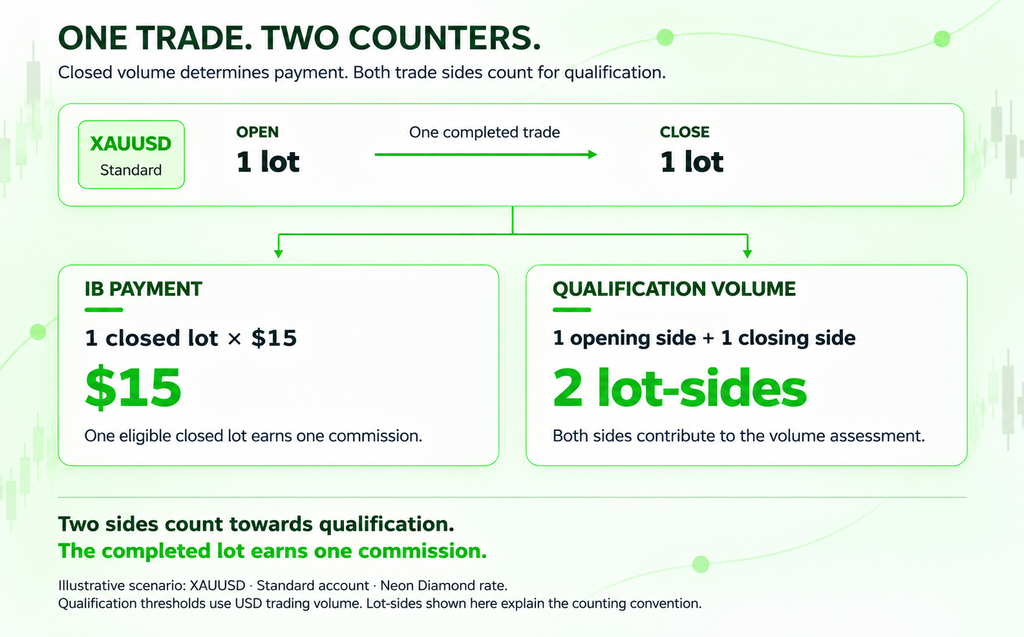
Take a client who closes an eligible one-lot XAUUSD position on a Standard account. At the confirmed Neon Diamond rate, that earns $15 for the partner. Qualification volume, though, counts both opening and closing sides. Mix up those two entries and you can double an earnings estimate.
The How to Choose the Best Forex IB Program guide covers the wider partnership decision. This page sticks to the payment attached to each completed trade. A headline rate means nothing without an instrument, an account type, and an eligible partner level beside it. Client counts alone won’t tell you income. The scenarios below separate payable lots, qualification volume, and business costs.
- Payment basis: the agreed rate for eligible closed volume.
- Qualification basis: the activity used to assess a partner level.
- Take-home earnings: receipts after network distributions, expenses, and applicable taxes.
Introducing broker commission: what triggers payment?
An introducing broker refers clients to a brokerage and gets paid under the partner agreement. Under a fixed commission model, eligible volume is what matters. A referred client opening an account or making a deposit doesn’t by itself trigger a per-lot payment.
Forex IB commission models beyond the headline
Across forex affiliate programs, payment arrangements differ:
| Model | Payment basis | Main variable |
| Fixed per lot | Agreed amount for eligible volume | Lots closed |
| Spread share commission | Contractual share of spread revenue | Applicable spread and volume |
| CPA | Payment for a qualifying acquisition | Acquisition conditions |
| Hybrid IB | Acquisition payment plus ongoing remuneration | Both sets of conditions |
There is no single dollar figure that answers “How much is forex affiliate commission?” In a CPA vs revenue share comparison, the CPA centres on a qualifying acquisition, sometimes including a first deposit. Revenue share follows the recurring revenue base in the contract. A broker offering a share of that revenue doesn’t tell you what’s payable on every instrument.
Some forex brokers quote a fixed amount. Others advertise a share of the spread. Any comparison needs the same instrument, the same account, and the same volume convention.
Our partnership team confirmed a fixed-amount model. The forex IB commission figures below stick to that basis, even where marketing frames the economics as a percentage.
Grow your eanings with premium IB conditions: No MTT, No MTP, daily payouts & a dedicated manager.

IB commission structure at Versus Trade
The Versus Trade broker uses fixed per-lot rates for IB remuneration. Our partnership team confirmed $15 per eligible closed XAUUSD lot on a Standard account at Neon Diamond, the highest partner level. Other instruments and levels carry their own commission rates. That $15 isn’t the starting rate for every referral. You need to know the applicable account and partner conditions to know what’s payable.
The “up to 75% of spreads” headline describes how remuneration relates to spread costs on selected instruments and accounts. The payment is a set sum per qualifying closed lot. There is no recalculation of this as a percentage of each trade’s actual spread. Our team confirms the fixed rates were built from the full spread, with no deductions from that calculation base.
Gold: commission per lot, one payment
Example scenarios throughout this article are illustrations, not income promises or records of a real IB’s results.
- Instrument and account: XAUUSD, Standard.
- Applicable partner rate: Neon Diamond, $15 per closed lot.
- Client opens 1 lot and closes the entire position.
- Eligible closed volume: 1 lot.
- Total commission: 1 × $15 = $15.
Commission per lot scales with eligible closed volume. A 0.20-lot completed position pays 0.20 × $15 = $3 on that same basis. Five separate 0.20-lot completed positions add up to one lot and $15. The number of orders doesn’t multiply the agreed rate apart from lot size.
Why qualification volume looks larger
That same one-lot opening and closing adds two lot sides to qualification volume. It still only produces one $15 payment. Neon Diamond qualification needs 20 or more active clients and at least $300 million in trading volume, counting both sides. Dollar notional depends on contract specifications and execution prices.
The published agreement sets partner levels on the first day of each month based on the previous calendar month’s performance. Access to the rate depends on current qualification requirements and any approved MIB arrangement. The earnings table below does not establish qualification.
Forex IB commission per lot: separating cost from income
The how to open a demo trading account guide helps with platform familiarisation before live trading. A demo runs on virtual funds. It doesn’t establish paid partner activity. Costs shown in a demo can’t guarantee future live execution either. The EUR/USD illustration below explains the arithmetic without using a live quote.
Imagine you have a USD account, one standard lot of 100,000 EUR, a pip size of 0.0001 USD per EUR, and a constant 1.5-pip spread:
Pip value = 100,000 × $0.0001 = $10.
Spread cost = 1.5 × $10 = $15.
That counts the spread once for a completed trade under the constant-spread assumption. Financing, slippage, and other applicable charges sit outside it. It’s the client’s spread cost, not automatically the partner’s income.
If a hypothetical broker pays $5 per lot, one completed standard lot produces 1 × $5 = $5. That rate is an illustration, not a confirmed EUR/USD rate from our team. Divide $5 ÷ $15 × 100, and you get about 33.3%, a comparison against the assumed spread cost. That doesn’t turn a fixed payment into a percentage-based contract.
Gold spreads also float. Under an unchanged applicable fixed rate, a wider or narrower spread does not itself change the $15 payment.
Amirul Mazlan, our Business Development Director for Malaysia, writes in Most IBs Are Building Someone Else’s Business?:
Business Development Director, Malaysia at Versus Trade—Amirul Mazlan
His observation is about relationships built beyond a single campaign. For IBs that matters, because registrations and promotional attention don’t guarantee sustained client activity. Trading volume can vanish when a referred trader stops participating, whatever the headline rate on the account says.
The broker pays the IB according to the agreed schedule. The rates and eligibility conditions still matter for every trade. IBs receive remuneration for qualifying activity, not for unrealised gains.
How much do Forex IBs earn?
People who trade FX don’t all behave the same way. One referred client might go quiet for weeks, another closes a handful of small positions in a single session. So a bigger client base doesn’t automatically mean a proportional jump in IB earnings. What you need is a forecast that tracks eligible lots per month against the rate that applies to each one.
Monthly volume across three network sizes
All rows below assume an IB who already has the confirmed $15 XAUUSD Standard rate and whose direct clients produce volume that’s fully eligible. They don’t imply that five clients would qualify for Neon Diamond. They also leave out floating bonus adjustments, sub-partners, and the costs of running the operation.
| Active clients | Closed lots per client | Monthly closed lots | Arithmetic | Gross earnings |
| 5 | 2 | 10 | 5 × 2 × $15 | $150 |
| 20 | 5 | 100 | 20 × 5 × $15 | $1,500 |
| 50 | 10 | 500 | 50 × 10 × $15 | $7,500 |
The middle row assumes 20 active clients, each closing 5 lots, so you end up with 100 lots. Multiply those 100 lots by $15 and you get $1,500. But opening and closing those positions counts as 200 lot-sides for qualification accounting. That doesn’t mean you’re paid for 200 lots.
Gross earnings for IBs are not business profit
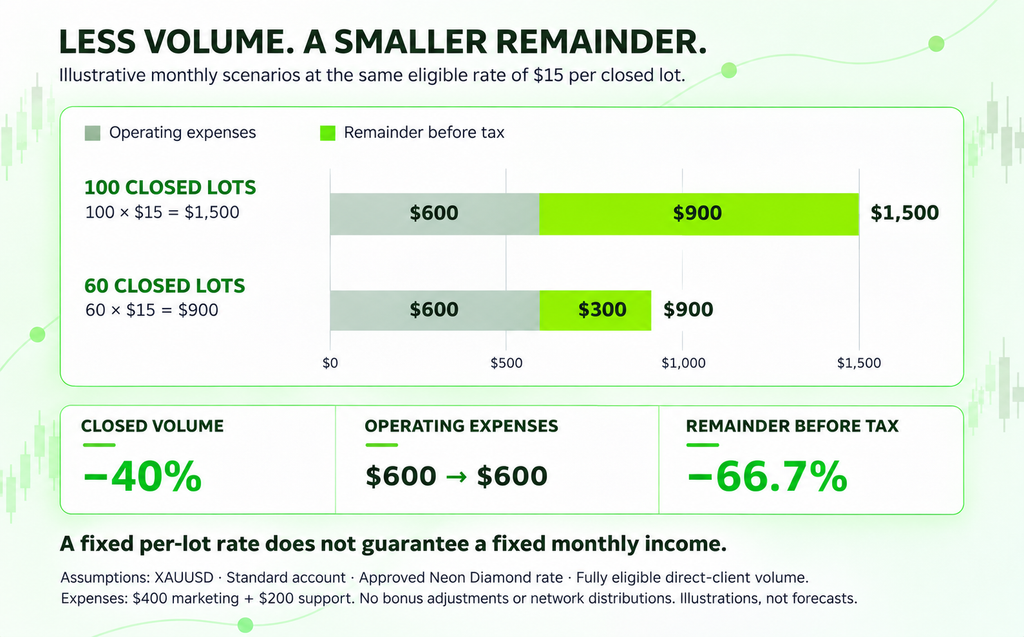
Let’s say the middle example spends $400 on marketing and another $200 on client support. That leaves $1,500 minus $400 minus $200, which is $900 before tax. Those numbers are invented to show the math, not broker fees or a standard every IB business should expect.
If the eligible volume drops by 40%, those 100 lots shrink to 60. Gross receipts then fall to 60 times $15, so $900. After the same $600 in expenses, you’re left with $300 before tax. The same applicable rate is still in place. Earnings vary with eligible closed volume. However, fixed operating costs may remain unchanged when that volume falls.
The commission paid on 100 standard lots might actually beat what you’d get from a larger set of clients trading instruments with lower per-lot rates. So the total needs a breakdown by symbol and account, even if the number of active clients stays the same.
Talk to our partnership team about the instrument rates and qualification route that apply to your situation.
How trading activity leads to the payout report
Our Introducing Broker program ties what you earn to the eligible trading done by clients you refer. The partnership team tells us that regular accounts have no minimum holding time or minimum price movement requirement.
They also note that volume from floating bonus margin only earns partial commission under the bonus terms. The published partner agreement removes credit- and bonus-generated volume from the standard formula. Therefore, applying the full rate to all bonus-supported volume could overstate the commission payable.
Reconciling to avoid double counting
When you review the partner dashboard, you can link each referred client to the right account, instrument, eligible closed volume, and agreed rate. If clients trade different instruments, you have to run separate commission calculations for each. If you simply multiplied every standard lot traded across your whole network by the gold rate, you’d ignore the fact that per-lot rates are not the same everywhere.
Expected gross remuneration = sum of (eligible closed lots × applicable rate) across all instrument, account, and partner-level combinations.
After that, you need separate entries for any bonus-related adjustments and for payments that pass through a network. An IB rebate might mean the broker paying a partner, depending on how the program uses the term. A forex cashback rebate is different: it gives part of the trading cost back to the client. If that cashback is taken from the partner’s commission, the partner keeps less.
The partner site advertises daily IB payouts, and stats are available in real time. The published agreement allows daily USD credits into the partner wallet for closed trades from the previous day, though the company decides the exact schedule. Getting money out to an external account requires a separate withdrawal request.
Morgan Housel, the finance writer, makes a point in Getting Wealthy vs. Staying Wealthy:
That warning is about general financial planning, but it fits an IB forecast too: test a lower volume scenario, not just the one you hope for. Fixed expenses don’t disappear if clients trade less often. A spreadsheet built around steady trading activity can hide that pressure until the money actually drops.
The partner agreement also rules out churning, which means trading done only to create commission. Normal volume-based payments don’t make manufactured activity eligible. That distinction matters even more once you have a multi-level network.
Adding another layer to a network
The Master IB Program (trading) lets you build a network that goes up to ten tiers deep. According to its public description, partners can decide how to split remuneration inside that network. So a sub-ib commission changes what the partner above keeps. You can’t add the advertised top rate in full at every level. Each allocation has to follow the agreed distribution.
For a master IB, here’s an example of a multi-tier IB commission split. Start with a $15 pool for a completed lot. If $10 goes downstream, the upstream associate retains $15 minus $10, leaving them with $5 for that particular lot. Across 100 eligible lots, the downstream side gets $1,000. The upstream side gets $500. That still adds up to $1,500. Those split amounts are just used to show the maths, they don’t have to be used in the same way as a required formula.
The best forex IB arrangement for your business is the one that leaves enough. This is after you subtract distributions, servicing costs, and taxes. The rate is set by the contract, but the volume eligible for payment determines what is actually received. Look at the partner structure and ask for the rates that apply to your network.
Earn from every trade in your Multi-tier network.

Risk disclaimer: Trading forex and CFDs carries real risk and can result in the loss of invested capital. The examples here are not forecasts, guarantees, or investment advice. What a partner earns depends on eligible activity and the contract. Availability and regulatory rules vary by jurisdiction, including Malaysia. Commissions and incentives can create conflicts of interest, and they must never push clients into trading that is unsuitable or excessive.