How to Trade Forex: Trading Strategies for Beginners in Malaysia


Let’s bypass the textbook definitions for a second. If you want to know how to trade forex, you need to look at the actual reality of the charts, not some idealized version of Wall Street. The foreign exchange market isn’t a magical money machine; it’s a giant, non-stop arena where one currency is constantly valued against another. When you start forex trading, you are essentially making a bet on economic momentum. You buy a currency pair because you expect its value to climb, or you sell it because you think it’s heading for a drop.
To survive the current market as a beginner, you need a solid grasp of the essentials. Here is a quick breakdown of what you must master before putting real cash on the line:
- Market Mechanics: Understanding the shift in an exchange rate and how the forex market moves.
- Risk Metrics: Knowing how leverage amplifies both your gains and your losses.
- Execution Tools: Operating a trading platform without making costly misclicks.
- Strategy Framework: Developing clear forex trading strategies instead of relying on gut feelings.
To build a sustainable income stream in Malaysia, you need to treat this as a business. Millions of people want to learn to trade forex, but many treat it like a casino. The difference between a retail gambler and a successful forex trader comes down to discipline, analytical clarity, and a reliable broker.
Understanding Forex Trading
What is forex trading?
At its core, foreign exchange trading is the act of exchanging one currency for another. Every time a central bank changes an interest rate or an economic indicator drops, the value of money shifts globally. This creates continuous price movement in the financial market.
When you trade FX, you always work with two currencies at once. For example, if you trade the euro against the US dollar (EUR/USD), you are dealing with the most liquid pair in the world. You aren’t buying physical paper bills. Instead, you are taking a position on the relative strength of these foreign currencies.
How Forex Trading Works
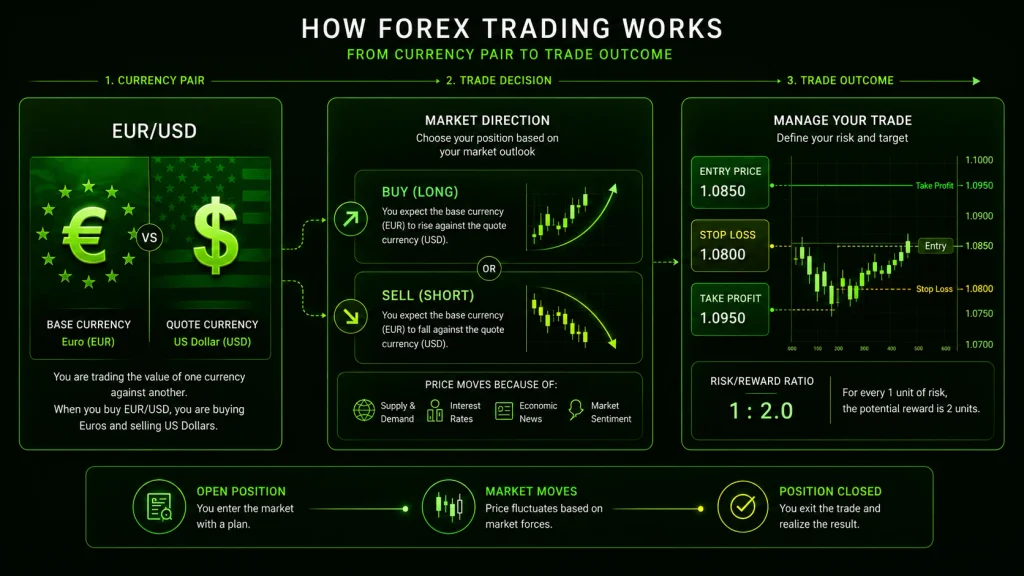
The mechanics of how forex trading works boil down to the spread, pips, and contract sizes. You either buy or sell a currency based on where you think the market is heading.
- Buy a currency pair (Long): You expect the base currency to appreciate against the quote currency.
- Sell a currency pair (Short): You expect the base currency to weaken.
Let’s look at a practical scenario with the Japanese yen (USD/JPY):
| Component | Example Value | What It Means |
| Base Currency | USD | The currency you are using as the reference point. |
| Quote Currency | JPY | The currency that measures the value of the base. |
| Bid Price | 155.20 | The price at which the market is ready to buy from you. |
| Ask Price | 155.22 | The price at which the broker will sell to you. |
| Spread | 2 pips | The transaction cost is paid directly to your platform. |
If you expect the US economy to outperform Japan’s due to rising interest rates, you buy the pair. If the exchange rate moves in your favor, you lock in a profit. If it drops, your trading account takes a hit.
The Forex Market Overview
Unlike traditional stock trading, the foreign exchange ecosystem operates as an over-the-counter (finance) market. There is no central building like the New York Stock Exchange. Instead, a global network of institutions, a commercial bank here, an investment banking firm there, and millions of retail traders keep the market open 24 hours a day, five days a week.
This means huge trading volume and deep liquidity. The market moves through key global sessions: Sydney, Tokyo, London, and New York. When sessions overlap, market volatility spikes, creating massive opportunities for those who know how to manage financial risk.
Where to Trade Forex: Getting Started in Malaysia
Choosing a Trading Platform
Your choice of forex broker dictates your entire trading environment. A bad platform will lag during high-impact news events, costing you money through slippage. Look for platforms that offer tight spreads, transparent trading costs, and reliable execution.
Make sure the broker gives you flexible options for leveraged trading. While leverage (finance) lets you control large forex positions with a small amount of capital, it can wipe you out if used recklessly.
Opening a Forex Trading Account
Getting your account live isn’t complicated, but you shouldn’t rush it. You’ll need to provide standard identification to comply with financial regulations.
Registration ➔ Verification (KYC) ➔ Demo Practice ➔ Live Deposit
Don’t skip the demo stage. Use a simulated trading account to get comfortable with the interface before risking a single ringgit.
Initial Steps to Start Forex Trading
Once your account is verified, you need to understand your market environment. In Malaysia, local traders keep a close eye on both global pairs and regional market dynamics. When you participate in currency trading, you are interacting with global capital.
Here is a quick checklist for your first live week:
- Deposit only risk capital—money you can afford to lose without affecting your daily life.
- Focus on just one or two major pairs, like EUR/USD or GBP/USD (pound sterling).
- Keep your trade sizes small by using micro-lots to keep your margin (finance) safe.
When you look at the landscape of modern retail finance, you realize that retail instruments like a contract for difference give you immense flexibility. Trading a Forex CFD allows you to speculate on price shifts without ever owning the underlying asset, making it highly efficient for short-term plays.
Co-Founder & COO, Versus Trade — Yurii Matkovskiy
Enter the market accessibly. Start a Standard Account from just $10 and take it from there.

Essential Forex Trading Courses for Beginners
Recommended Online Courses
You don’t need a formal degree in finance to figure out how to trade in forex market environments. High-quality forex trading courses focus on market structure, price action, and order flow. Look for programs that teach you how to read raw charts rather than selling you a magical, proprietary indicator that promises impossible wins.
In-Person Workshops in Malaysia
For those who prefer face-to-face learning, local workshops offer a chance to see live market analysis in real-time. These sessions often focus on practical setups, showing how domestic and international news updates impact pairs during the Asian trading session. It’s a great way to talk directly with an experienced stock trader or currency specialist who understands local market hours.
Free Resources to Learn Forex Trading
You can access an incredible amount of education without spending a dime. Reliable brokers offer a comprehensive guide for beginners series, daily webinars, and market breakdown articles.
- Macro Analysis: Watch how a central bank changes liquidity via quantitative easing.
- Sentiment Metrics: Monitor how a major hedge fund positions itself using open interest data.
- Technical Literacy: Learn to identify support and resistance zones without cluttering your charts.
Forex Trading Strategies
Popular Trading Strategies for Beginners
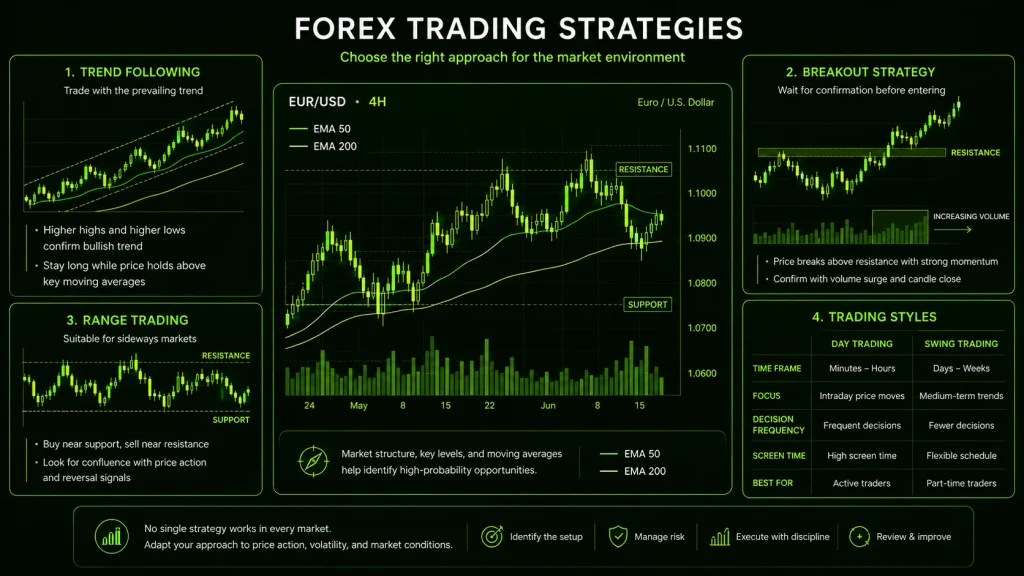
A trading strategy is simply a repeatable blueprint for entering and exiting the market. Without one, you’re just gambling with your investment. Beginners often start with simple trend-following systems. You wait for the market to establish a clear direction, look for a minor pullback, and then execute your trade.
Day Trading vs. Swing Trading
Your lifestyle determines your trading style. You need to choose an approach that matches your daily schedule and personality.
Choose Your Style
Day trading:
- Holds positions for minutes/hours.
- Zero overnight risk.
- Demands high focus and quick execution.
Swing trading:
- Holds positions for days/weeks.
- Catches broader structural trends.
- Requires patience and wider stop-losses.
Let’s break down how swing trading and position trading stack up against fast-paced day execution:
| Feature | Day Trading | Swing Trading |
| Holding Time | Minutes to hours | Days to weeks |
| Chart Timeframes | 5-minute / 15-minute | 4-hour / Daily |
| Transaction Volume | High frequency | Low frequency |
| Impact of Spreads | High impact on profit | Minimal impact on net returns |
| Stress Level | High during active hours | Moderate, distributed over time |
Understanding Currency Pairs
To trade forex successfully, you must know your instruments inside out. Pairs behave differently based on who is trading them. Major pairs feature high liquidity and low transaction costs. Crosses (pairs without the United States dollar) can exhibit higher volatility, while exotic pairs are thin and expensive to trade.
Effective Ways to Trade Forex
Long-Term vs. Short-Term Trading
Long-term positions rely heavily on macroeconomic fundamentals. You analyze structural shifts like inflation, national demand trends, and changing trade balances. Short-term trading cares far more about immediate liquidity pools and technical daily levels. Neither path is inherently superior; it’s all about consistency and your tolerance for uncertainty.
Automated Trading Systems
The modern currency market relies heavily on automation. Many retail participants use automated systems to take the emotional strain out of daily execution.
- Algorithmic execution: Software handles entries and exits based on strict mathematical rules.
- Risk protection: Code can instantly calculate your maximum forex exposure across multiple positions.
- Backtesting power: You can run a strategy through years of historical data to check its performance before going live.
However, automation isn’t a substitute for market understanding. If a major economic shock occurs, a poorly optimized algorithm can drain a live account remarkably fast.
Risk Management in Forex Trading
This is the most critical part of the entire guide. You can have an average strategy, but with rock-solid risk management, you can still protect your capital over the long haul. Conversely, the best entry strategy will fail if you don’t manage your downside exposure.
Here is your daily operational framework to protect your portfolio:
- Strict Position Sizing: Never risk more than 1-2% of your total account balance on a single trade.
- Hard Stop-Losses: Always place a defensive order before your trade goes live. Never move it further away during a losing position.
- Realistic Ratios: Aim for setups where the potential reward outweighs the money you’re risking.
- Preserve Your Capital: If the market conditions look unpredictable or messy, stay on the sidelines.
American investor and philanthropist — George Soros
Soros on Soros: Staying Ahead of the Curve. John Wiley & Sons.
Mastering the Reality of Trading: Capital, Legality, and the 3-5-7 Rule
When you drop the theoretical textbook talk, two massive questions hit every beginner before they click their first live buy button: “How much cash do I actually need to start?” and “Am I going to get in trouble with local laws?” Let’s look at the hard truth behind both.
Is Forex Trading Legal in Malaysia?
The short answer is yes, but the regulatory landscape has strict boundaries. In Malaysia, retail foreign exchange trading is completely legal when executed through institutional accounts or platforms tied to authorized financial bodies. If you choose an offshore retail platform, you are operating at your own risk. Local authorities don’t penalize individuals for trading, but they heavily crack down on unlicensed entities trying to pool or manage public funds. To protect your investment, you must stick to reputable, globally regulated platforms that offer clear client-fund segregation and transparent accounting.
Is $100 Enough to Start Forex Trading?
Technically, yes- most modern platforms let you open a trading account with as little as $10 to $50. But there is a massive gap between what is possible and what is mathematically viable.
If you start with a $100 balance, you cannot expect to make a full-time living or buy a sports car by next month. A $100 account is purely an educational tool. It is a bridge between a fake demo environment and the real psychological pressure of live trading. With $100, your focus shouldn’t be on the dollar amount of your profit; it should be on mastering micro-lots (0.01 size) so that a bad market swing doesn’t wipe out your entire balance in an hour.
The Professional Safety Net: What is the 3-5-7 Rule in Forex?
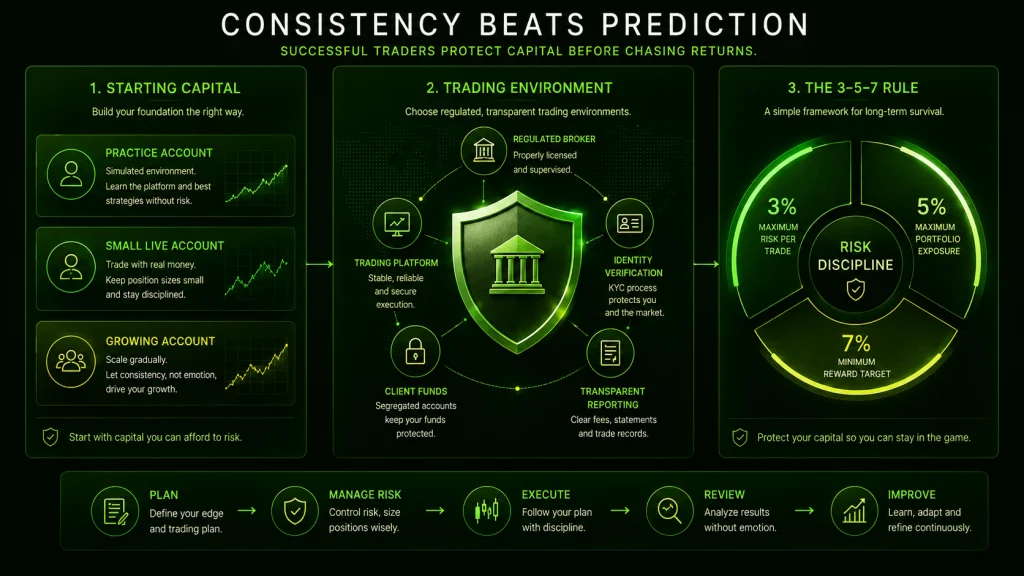
When retail accounts fail, it’s almost never because their charts were wrong—it’s because they lacked a structural framework. Professional traders rely on rigid mathematical constraints to survive high market volatility. One of the most effective setups for beginners is the 3-5-7 Rule:
- 3% Maximum Risk: You never risk more than 3% of your total account equity on a single currency pair. If your stop-loss hits, the damage to your portfolio is minor.
- 5% Total Exposure: Your combined risk across all simultaneously open forex positions never exceeds 5%. This prevents you from blowing up your account if multiple correlated pairs drop at the exact same time.
- 7% Profit Target: You structure your entries so that your minimum target on a winning trade yields a 7% return, or you maintain a risk-to-reward ratio where your winners are significantly larger than your average loss.
The 3-5-7 Risk Shield
3% Single Trade Cap -> Prevents catastrophic loss
5% Total Portfolio Cap -> Stops correlation danger
7% Minimum Target -> Ensures winners outpace losers
By imposing these numbers on your daily routine, you completely remove emotional guesswork from your execution. You stop looking for a flawless indicator and start operating like a risk manager who understands that losing streaks are just a statistical cost of doing business.
Conclusion
Figuring out how to trade forex is a continuous journey of practice and refinement. The markets are constantly adapting to shifting economic realities, and your strategy needs to evolve alongside them. Real consistency doesn’t come from finding a secret indicator or a flawless setup; it comes from treating your capital with respect, keeping your losses small, and sticking to your plan day after day.
Focus on building good habits early on. Keep your trade sizes manageable, track your results in a journal, and protect your downside every single time you enter the market. Over time, those disciplined actions are what genuinely separate a professional trader from the crowd.
Try strategies, explore MT5 and get a feel for the markets with a demo account before putting real capital on the line.