
How to Trade Indices: from Bangkok to Wall Street

- How to trade indices: index CFD and S&P 500 basics
- CFD indices: what the position actually buys
- Trading hours in Thailand: the November clock change
- Index trading strategies for the opening session
- Synthetic indices and volatility indices follow different rules
- A position-size calculation before the order
- An illustrative US500 risk budget
- Starting index trading on the platform
- Choose the index that matches the market view
Wall Street opens just as Bangkok settles into the evening. A US inflation release can move an index futures before the main American stock-market session begins. You may need to revise your trading idea before the opening bell even rings.
A beginner looking to learn how to trade indices must consider several factors before the US market opens:
- Which companies drive the benchmark you picked.
- When its main market opens in Thailand time.
- How much money each index point represents in your position.
At Versus Trade, trade index CFDs without owning the shares. Know the difference between the benchmark and the contract you trade to understand indices.
How to trade indices: index CFD and S&P 500 basics
The stock market indices show how the prices of a group of companies are doing compared to each other. A single stock can suddenly fall in value after reporting poor profits, and this fall can have little effect on the general market. And losses in heavily weighted companies can drag a benchmark lower even when most stocks gain.
How indices are calculated
You can work out the index using share prices, the market’s total value, or equal weights. The weight that each method gives to companies within an index is different.
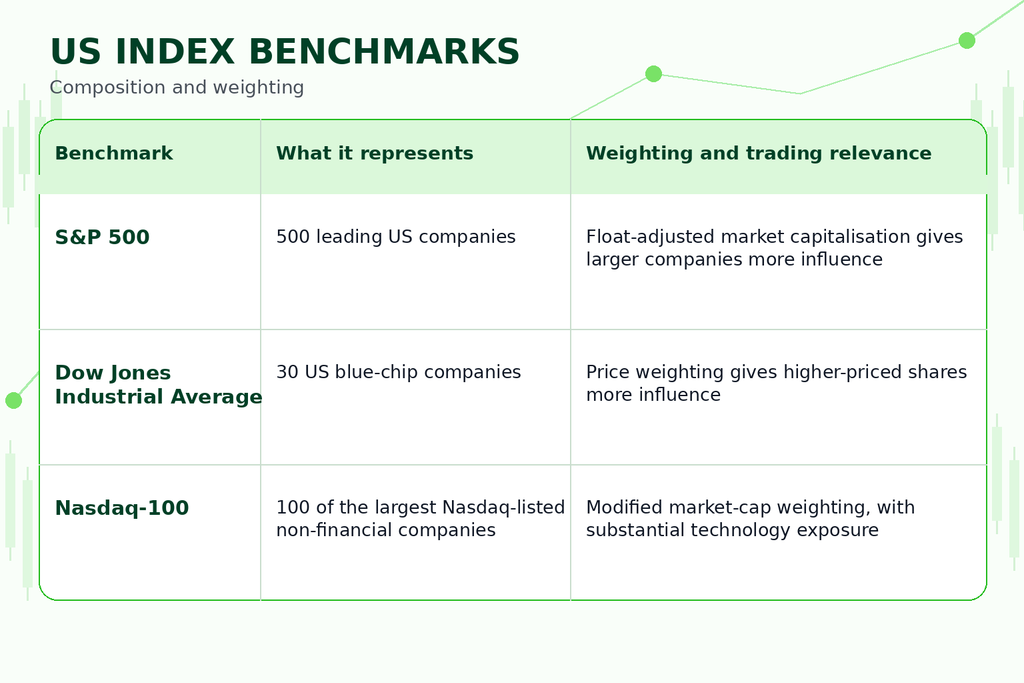
S&P Dow Jones Indices documents the first two methodologies. Nasdaq publishes the third. Their construction explains why these popular global indices can react differently to the same earnings report.
Other types of indices include sector indices focused on specific industries and regional indices covering several national markets. These market indices answer different questions. A bank-sector benchmark says little about whether technology shares are leading a rally.
Since indices track baskets, they reduce dependence on one company. But they do not remove market risk. If you buy several US benchmarks that overlap, your trading account could be exposed to the same large companies.
CFD indices: what the position actually buys
An index is a calculation, so you cannot purchase it directly. Index funds, exchange-traded funds, and index futures are different products that allow traders or investors to get exposure. Trading and investing through these vehicles involve different ownership, financing, and expiry arrangements.
Our Indices CFD page covers available contracts and conditions. Index CFD trading involves an agreement to settle price differences. Your trading profit or loss depends on direction, position size and prices. Costs affect the final account result.
Long or short: costs on both sides
Before costs, a long position gains from rising prices and a short position gains from falling prices. Either loses when the market moves against it. Trading index CFDs therefore creates exposure to rising and falling index prices without buying the shares in the underlying index.
A cash index CFD may include overnight financing and dividend adjustments. A futures-linked contract can have expiry or rollover arrangements. The index price displayed by a broker may differ from the published cash index because of its pricing basis, spread, and session.
Trading costs include the bid-ask spread, any commission, applicable overnight charges, and currency conversion. Slippage changes the executed price. Claims that indices have tighter spreads need a comparison of actual contracts and sessions, including the money value of each point.
Our published conditions list fixed leverage of 1:500 for DE40, US100, JP225, US30, and US500. That is a margin setting, not a sensible target for exposure. The trading platform displays the applicable contract parameters. Swap-free eligibility depends on account status and applicable terms.
Factors influencing index prices
Things like interest rates, earnings, currencies, and energy prices all have an impact on index prices, but they do so in different ways. Higher bond yields can have a negative effect on valuations. Soaring oil prices can pinch airlines’ profit margins while boosting energy producers’ revenues. The weighting of those businesses affects index performance.
Yurii Matkovskiy writes in his published post:
Co-Founder and COO of Versus Trade—Yurii Matkovskiy
That observation helps explain why stock indices are affected by events beyond their home stock exchange. A view on growth still needs to account for financing conditions and company weights.
Explore our index contracts and practise matching point value to a defined loss budget in a demo account.
Enter the market accessibly. Start a Standard Account from just $10 and take it from there.

Trading hours in Thailand: the November clock change
Thailand uses ICT, UTC+7, throughout the year. New York changes its clocks. The US core equity session runs from 09:30 to 16:00 Eastern Time, according to the NYSE calendar.
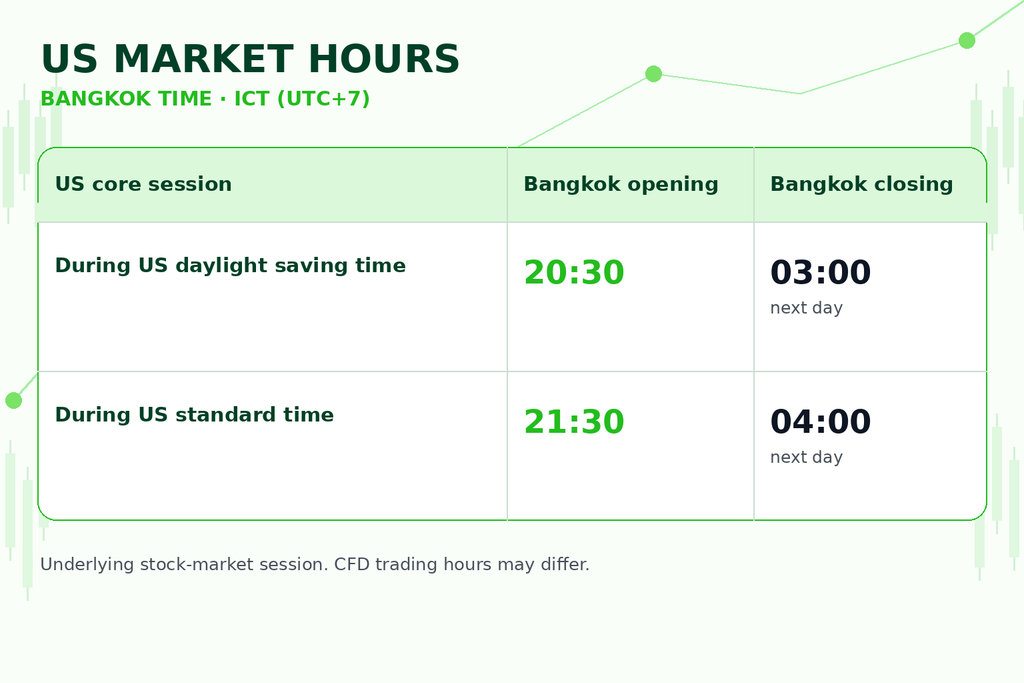
The Bangkok times above depend on whether New York is observing daylight saving time or standard time. Holidays and early closes can alter the timetable.
These are the underlying stock markets’ core hours, not a promise of CFD availability. Broker sessions can extend beyond them, with daily breaks. The platform server time may also differ from local time.
Index trading strategies for the opening session
Some traders in Bangkok do fine with a late evening open, but tiredness after midnight can cloud judgment. Our Day Trading Strategies guide gives more background for intraday work. If you want to day trade a US benchmark, the trading method needs clear rules around the opening auction, scheduled news, and spreads that widen fast.
Here is a simple test you can run. Record the first 15 minutes after the main US session opens. A breakout trade takes place only when a full candle closes outside that opening range. If the price moves back inside the range, the signal is void under this rule set. You also cap the stop distance separately, so a very wide opening range cannot turn into a huge losing trade.
This strategy needs the same testing window every day. Indices like the S&P 500 can react sharply to pre-scheduled announcements. Such movements often create attractive trading scenarios, yet an index’s market price can shift before your order is filled.
You still need to check the approach. A breakout can lead to failure, and the anticipation of confirmation may leave one’s position entered at a less advantageous price. Furthermore, results from calm periods alone say little as to the effectiveness of different trading strategies when news is released or there is a change in volatility.
The Bangkok session record
A trading journal records the opening time in Bangkok, the high and low of the first 15 minutes, the entry spread, the planned stop, the actual fill price, and the scheduled release. Note whether the US was on daylight saving or standard time to avoid comparing sessions.
To know if a method can work profitably, you need to include every trading cost and every losing trade. A few winning screenshots don’t prove anything.
Synthetic indices and volatility indices follow different rules
Some brokers offer synthetic indices that are generated by algorithms and have no underlying basket of listed stocks. Their pricing mechanics deserve separate study. This article cannot tell you whether our brokerage carries them.
A volatility index such as the VIX uses prices of S&P 500 options to estimate the likely volatility of the S&P 500 within the next 30 days. This reading is expressed in annualised terms. It does not predict which way the market will go. Cboe explains that the VIX itself cannot be traded directly. Derivatives tied to it can move very differently from the headline number.
A position-size calculation before the order
The lot size you know from Forex trading does not tell you the exposure of an index contract. A one-lot position in forex can have a very different cash value from one lot in an index CFD. The contract multiplier, tick size, tick value, and your account currency set the money at risk. A broker’s minimum quoted price increment may be smaller than a full index point.
Trade XAUUSD with spreads from 2.4p and zero commission per lot. When gold moves, trading costs shouldn’t steal the spotlight.

An illustrative US500 risk budget
Imagine a USD account with $1,000 in equity, and a trader sets aside $5 (0.5%) for one trade. For this example only, say one lot moves $1 for every full index point. A 20 point stop plus a separate 5-point allowance for costs and slippage gives:
Position size = $5 ÷ [(20 + 5) × $1] = 0.20 lots.
This is not an official Versus Trade contract spec. It assumes those extra 5 points were not already part of the stop distance. Real costs often run higher. Minimum volume and step sizes might block this exact size, and rounding up would push you over the $5 planned risk budget.
Margin is a separate calculation
At a made-up price of 6,000, that 0.20 lot position equals $1,200 in notional value. With 1:500 gearing, a rough calculation of notional divided by gearing gives $2.40. Your total planned loss stays at $5, counting the cost and slippage allowance. Real margin depends on each symbol’s settings. If price gaps through your stop, the loss will be bigger.
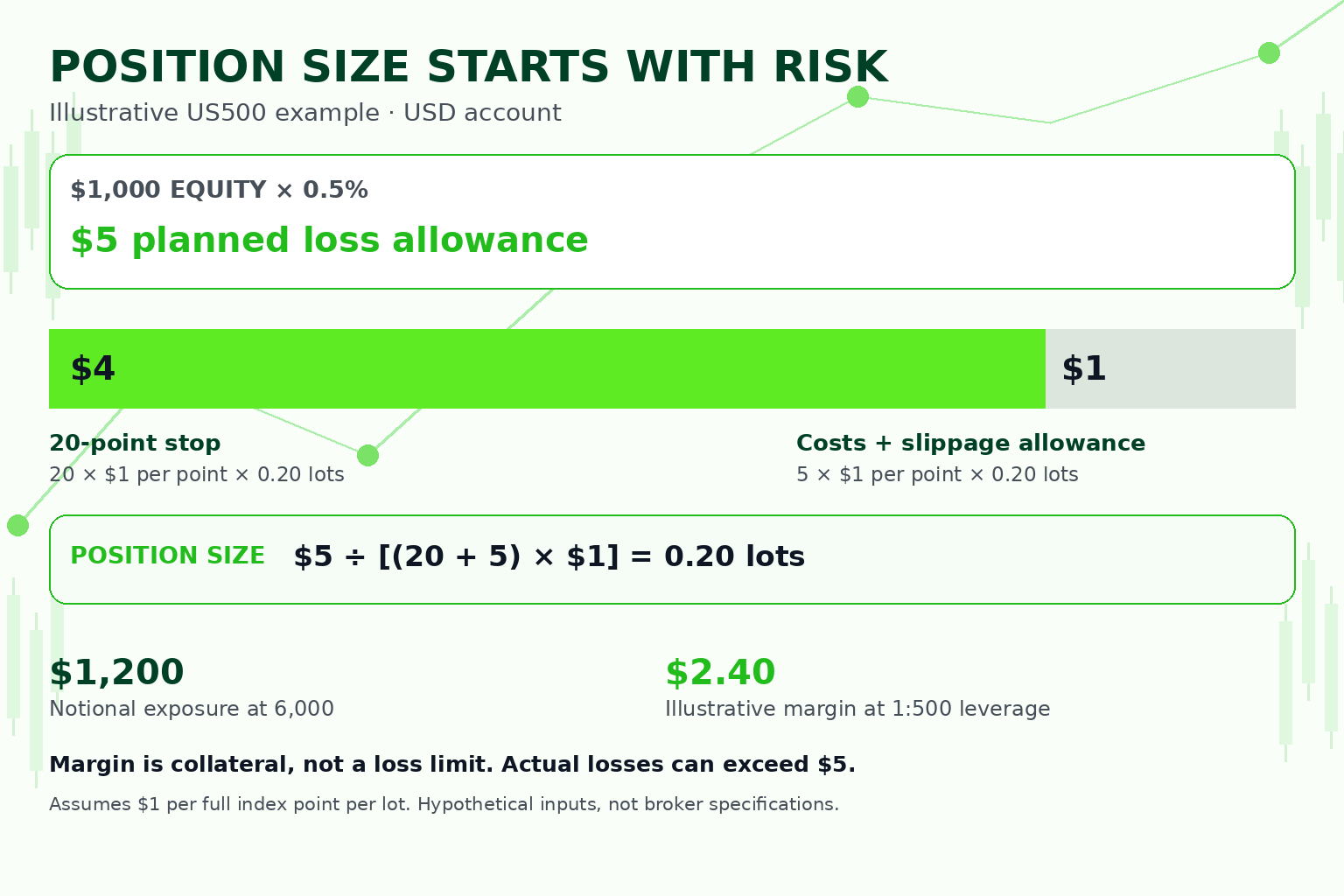
Proper preparation means having a loss budget that can handle a normal string of losses. The phrase “don’t trade emotionally” turns into something you can measure: a hard daily loss cap, a break after consecutive losses, and never increasing size to win back what you lost.
Starting index trading on the platform
If you come from MT4, the charting tools you know do not mean the symbols or contract terms will match. On MT5, MetaQuotes documents say the Specification window shows the broker settings for each symbol.
- Pick the symbol in Market Watch and open the Specification window.
- Write down tick value, tick size, minimum volume, volume step, and trading hours.
- Practice your entry, stop, and exit in a demo trading account.
- Compare the demo cash result with your planned numbers.
Practising with a demo account may help beginner traders prepare for live trading. You still have to meet the eligibility requirements when you open a live trading account. Although software alone won’t teach you to trade like a pro, having execution records can help you make more informed trading decisions.
Choose the index that matches the market view
Our pairs trading product focuses on how two assets perform relative to each other. That is not the same as a straight long or short position on a single benchmark. Saying tech will beat oil is different from saying tech stocks will go up.
When you try to decide which indices suit your plan, look at what the index holds, when it trades, and what size you can afford. The right index to trade depends on those limits. Major global indices are not interchangeable just because their charts move up together.
Our article, “Which Instruments Does Versus Trade Offer?” lists index contracts next to other markets. Depending on your trading strategy, the preferred trading hours may matter more than how many symbols you can access.
Once a week, review the performance of your index trades to split forecasting mistakes from execution mistakes. That log keeps your approach aligned with your trading goals. And don’t start trading with money you need for rent or food.
Join Versus Trade to check what accounts and index products are available, and set your contract terms and risk limits before going live.
Risk disclaimer: CFDs are complex products that use margin and carry a high risk of fast losses. Leverage magnifies gains and losses. Stop-loss orders do not promise a fill at your price. This content is for education only, not investment advice or a recommendation. Understand the risks involved and trade only with cash you can afford to lose. Availability and terms depend on your eligibility and local rules.
- How to trade indices: index CFD and S&P 500 basics
- CFD indices: what the position actually buys
- Trading hours in Thailand: the November clock change
- Index trading strategies for the opening session
- Synthetic indices and volatility indices follow different rules
- A position-size calculation before the order
- An illustrative US500 risk budget
- Starting index trading on the platform
- Choose the index that matches the market view