
Insider Trading Meaning: Rules, Laws, and Reality in the Stock Market


- What Is Insider Trading and How Does It Function?
- Who Is an Insider and What Counts as Material Nonpublic Information?
- Legal vs Illegal Trading by Insiders in the Stock Market
- Notable Examples of Insider Trading Cases
- How Regulators Monitor Trading and Find Insider Violations
- Malaysia Insider Trading Regulation: Laws and Enforcement Reality
- Penalties for Insider Trading Violations
- Insider Trading vs Market Manipulation: Key Differences
- How Everyday Traders Protect Their Portfolios
“Insider trading”, meaning generally, refers to trading securities while aware of material nonpublic information. The precise test varies by jurisdiction. Under U.S. enforcement standards, liability usually hinges on a violated duty of trust or fiduciary obligation, alongside specialized frameworks for tender offers. Executing trades on insider knowledge before it becomes available to the public stock market hands individual players an unfair advantage. It distorts how assets are priced and degrades the integrity of global financial markets.
What Is Insider Trading and How Does It Function?
To understand what is happening beneath the surface of illegal transactions, you have to look at how confidential corporate data transforms into market orders.
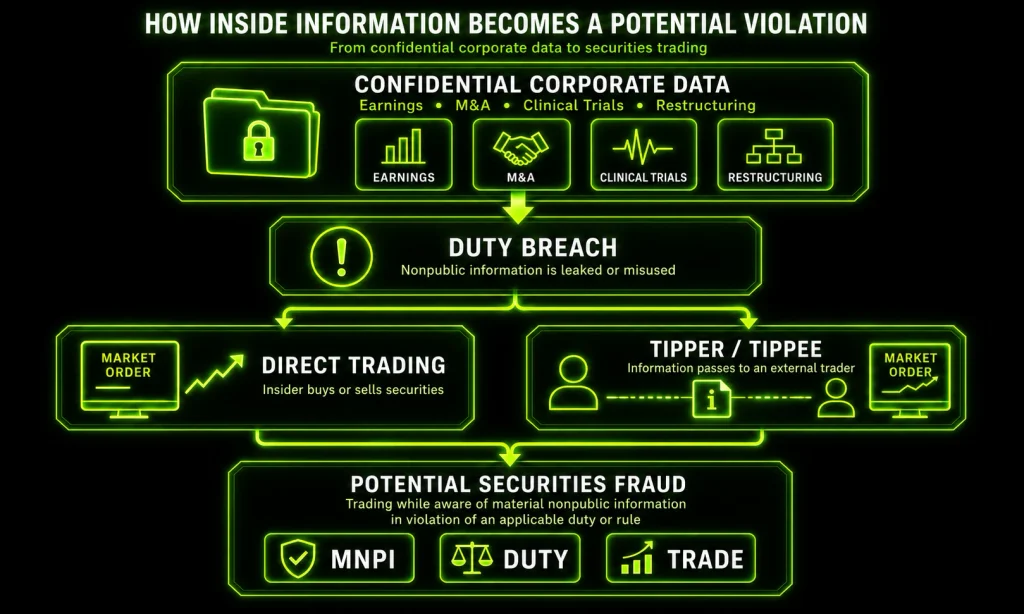
When an insider trades on inside information, they bypass public price discovery mechanisms. The United States Securities and Exchange Commission (SEC) and international regulators consider this a direct form of securities fraud. Under Section 10(b) of the Securities Exchange Act of 1934 and Rule 10b-5, a person who trades while aware of material nonpublic information in breach of an applicable duty may face civil liability and, in criminal cases, imprisonment and fines.
Business Development Director (Malaysia), Versus Trade — Mohd Fazrin,
An insider information flow typically involves a corporate executive, an analyst, an attorney, or an accountant who gains access to nonpublic data through their professional services to the corporation. If that individual trades while aware of the information in breach of a duty, liability may follow. Passing the information to an outside trader may also create liability when the legal requirements for tipping are satisfied, including the applicable personal-benefit test. Separate rules govern tender-offer information.
Who Is an Insider and What Counts as Material Nonpublic Information?
A corporate insider definition is broadly specified across global regulatory frameworks. Understanding who is an insider requires looking at both permanent access and temporary duties to a firm.
- Primary Insiders: Officers, directors, chief executive officer figures, and certain beneficial owners of more than 10% of a class of equity securities registered under Section 12 of the Exchange Act. Officers, directors, and qualifying beneficial owners generally report covered transactions on Form 4, subject to applicable exceptions.
- Temporary Insiders: Lawyers, auditors, investment bankers, and consultants providing services to the corporation who receive access to sensitive internal books.
- Misappropriators: Individuals who use material nonpublic information in breach of a duty owed to its source.
- Tippees: Recipients who may face liability if they trade while knowing or having reason to know that the information from an insider was disclosed in breach of the tipper’s duty and the other applicable requirements are satisfied.
What counts as material info? Information counts as “material” if there is a real chance a reasonable investor would rely on it when deciding whether to buy, sell, or hold a stock. Meanwhile, data remains “nonpublic” until it’s widely blasted out to the market through press releases, news wires, or official SEC filings.
| Type of Corporate Event | Possible Materiality | Possible Market Reaction |
| Pending M&A | Often material, depending on probability and significance | May produce a price gap or increased volume |
| Earnings Surprise | Depends on size and market expectations | May cause a valuation adjustment |
| FDA Decision / Trial Data | Depends on the product’s importance and the results | May increase volatility |
| Unscheduled CEO Resignation | Depends on circumstances and the executive’s importance | May affect perceptions of leadership risk |
Legal vs Illegal Trading by Insiders in the Stock Market
Not every executive stock trade breaks the law. Understanding legal vs. illegal trading comes down to timing, intent, and structural compliance.
Legal Insider Transactions
Corporate officers trade their own company’s shares legally all the time. These transactions are a routine part of executive compensation and portfolio diversification.
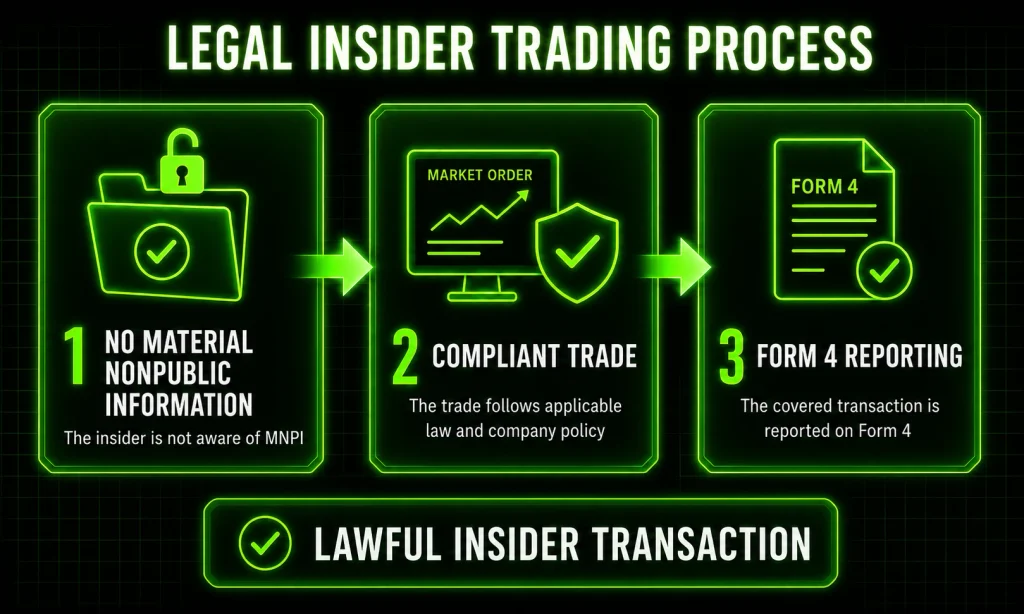
Note: A qualifying Rule 10b5-1 plan may provide an affirmative defense but is not mandatory for every lawful trade.
When conducted within these parameters, transactions by corporate insiders may be lawful, although an individual trade does not necessarily reveal the insider’s view of the company’s prospects. Corporate executives sell shares for routine reasons: purchasing real estate, paying tax obligations on vested grants, or balancing personal asset allocation.
Enter the market accessibly. Start a Standard Account from just $10 and take it from there.

Illegal Insider Trading Mechanics
Conversely, illegal insider trading occurs when a trade hinges on confidential information. Illegal trading distorts market efficiency because one party trades with a material informational advantage unavailable to the public.
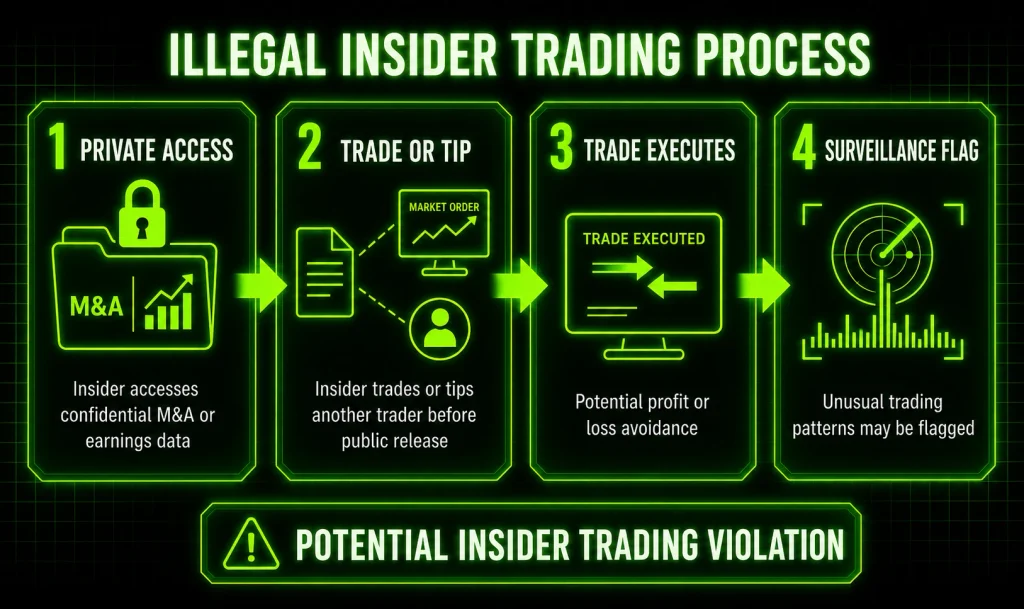
If you are exploring the markets through an online trading account, using public technical or fundamental research avoids the central information problem involved in insider trading, although traders must still comply with other applicable market rules.
Notable Examples of Insider Trading Cases
Examining real-world examples of insider trading cases shows how regulatory bodies identify, track, and prosecute illicit activity.
The Raj Rajaratnam & Galleon Group Network
The downfall of Raj Rajaratnam remains one of the defining insider trading cases in financial history. The former hedge fund titan leveraged an extensive web of informants inside major tech and financial institutions, including former McKinsey director Rajat Gupta, to harvest confidential market tips.
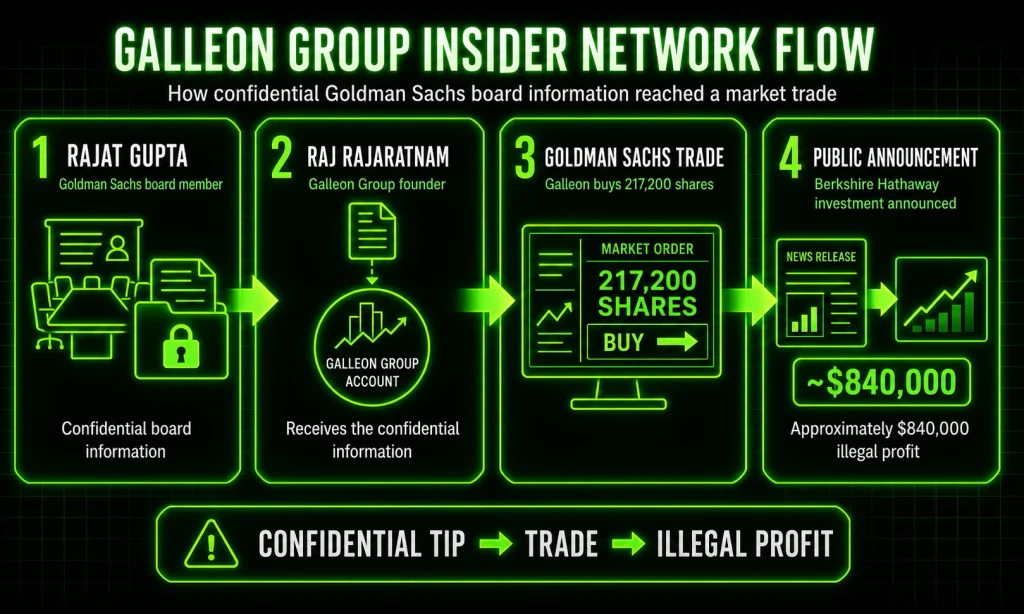
When the market learned of the Berkshire Hathaway deal, Galleon immediately sold off its 217,200 Goldman Sachs shares for an illegal profit near $840,000. Regulators at the SEC ultimately mapped out a much broader network of trades fueled by information supplied by Gupta, calculating total illicit profits and saved losses at over $23 million. Consequently, Rajaratnam was sentenced to 11 years in federal prison, and Gupta was handed two years in prison.
Texas Gulf Sulphur Co. (1968)
The landmark case SEC v. Texas Gulf Sulphur Co. established early baseline prohibitions of insider trading principles under US federal law. TGS discovered major mineral deposits in Canada. Company insiders bought shares and options before publishing the discovery. Applying the “disclose-or-abstain” rule, the Second Circuit ruled that the insiders in question were barred from trading while holding material nonpublic data. However, later Supreme Court rulings refined this standard, emphasizing that standard Rule 10b-5 liability still requires showing an underlying duty or a similar legal obligation.
Modern Enforcement: Shadow Trading & SEC v. Panuwat
Regulatory frameworks continue to evolve beyond traditional tipping. So-called shadow trading may create insider-trading liability when a person misappropriates confidential information about one company to trade stocks of another company and the information is material to those securities. Liability depends on the facts, including the trader’s duty to the source of the information.
Matthew Panuwat, an executive at Medivation, leveraged secret details about his company’s upcoming takeover to buy call options in a rival mid-cap oncology firm, Incyte. That move backfired in April 2024, when a federal jury found him liable in a groundbreaking civil insider-trading lawsuit brought by the SEC. The outcome was based on the specific evidence concerning materiality and Panuwat’s duty to Medivation.
How Regulators Monitor Trading and Find Insider Violations
Detecting illegal activity within billions of daily trades requires advanced data analytics. The SEC’s Division of Enforcement analyzes raw trading data to identify suspicious trading patterns.
Market surveillance algorithms often catch weird trading volume surrounding market-moving news, but a simple system flag isn’t enough to build a case or level charges right away. Investigators have to build proof by overlaying order histories onto corporate calendars, network maps, and lawfully obtained communications. In these matters, the SEC relies on subpoenas for civil enforcement, while criminal evidence-gathering is handled separately by the DOJ and partner law enforcement agencies.
Brokers and financial firms also deploy strict internal compliance systems. Traders testing strategies on a trading demo gratis platform learn early on that order routing, execution speed, and transparent market access form the backbone of modern brokerage integrity.
Trade transparently with trusted market execution. Open a live account with Versus Trade today.
Malaysia Insider Trading Regulation: Laws and Enforcement Reality
In Malaysia, regulating insider trading falls under the jurisdiction of the Securities Commission Malaysia (SC) pursuant to the Capital Markets and Services Act 2007 (CMSA).
Section 188 of the CMSA explicitly prohibits anyone who possesses inside information from:
- Acquiring or disposing of securities affected by that information.
- Procuring another person to acquire or dispose of those securities.
- Communicating inside information to another person if they know or ought to know that the recipient would trade on it.
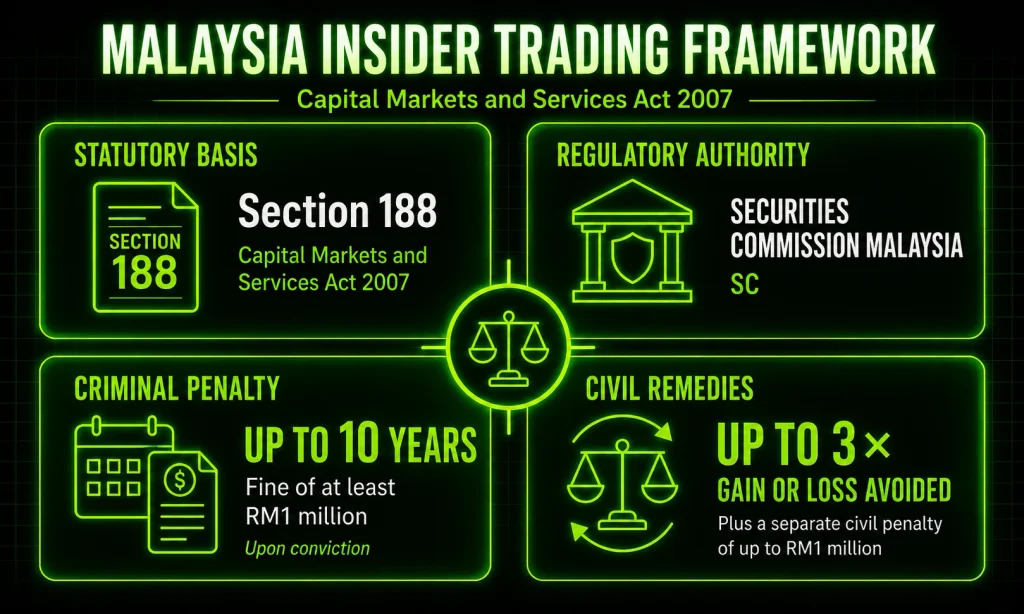
Unlike older common law frameworks that required proving a breach of a fiduciary duty, Malaysian law focuses primarily on the possession of price-sensitive, nonpublic information itself. If a trader in Kuala Lumpur receives an undisclosed tip about a listed plantation or technology firm and executes an order, both the insider who leaked the info and the recipient can face criminal prosecution.
Civil sanctions in Malaysia allow the Securities Commission to recover up to three times the amount of profit gained or loss avoided, alongside a separate court-imposed civil penalty of up to RM1 million. Regulatory developments in Southeast Asia have highlighted how corporate transparency directly impacts broader market participation, a topic expanded in the article “What We Didn’t Have Time to Say at FMSS 2026.”
Penalties for Insider Trading Violations
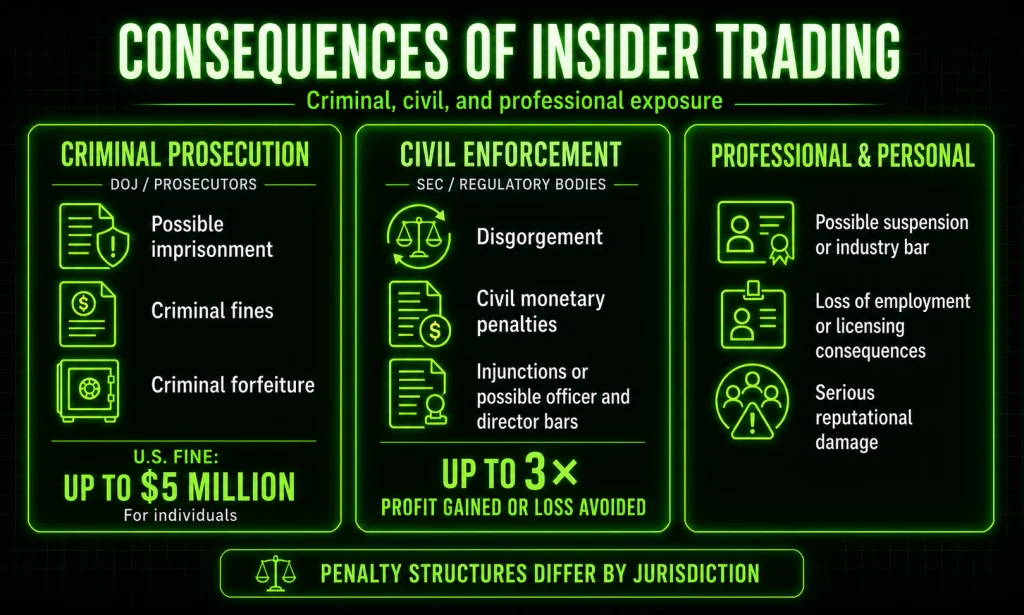
The legal consequences for executing an illegal act based on inside information are severe, encompassing both criminal prosecution and civil liability.
Former SEC Enforcement Director — Linda Chatman Thomsen
SEC Charges 14 in Wall Street Insider Trading Ring
The landmark Insider Trading and Securities Fraud Enforcement Act of 1988 marked a major shift in compliance, boosting potential jail time and creating oversight exposure for leadership. If a manager or firm disregards clear red flags about an employee’s misuse of nonpublic information, they can face civil enforcement. These civil enforcement actions can lead to steep monetary penalties, profit clawbacks, and injunctions, whereas imprisonment and criminal forfeiture mandate an independent criminal conviction.
Insider Trading vs Market Manipulation: Key Differences
While both constitute illegal activity that destabilizes market trust, market manipulation and insider trading operate through distinctly different mechanisms.
| Feature | Insider Trading | Market Manipulation |
| Core Mechanism | Exploiting nonpublic information to trade ahead of the market. | Creating artificial market signals, false volume, or price trends. |
| Information Status | Material, genuine corporate information unavailable to the public. | May involve false statements or deceptive trading activity; fabricated information is not required. |
| Primary Examples | Buying shares before an M&A announcement while aware of material nonpublic deal information and in breach of an applicable duty or rule. | Wash trading, spoofing orders, pump-and-dump schemes. |
| Statutory Basis | Securities Exchange Act Section 10(b), Rule 10b-5. | Securities Exchange Act Section 9(a), Section 10(b). |
How Everyday Traders Protect Their Portfolios
For retail traders, navigating the stock market means focusing on transparent strategies, systematic risk management, and public data analysis rather than chasing “hot tips.”
- Verify Your Data Sources: Rely strictly on verified financial news feeds, audited corporate quarterly reports, and official public exchange disclosures.
- Ignore Rumor Networks: Unverified tips shared in chat groups may be inaccurate or manipulative. If a tip contains material nonpublic information obtained through a breach of duty, trading on it may also create insider-trading liability.
- Deploy Robust Trading Tools: Serious market participants use professional terminal software. Setting up MT5 for PC provides access to technical indicators and execution capabilities based on real-time public market prices.
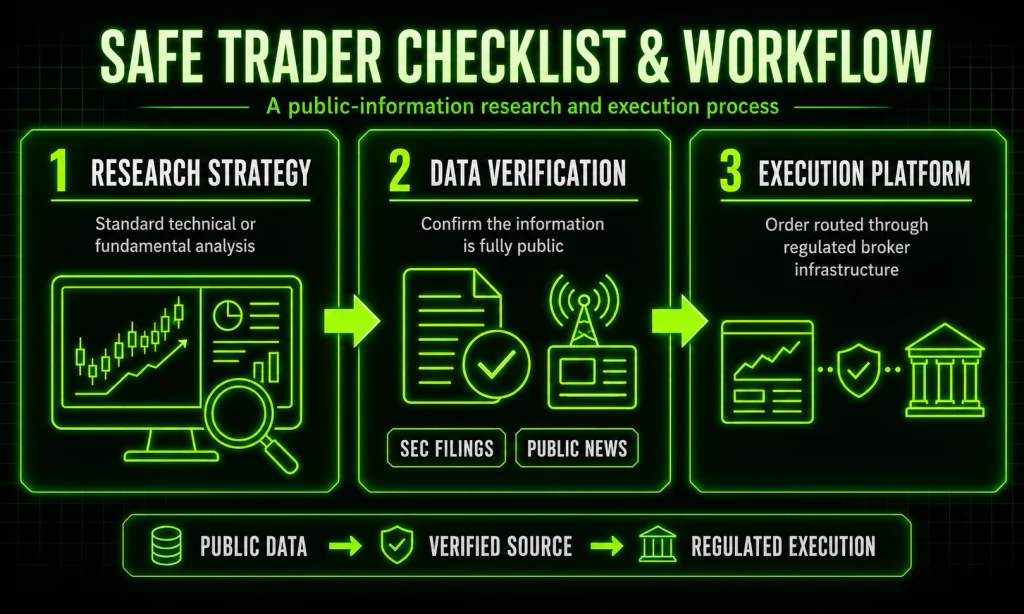
By prioritizing sound analytical methods over nonpublic shortcuts, retail investors participate safely in financial markets, reducing the risk of trading on material nonpublic information while remaining subject to the other laws and rules applicable in their jurisdiction.
Ready to trade the markets with total confidence? Get started with Versus Trade and access global financial markets securely.
Go from registration to trading with Versus Trade in 5 minutes.

- What Is Insider Trading and How Does It Function?
- Who Is an Insider and What Counts as Material Nonpublic Information?
- Legal vs Illegal Trading by Insiders in the Stock Market
- Notable Examples of Insider Trading Cases
- How Regulators Monitor Trading and Find Insider Violations
- Malaysia Insider Trading Regulation: Laws and Enforcement Reality
- Penalties for Insider Trading Violations
- Insider Trading vs Market Manipulation: Key Differences
- How Everyday Traders Protect Their Portfolios