
Introducing Broker Meaning: What an IB Does and How It Makes Money


An introducing broker, or IB, introduces prospective or existing traders to a brokerage while the brokerage provides the account and trading infrastructure. In a typical referral arrangement, the IB may receive commission but does not hold client funds or execute transactions for the client.
A trader may encounter an IB through an educator, a comparison site, or a trading community. The relationship often begins when someone explains the broker, refers a client, and stays available for platform or account questions.
That is the core introducing broker meaning, although the legal perimeter changes across markets. An IB introducing broker arrangement used as a commercial label in retail derivatives is not automatically the same as the regulated US futures category. Product, jurisdiction, and the partner’s actual conduct determine which rules apply.
The broker remains central to the trading relationship. It opens and administers the account, applies its onboarding controls, and provides the operational infrastructure. An IB brings distribution, local knowledge, and client contact. A partner evaluating Versus Trade therefore needs to distinguish commercial referral work from activities that may require authorisation, such as dealing, arranging transactions, or giving investment advice.
What does an introducing broker do
An introducing broker acts as a middleman between a brokerage firm and a group of potential clients. That broad description covers several business models, from a publisher referring readers to a broker to an established trading educator supporting a large community.
Typical work may include:
- publishing research or platform explainers
- introducing prospects to the broker
- localising educational material
- supporting clients after onboarding
The boundary around those tasks matters. An IB can offer personalised support without taking control of a client’s account. It can discuss trading platforms without promising returns. It can help clients find information without recommending a particular purchase or sale. Once a partner begins to advise, transmit or accept orders, execute trades, receive client money, or exercise discretion, its activities move into a different regulatory category.
Who needs an introducing broker
An IB may be useful to traders who value local-language support, platform guidance, or access to an established trading community. Experienced clients may also use one when the IB has specialized market knowledge. No trader is inherently required to use an IB, and the broker remains responsible for the account and execution service.
Explore the Versus Trade platform and discover the tools traders use to analyze markets, manage risk, and improve performance.

Client acquisition is only the opening stage
The weakest version of the model treats every referral as a completed transaction. Stronger IBs pay attention to whether the client understands the service and can reach support. Account management and accurate communication usually matter more over time than a burst of traffic.
Head of Key Account Management, Versus Trade — Nicole Yap
That continuing contact does not turn an IB into the broker’s dealing desk. The client still uses the broker’s systems for onboarding, funding, and trade execution. A prospective trader who wants to learn the interface without immediately placing a live position may begin with demo trading, while the IB concentrates on clear orientation rather than account access.
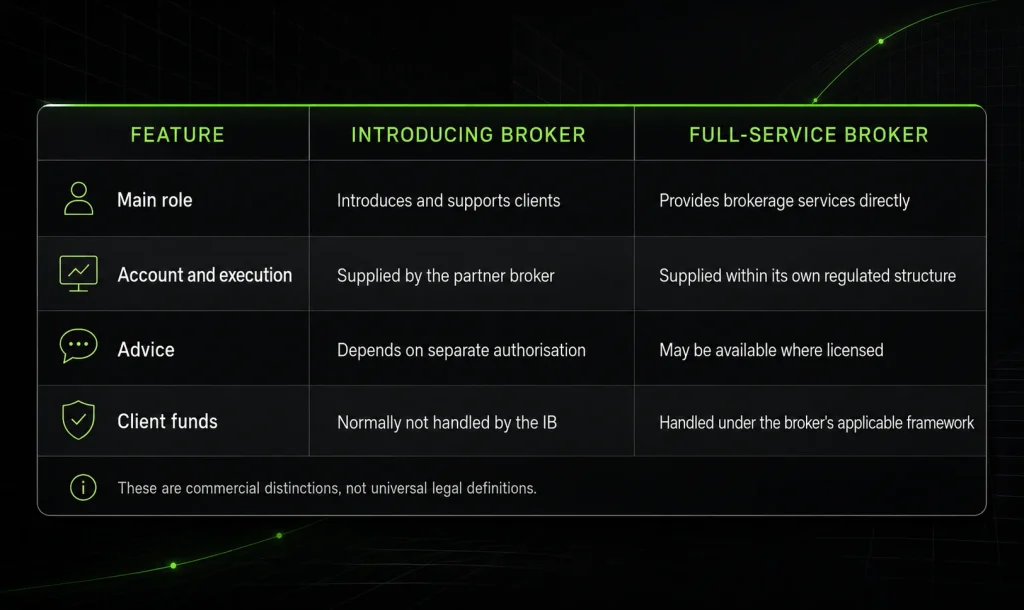
What is the difference between an introducing broker and a full-service broker
An IB introduces and supports clients but normally relies on another firm for accounts and execution. A full-service broker provides brokerage services directly and may also offer research, advice, or portfolio support, depending on its licence and business model. A full-service broker, if authorised and using a certain business model, may provide direct access to equity, derivatives and other markets.
Introducing broker programme
An introducing broker programme establishes the commercial and operational rules between the broker and the partner. The formal agreement normally identifies permitted marketing channels, eligible clients, commission structures, brand standards, reporting access, payment terms, and compliance responsibilities.
The operating sequence often looks like this:
- The broker reviews the applicant, its audience, and its promotional methods.
- Both parties enter a formal agreement defining responsibilities and restrictions.
- The IB receives an attribution link, code, or another approved referral method.
- The prospective client applies directly to the broker and completes the broker’s checks.
- The broker provides the account and different trading platforms, then processes deposits, withdrawals, and execution under its applicable terms and operating framework.
- Approved client activity is attributed under the agreed commercial model.
- The IB receives reports and commission, subject to validation and program terms.
Commission may be linked to trading volume, spread revenue, qualified accounts, or another agreed measure. Rates can vary by instrument, region, and client type. Retention, acquisition costs, and traffic quality all affect whether the relationship remains viable.
What are the benefits of becoming an introducing broker
The model allows an IB to build a client-facing business without creating its own execution and back-office infrastructure. Potential benefits include commission income, broker reporting and support, and the ability to serve a particular language, region, or trading niche. Some IBs build their communities around specific markets or trading strategies. Remember, though, that educational support must not cross the line into regulated investment advice.
Results still depend on client quality, operating costs, programme terms, and compliance.
For example, interest in forex trading may produce a large audience, but traffic alone says little about its value. Clients who misunderstand margin or arrive through exaggerated claims can create complaints, rapid churn, and compliance risk. The same risk appears when leverage is promoted to increase potential returns without equally explaining how it can magnify losses. A smaller community with realistic expectations may generate steadier trading activity and require less remedial support.
Go from registration to trading with Versus Trade in 5 minutes.

Where the broker takes over
The arrangement allows introducing brokers to focus on client relationships while the brokerage maintains the operational infrastructure. That split typically covers:
- identity and account verification
- client-money processing under the applicable model
- pricing, trade execution, and platform security
- transaction monitoring and records
- account statements and payments
This division normally keeps the IB away from credentials and client funds while giving clients a route for issues only the broker can resolve.
Growth strains that division when recruitment runs ahead of supervision. The Versus Trade article Rapid Growth Doesn’t Break Companies. Bad Hiring Does describes how expansion becomes fragile when selection standards fail to keep pace.
Are introducing brokers regulated
Some are regulated directly, while others operate as commercial referral partners. Licensing requirements depend on location, clients, products, and the work performed. A Malaysian educator and a US futures firm may use the same label while facing different obligations.
Requirements to become an introducing broker
At the commercial level, a reputable broker may examine:
- identity and business history
- traffic sources and audience geography
- marketing methods and compliance capacity
A partner may also need a registered entity, tax information, and banking details. Program approval is not a substitute for regulatory authorisation.
Malaysia: activities matter more than the label
Malaysia’s framework does not treat “introducing broker” as a universal permission to market or arrange investment products. The Securities Commission Malaysia regulates capital-market activities under the Capital Markets and Services Act 2007, while its CFD Guidelines establish requirements for providers of OTC contracts for difference. The relevant authorisation depends on the product, the service, and how the activity is conducted.
An applicant considering an introducing broker partnership, therefore, needs a specific role description and must be eligible under the programme terms and applicable law. Financial authorities may examine solicitation, recommendations, order handling, client information, and compensation. A foreign licence or commercial agreement does not by itself establish permission to offer or promote capital-market services in Malaysia. Promotions aimed at Malaysians fall within the scope of applicable local advertising rules, and authorisation can be checked through the SC’s official registers.
Compliance work may cover:
Marketing controls
- Claims are substantiated, and risk language fits the product.
- Past performance is not presented as a promise.
Client and conduct controls
- Applications and money use official broker channels where an account is available.
- Credentials, personal data, and complaints are handled correctly.
- Support does not become unlicensed advice or account management.
- Incentives do not encourage misleading or excessive trading.
Chief Commercial Officer, Rostro Group — John Murphy.
Gulf News, Money Reimagined: “How Partners Make Money”, April 21, 2026.
Support stops being helpful when it disguises risk or overrides the client’s judgement. Commission disclosure helps the client interpret the relationship.
The US futures definition
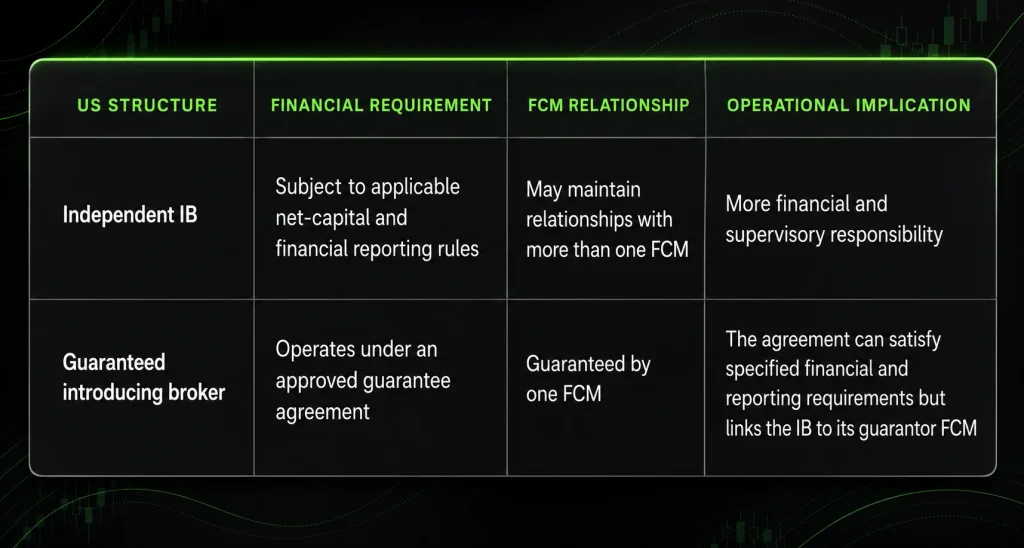
Terms such as CFTC, NFA, futures commission merchant, and guaranteed introducing broker belong mainly to the US commodity derivatives framework. Under the Commodity Exchange Act, the definition of introducing broker covers a person soliciting or accepting orders for specified commodity interests, including a commodity for future delivery, while not accepting money or property to margin or secure the resulting trades.
In that model, IBs and FCMs perform separate functions. The IB solicits or accepts orders, while the futures commission merchant carries accounts and handles customer funds. FCMs may also work with clearing firms that process transactions through the market infrastructure. Registration with the Commodity Futures Trading Commission is generally required unless an exemption applies. The CFTC has delegated IB registration functions to the National Futures Association.
IBs may have capital requirements and financial reporting obligations, while a guaranteed IB fulfils financial obligations through an approved agreement with an FCM.
NFA rules and CFTC registration do not automatically regulate an IB in Malaysia. They become relevant when US jurisdiction, customers, or covered commodity interests are involved. FINRA and SEC securities rules are not interchangeable with the CFTC regime.
Master IB and network management
A master introducing broker adds another layer by recruiting or supporting sub-IBs under the relevant programme structure. The role can expand reach across languages and local communities, subject to the broker’s terms and applicable local requirements.
A master IB may monitor messages, traffic quality, and sub-partner conduct. Broker oversight also affects the result.
Commission may follow spread revenue, trading volume, qualified acquisition, or a hybrid formula. Chargebacks and payment thresholds can change the headline rate.
What clients can expect from an IB
The IB may provide local context, while the broker controls the account and execution. Registration should occur on the broker’s official domain, the IB’s commission interest should be disclosed, and credentials or personal transfers should never be requested. An IB cannot remove market risk, guarantee returns, or replace an authorised provider’s responsibilities.
Introducing the broker’s meaning in practice
In practice, the IB introduces clients and may continue supporting them, while the broker supplies the account and execution systems. Product, geography, contractual limits, and compliance determine the precise boundary.
Disclaimer: This is information, not legal or investment advice. Availability depends on jurisdiction, eligibility, and applicable law.