
What Is Commodity Trading? A Guide to Markets, Derivatives and Investing


- What Is Commodity Trading and How Does the Commodity Market Work?
- What Makes Commodity Prices Move?
- How to Trade Commodities Without Taking Delivery
- Building a Trading Commodities Strategy
- Commodity Investment or Short-Term Trading?
- Is Commodity Trading Profitable and What Are Its Risks and Benefits?
- Which Commodity Is Best for Trading, Especially for Beginners?
- Who Are the Major Participants or Traders in the Commodity Market?
- Is Commodity Trading Suitable for Beginners?
- What Commodity Trading Ultimately Represents
Coffee, petrol and jewelry begin in markets shaped by weather, extraction, and consumption. Traders rarely handle the goods. Their positions follow commodities like oil, gold, or palm oil through a financial instrument.
That distinction defines commodity trading. Producers manage real costs while speculators seek to profit from price moves. In Malaysia, Bursa Malaysia Derivatives’ ringgit-denominated palm oil futures provide a familiar local reference.
What Is Commodity Trading and How Does the Commodity Market Work?
Trading in commodities means taking exposure to raw materials or primary agricultural products. A position may involve an actual commodity, but retail activity more commonly uses a derivative whose value follows an underlying commodity. The trader gains exposure without arranging storage, insurance, or delivery.
Prices emerge from participants with different aims. A producer may hedge revenue, while a speculator reacts to supply and demand. A commodity exchange standardises contracts and supports price discovery. The physical exchange of commodities continues separately.
Malaysian traders can trade commodities online through brokers, subject to the product provider and regulations. Exposure is financial unless the terms provide for delivery.
Spot, futures and retail derivative markets
The spot price is associated with prompt delivery of a physical commodity. Local prices can differ with quality, location, and transport costs. Retail spot trading may still follow a benchmark rather than involve ownership.
Futures contracts
A futures contract fixes a standard quantity, quality, delivery month, and settlement process. These commodity contracts trade on regulated venues. Every contract has an expiry and settlement method. Depending on the contract, settlement may be financial or create a delivery obligation if the position is open into the delivery period. Many financial traders close or roll their positions earlier.
Retail derivatives
CFDs form another part of derivative trading. The customer contracts with the provider rather than buying an exchange-listed future. Malaysia’s Securities Commission treats offering CFDs as dealing in derivatives and restricts locally regulated CFD offerings to sophisticated investors.
Types of Commodities Available for Trading
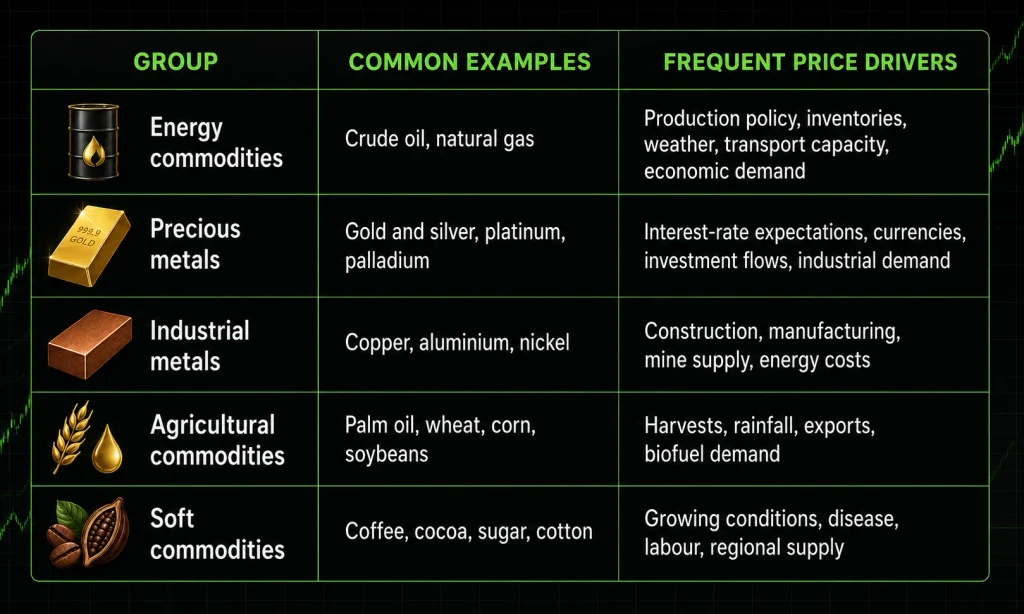
The major types of commodities divide into extracted resources and products grown or raised. These categories react to different information.
Hard commodities and metal commodities
Hard commodities are mined or extracted. Oil and gas sit beside metal commodities, although their storage economics differ. New mine output may take years to develop. A metal position can respond to industrial demand, real yields, currencies, and geopolitics.
CEO and founder, Versus Trade — Vitalii Bulynin
Interviewed for Finance Magnates on December 9, 2025.
The comparison describes behaviour, not an assurance. Precious metals can fall, and Bitcoin differs substantially from a physical raw material.
Trade XAUUSD with spreads from 2.4p and zero commission per lot. When gold moves, trading costs shouldn’t steal the spotlight.

Agricultural and primary commodity markets
Weather makes agricultural commodities seasonal. Forecasts can change the expected supply of commodities before crops reach warehouses.
Palm oil places Malaysia inside this global commodity system. Bursa Malaysia’s ringgit-denominated FCPO shows how a primary commodity supports hedging and speculative trading activity.
What Makes Commodity Prices Move?
Unlike a stock, a barrel of oil has no earnings report, and a tonne of copper has no management team. The relevant balance sheet belongs to the market: production, inventories, spare capacity, and consumption. Changes in any of them can influence commodity prices.
Investor — Jim Rogers,
in a BBC Radio 4 interview reported by MarketWatch
Small shortages can cause large market fluctuations because production cannot expand immediately and consumption may be slow to adjust.
Supply, market demand and inventories
Four forces recur across various commodities:
- Supply and demand: Production cuts, crop failures, and stronger market demand change the expected balance.
- Inventories: Available stocks cushion short disruptions. Low inventories can amplify price volatility.
- Currencies: Many benchmarks are quoted in US dollars, so exchange-rate changes can affect buyers using other currencies.
- Logistics: Port congestion, sanctions, and the cost of transporting commodities can separate regional prices from a global benchmark.
For specific commodities, one factor may dominate. Cold weather can lift gas, while refinery outages can move fuel even when crude supply looks adequate.
Inflation, geopolitics and market volatility
Commodity costs feed into transport, food, and manufacturing, so broad rises often accompany concern about inflation. Geopolitics can remove supply or reroute trade, yet prices of commodities may retreat when a feared loss does not materialise.
Traders can trade commodities with MetaTrader 5 when the relevant instruments are offered. A trading platform provides quotes, charts, and order controls, but it cannot remove gaps, slippage, or rapidly changing liquidity.
How to Trade Commodities Without Taking Delivery
Retail access comes through several structures. Each produces a different relationship with the asset, the provider, and the benchmark.
Commodity futures and exchange trading
Commodity futures are standardised contracts traded on an exchange. The New York Mercantile Exchange, part of CME Group, hosts major energy and metals benchmarks, while Bursa Malaysia Derivatives operates FCPO.
In commodity futures trading, participants post margin rather than the full notional value. Contract size, tick value, expiry, and settlement matter. The US Commodity Futures Trading Commission regulates US derivatives markets, not every international product.
CFDs and margin trading
A commodity CFD is a commodity derivative that settles the difference between opening and closing prices. Margin trading magnifies losses as well as gains, while financing and spreads affect the result.
Not every instrument is available for trading in every country or account. Contract specifications may also differ between providers. The relevant benchmark, trading hours, and rollover method determine how closely a quote follows the headline market price.
Commodity ETFs, stock and index exposure
Commodity ETFs may hold physical assets, futures, or producer shares. Fees and rolling can separate returns from spot prices. A commodity index spreads exposure, but its weights shape performance.
Commodity stocks are miners, energy producers, or agricultural businesses listed on a stock exchange. The value of commodities matters, but so do debt, costs, and management. These remain shares, not raw materials.
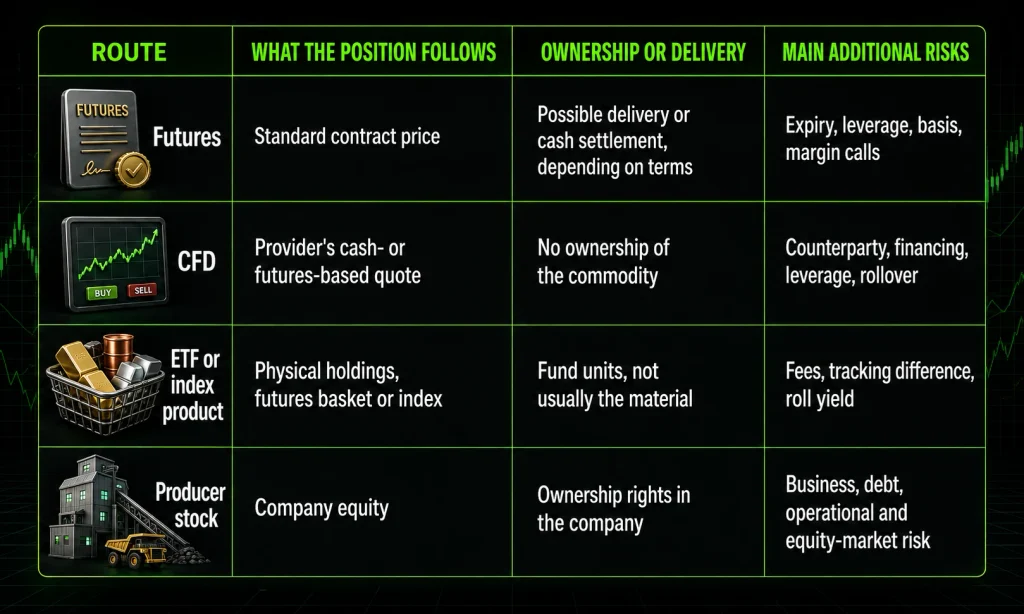
This matters when seeking to gain exposure to commodities or diversify beyond stock and bond markets. A basket can behave differently from individual commodities.
Building a Trading Commodities Strategy
A useful trading strategy begins with the contract rather than a prediction. The same 2% move can produce very different outcomes depending on position size, leverage, and financing.
From market thesis to position
A repeatable process usually covers:
- Identify the particular commodity and the event expected to alter its balance.
- Establish whether the position follows cash, futures, or a company share.
- Record contract size, margin, spread, financing, and expiry.
- Define the price level that would invalidate the thesis.
- Size the position so a gap or adverse move remains manageable.
The decision to buy or sell the commodity exposure depends on timing. Long-term demand does not prevent a short-term fall when inventories rise.
Beginners can practice commodity trading on a demo account before risking capital. Simulation can build familiarity with order entry and market operations, although demo execution and emotional pressure do not fully reproduce live conditions.
Risk, costs and trading volumes
Liquidity is uneven. Higher trading volumes often support tighter spreads. Costs may include commissions, exchange fees, and overnight financing of commodity positions through a leveraged product.
Position size, leverage, and event risk drive exposure. Stop orders may execute beyond the chosen level after a gap. A broker can be assessed through its legal entity, authorisation and product terms.
The Securities Commission Malaysia maintains a register of licensed intermediaries and an Investor Alert List. International providers are regulated elsewhere, but foreign authorisation doesn’t automatically confirm Malaysian authorization. National providers may operate under a different framework.
Commodity Investment or Short-Term Trading?
The case to invest in commodities often rests on diversification or scarcity. Short-term trading commodities focuses more on catalysts and market dynamics.
Long-horizon investments in commodities can face roll costs. Short-term traders encounter spreads more frequently. Physical trading adds storage, quality, and resale constraints.
Versus Trade provides access to market information and trading tools through its platform, subject to eligibility and product availability.
Technology can help organise research across reports, inventories, and price series, but it does not create market knowledge on its own. The same principle runs through AI Isn’t Taking Fintech Jobs. It’s Exposing Who Continues to Grow: tools become more useful when paired with judgement and domain expertise.
Is Commodity Trading Profitable and What Are Its Risks and Benefits?
Commodity trading can be profitable, but returns depend on timing, position size, costs, and risk control. Potential benefits depend on the instrument: access to rising or falling markets, diversification, and exposure to supply-driven trends. The same markets carry sharp volatility, leverage risk, overnight financing costs, and price gaps after unexpected political, weather, or inventory news. Profit is therefore
possible, not predictable.
Microsoft vs Apple. Bitcoin vs Gold. Nasdaq 100 vs Oil. With Versus Pairs, you decide which side comes out stronger.
Which Commodity Is Best for Trading, Especially for Beginners?
No single commodity suits every beginner. Gold and major oil benchmarks usually attract substantial liquidity and extensive market coverage, making their price drivers easier to research. Oil can still move abruptly, while gold responds to currencies, interest rate expectations, and risk sentiment. A beginner may find one liquid market with clear contract terms more manageable than switching among several unfamiliar products.
Who Are the Major Participants or Traders in the Commodity Market?
The market brings together producers, processors, manufacturers, merchants, banks, funds, and retail traders. Producers and commercial users often hedge input costs or future revenue. Trading houses connect physical supply with buyers, while investment funds and speculators provide capital and liquidity. Exchanges list and facilitate trading in standardised contracts. Clearing houses manage settlement and counterparty obligations.
Is Commodity Trading Suitable for Beginners?
Commodity markets can conceal substantial leverage. A small deposit may control a much larger quantity of a commodity, allowing sudden news to move the account sharply.
Following one or two markets makes reports and seasonality easier to understand. Crude oil, natural gas, and gold and silver are widely discussed, but familiarity does not make them low risk.
What Commodity Trading Ultimately Represents
As commodities are traded, prices absorb harvest forecasts, mine disruptions, and consumption. Financial instruments create tradable exposure, but each adds risks.
For anyone studying how to trade commodities, the decisive distinction is the link between the screen price and the market underneath it. That link helps explain volatility and shows when a position no longer reflects the original idea.
- What Is Commodity Trading and How Does the Commodity Market Work?
- What Makes Commodity Prices Move?
- How to Trade Commodities Without Taking Delivery
- Building a Trading Commodities Strategy
- Commodity Investment or Short-Term Trading?
- Is Commodity Trading Profitable and What Are Its Risks and Benefits?
- Which Commodity Is Best for Trading, Especially for Beginners?
- Who Are the Major Participants or Traders in the Commodity Market?
- Is Commodity Trading Suitable for Beginners?
- What Commodity Trading Ultimately Represents