
What Is Forex Trading & How Does It Work?


- Forex Trading: How Does It Work?
- Where Forex Trading Happens and Who Takes Part
- What Moves the Forex Market?
- What Is Spread, Pip Value, Margin, and Leverage Meaning?
- What Are CFDs in Forex?
- What Is Different About Forex Trading in Thailand?
- What Are the Benefits of Forex Trading?
- What Are Common Forex Trading Strategies?
- What Are the Main Risks of Forex Trading?
- Is Forex Trading Worth It?
- How Much Money Do You Need to Start Forex Trading?
- How Can I Learn or Teach Myself Forex Trading?
- Forex Trading Begins With Understanding the Exposure
What is forex trading? It is the buying of one currency while selling another, with the gross result driven by changes in their exchange rate and the net result also affected by trading costs. This definition covers both practical foreign exchange and speculative trading, although retail positions are often derivatives that do not deliver the underlying currencies.
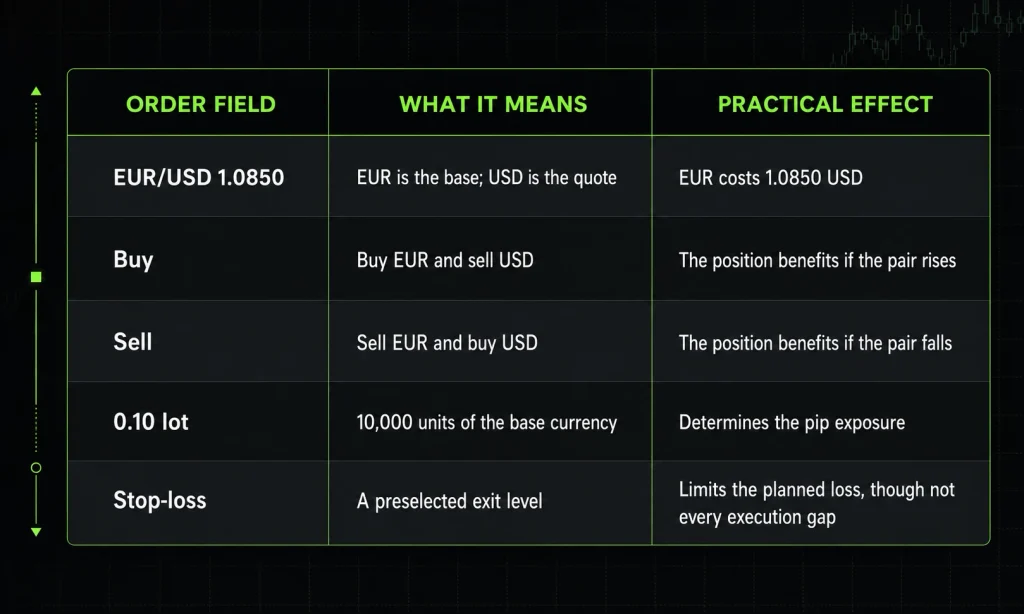
A Bangkok trader may see EUR/USD at 1.0850 on a trading platform. The Buy button looks simple, but pip value, position size, and acceptable loss still need answers. That is where forex trading work becomes real.
Forex Trading: How Does It Work?
How a Currency Pair Combines Buying and Selling
Every currency pair compares two currencies. In EUR/USD, the euro is the base currency and the dollar is the quote currency. At 1.0850, each unit of the base currency costs 1.0850 dollars.
Buying a currency pair means buying the base currency and selling one quote-currency exposure. A trader expecting euro strength may buy a currency pair such as EUR/USD and expecting weakness may sell a currency pair.
Companies also buy and sell currencies for practical reasons. A Thai company may exchange one currency for another to use foreign revenue locally; speculative currency trading seeks price movement.
A EUR/USD Trade From Entry to Exit
Take an example: EUR/USD is bought at 1.0850 and closed at 1.0870, a move of 20 pips. For most four-decimal pairs, a pip is the fourth decimal place and a unit of measurement.
With 10,000 base-currency units, one EUR/USD pip is about USD 1, making the gross change USD 20 before costs.
Position Size Comes Before the Forecast
With 1,000 base units, that move is roughly USD 2; with 100,000, about USD 200.
CEO, Versus Trade — Vitalii Bulynin, in an interview with FXStreet, July 15, 2026.
Maximum loss and stop distance determine position size. Starting with leverage reverses that logic.
Every pip counts. Trade with paper-thin spreads built to keep more of every market move in your hands.
Where Forex Trading Happens and Who Takes Part
A Global Network, Not One Central Exchange
The foreign exchange market is the largest financial market in the world and a global network, not one exchange. The forex market connects banks, liquidity providers, brokers, and electronic venues that quote and trade currencies. There is no single worldwide order book.
Foreign exchange is done for practical and financial reasons. Companies hedge, asset managers rebalance, and central banks manage reserves. The majority of currency conversion is not retail speculation.
Through online CFD trading, a client may receive exposure without delivery. The forex broker, contract, and jurisdiction also matter.
The Participants Behind Daily Trading Volumes
Daily trading volumes combine different objectives:
- Central banks influence rates, reserves, and liquidity.
- Commercial banks and other investors quote prices and hedge.
- Companies exchange one currency for another for payments.
- Funds use spots and derivatives for investment or hedging.
- Retail forex traders buy or sell through forex providers.
The BIS put average OTC foreign exchange trading at about $9.6 trillion per day in April 2025, including spot, swaps, forwards, and options. Spot accounted for about $3 trillion. BIS 2025 Triennial Survey
Why the Market Operates 24 Hours a Day
The market operates 24 hours a day, five days a week, as trading activity passes through time zones. Retail trading schedules commonly divide the market day into Sydney, Tokyo, London, and New York sessions, although the largest FX centers by turnover are not the same as these session labels.
Liquidity changes through the cycle. Thin conditions may produce wider spreads, trading delays, or abrupt fluctuations.
What Moves the Forex Market?
Interest Rates, Inflation, and Central Bank Policy
Currency prices move when economic data changes expectations. Inflation above forecasts may imply a higher interest rate; weak growth may point the other way. What moves the forex market is often the gap between result and expectation.
A central bank can change rates or use quantitative easing. QE purchases add money into an economy and affect yields, but the currency response still depends on expectations.
USD/JPY responds to the Federal Reserve–Bank of Japan policy gap, yields, intervention risk, and market sentiment. Traders interpret those forces, trade accordingly, and may still be wrong as supply and demand shifts.
Liquidity, Sentiment, and Unexpected News
Geopolitics, uncertainty, and large flows can make a market volatile. The same news hits harder when fewer orders are available.
Major currencies such as the dollar, euro, yen, and pound normally have deeper liquidity. Even so, GBP/USD can widen around a Bank of England surprise. Price movement is a live auction, not a response table.
What Is Spread, Pip Value, Margin, and Leverage Meaning?
The Difference Between the Buy and Sell Prices
The spread in a forex order is the difference between the buy and sell prices quoted for the same pair. If EUR/USD shows a bid of 1.0849 and an ask of 1.0851, it is 0.0002, or two pips.
A Buy opens at the ask and closes at the bid, so it begins with a small unrealized loss. Spreads depend on liquidity and conditions.
A pip in forex has no fixed cash value; it changes with size, pair, and trading account currency.
How Margin and Leverage Change a Trade
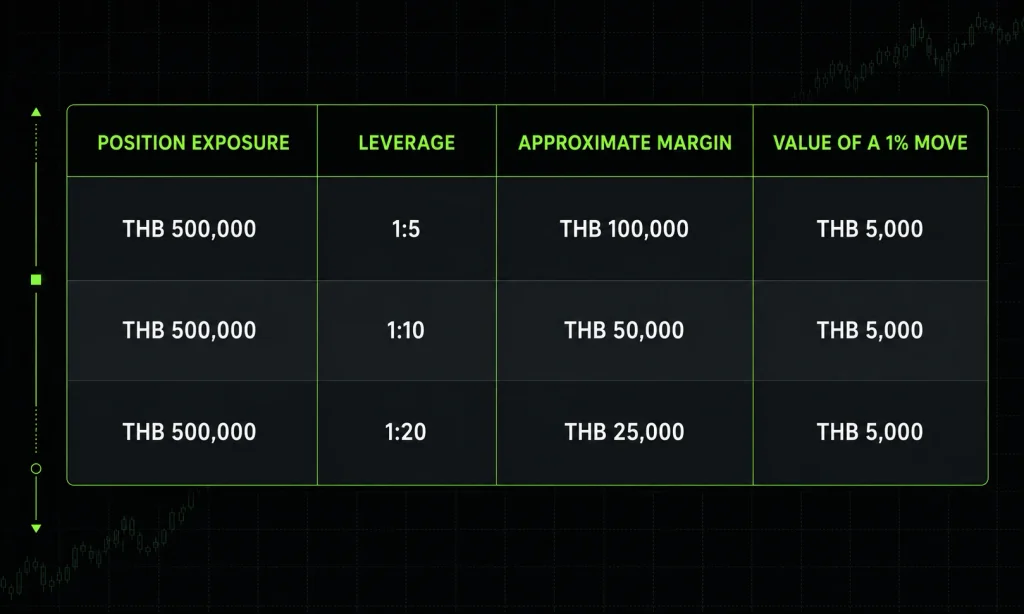
Leverage controls exposure larger than the margin set aside. It does not reduce the value gained or lost when the full position moves.
For THB 500,000 exposure, 1:5 leverage requires about THB 100,000 margin; 1:20 requires THB 25,000. A 1% move remains about THB 5,000. Higher leverage in forex releases margin but makes oversizing easier.
Margin, conversion, and financing depend on the forex broker. A trading demo account allows testing before live funds are exposed.
Enter the market accessibly. Start a Standard Account from just $10 and take it from there.

What Are CFDs in Forex?
Trading Price Exposure Without Currency Delivery
Forex is a market; a CFD is a financial product. With forex CFDs, the parties settle the change in the price of a currency pair without delivery of the underlying asset.
Forex trading involves buying and selling exposure, not cash exchange. A leveraged CFD may involve spread or commission, overnight financing, execution risk, and counterparty risk.
Forex prices, leverage, and stop-out rules depend on the provider. Not all forex transactions are CFDs, and forex providers differ.
Spot, Forwards, Futures, Options, and CFDs
Deliverable spot FX usually settles within two business days, although some currency pairs use a T+1 convention. Rolling retail forex CFDs do not normally result in delivery of either currency. A forward fixes an exchange rate for a date in the future, sometimes within a range of future dates. A futures contract is exchange-traded; an option gives its buyer a contractual right.
Retail CFDs provide leveraged exposure without delivery. Calling all fx trading “spot forex” hides differences in venue, credit risk, and settlement.
What Is Different About Forex Trading in Thailand?
Bangkok Trading Hours and the ICT Time Zone
Thailand uses Indochina Time, UTC+7, year-round. Asia fits the Bangkok working day, London begins later in the afternoon, and the London–New York overlap falls in the evening. Daylight-saving changes shift exact hours.
Liquidity varies. EUR/USD and GBP/USD often become more active with London, while US data can move pairs late in Bangkok. Rollover may occur in the early morning.
THB Accounts, Currency Conversion, and Available Pairs
Thai baht is not a major currency. USD/THB exists in the foreign currency trading market, but a retail trading platform may not list it.
A Thai client may fund a USD account in THB and later convert a result back. Those conversions are separate from the forex pair spread.
For an overseas trip or supplier payment, exchange is done for practical use and one currency is needed. A CFD seeks exposure to changing currency prices.
Broker Access and the Thai Regulatory Context
A Thai-language site does not prove local authorization. The contracting entity, regulator, client-money terms, and complaint route should match the account documents.
Thailand’s SEC lists businesses and sites that may lack required authorization. Absence from the list is not proof of licensing. Thai SEC Investor Alert
Thai residents may invest in permitted offshore securities and derivatives under Thailand’s exchange-control rules. Thai retail investors who remit funds directly for permitted offshore securities and derivatives are generally subject to a USD 5 million annual limit per investor. Different procedures may apply when investing through a licensed intermediary in Thailand.
What Are the Benefits of Forex Trading?
Major pairs usually have deep liquidity, trade across global sessions, and allow long or short exposure. Position sizes can also be adjusted precisely.
Different time frames accommodate short and long views, while demo access makes mechanics inexpensive to practice. These benefits describe flexibility, not easy profit.
What Are Common Forex Trading Strategies?
Trend, Breakout, Range, and News Strategies
Trend following buys strength or sells weakness while structure remains directional. Breakout trading waits for price to leave a range, sometimes entering on a retest. Range trading uses repeated reactions near support and resistance. News trading focuses on economic releases, when volatility and slippage can rise together.
Price action, moving averages, or economic data may support these methods. Entry, invalidation, size, and exit rules make a trading strategy testable.
Day Trading, Swing Trading, and Position Trading
Day trading closes within the day and can make the spread a larger share of results. Swing trading holds for days or weeks. Position trading may follow an economic view for months and accumulate financing.
A style has to fit the trader’s schedule and tolerance for fluctuation. Short-term trading emphasizes execution; longer positions face more event risk.
Price Levels and Smart Money Concepts
Resistance in forex trading is an area where selling previously slowed a rise, not a guaranteed turning price. A breakout can invalidate it; a retest may turn it into support.
SMC in forex trading uses structure, liquidity, order blocks, and imbalances. It organizes analysis but cannot reveal bank orders.
TradingView and broker charts show the same levels, but testing reveals whether an interpretation survives different conditions.
Why One Method Cannot Work in Every Market
A trend method may work during a sustained move and fail when price stays within a range; mean reversion faces the opposite problem.
Founder & CEO, Zerodha — Nithin Kamath
What Are the Main Risks of Forex Trading?
The main risks of forex trading often appear in how exposure is built and executed:
- Leverage risk: a small fluctuation can produce a large change in account equity.
- Gap and execution risk: an order may fill far from the requested price in a fast market.
- Liquidity risk: the difference between the buy and sell prices can widen sharply.
- Financing risk: holding a leveraged CFD overnight may create a daily charge or credit.
- Broker and credit risk: the provider is part of the transaction, not just an app interface.
- Behavioral risk: traders often increase size after a win or try to recover a loss too quickly.
Risk management cannot remove these risks. It connects maximum loss and stop distance to position size.
A Profitable Forecast Can Still Produce a Poor Trade
A correct GBP/USD forecast can lose if size is excessive, the stop catches market noise, or margin pressure forces an early exit.
Market analysis asks why a pair might move. Trade construction asks whether the account can survive being early, wrong, or poorly filled.
Is Forex Trading Worth It?
Forex may suit someone who values liquidity, flexible hours, and a testable process. It is less compelling as quick income, passive returns, or recovery from financial pressure. Costs, losses, and review time belong in the calculation.
Demo results across several conditions provide more evidence than one successful week. Deciding not to trade live after that test is also valid.
How Much Money Do You Need to Start Forex Trading?
There is no universal minimum. A broker’s smallest deposit may still be inadequate. Capital needs depend on order size, margin, account currency, spread, and stop distance.
At 1% planned risk, a THB 10,000 balance allows THB 100; THB 100,000 allows THB 1,000. If minimum size risks more at a logical stop, the account is too small. Demo requires no live capital.
How Can I Learn or Teach Myself Forex Trading?
A Six-Step Self-Study Trade
A controlled test is more useful than switching among pairs:
- Select one liquid currency pair and note its time zones.
- Record the entry, invalidation, and intended exit.
- Set account risk before calculating position size.
- Calculate pip value, spread, margin, and financing.
- Place the demo order using MT5 for PC and record execution.
- Compare the result, trading delays, and costs with the plan.
The routine cannot predict the future. It shows whether the trader understands the order. Self-study works when each concept is attached to a chart, calculation, or recorded trade.
What a Demo Account Can and Cannot Show
A demo shows orders, charts, margin, and pip calculations. A journal compares the intended setup, execution, and outcome to reveal recurring errors.
A demo cannot reproduce emotional pressure, withdrawals, or the live trading experience.
Industry Knowledge Is Not Trading Discipline
Knowing fintech vocabulary does not create a repeatable process. The Real Reason You’re Not Getting Hired in Fintech draws a similar line between vocabulary and demonstrated ability. In trading, records provide the evidence.
Forex Trading Begins With Understanding the Exposure
The forex trading market offers opportunities, not predictable outcomes. Every trade joins two currencies, size, price, and contract terms. Leverage changes margin, not price movement.
Reading the currency pair, pip exposure, spread, and maximum loss moves a trader beyond the Buy and Sell buttons. It cannot guarantee profit, but it makes the exposure visible.
- Forex Trading: How Does It Work?
- Where Forex Trading Happens and Who Takes Part
- What Moves the Forex Market?
- What Is Spread, Pip Value, Margin, and Leverage Meaning?
- What Are CFDs in Forex?
- What Is Different About Forex Trading in Thailand?
- What Are the Benefits of Forex Trading?
- What Are Common Forex Trading Strategies?
- What Are the Main Risks of Forex Trading?
- Is Forex Trading Worth It?
- How Much Money Do You Need to Start Forex Trading?
- How Can I Learn or Teach Myself Forex Trading?
- Forex Trading Begins With Understanding the Exposure