
What is scalping in trading? A fast strategy built on tiny moves

- The mechanics of a scalp trade
- Forex scalping: liquidity in forex trading
- Common scalping strategies
- Scalping in crypto trading: a market that keeps moving
- Scalping in stock trading: what stock scalping involves
- Scalping in options trading: another layer of pricing
- How scalping fits in day trading
- The pluses and minuses of scalping
What is scalping in trading? It’s a short-term trading style that involves opening and closing trades quickly, often within minutes or even seconds, to catch small price movements before they fade. A scalper can place many trades throughout the day, but the pace doesn’t make the outcome predictable. The spread, execution, and losses all still count.
Short-term trading turns repeated swings inside a narrow range into separate attempts to profit from small price changes. A price change that looks decent on a chart might be too small after costs get deducted. Versus Trade provides CFDs on forex, stocks, indices, commodities, and cryptocurrencies, without ownership of the underlying asset. The company’s article, Which Instruments Does Versus Trade Offer?, goes further, separating currency pairs, share CFDs, cryptocurrencies, and commodities. Those markets don’t behave the same during a quick trade: the liquid hours for a forex pair look different from the opening minutes of a single stock.
- Holding period: usually seconds or minutes.
- Objective: capture small moves across separate trades.
- Main constraint: gains must exceed trading costs.
- Main risk: one bad fill or sharp move can outweigh several gains.
The mechanics of a scalp trade
Scalping involves entering a position for a small price move, then leaving at a planned target or when the idea fails. That’s the core of the trading strategy. Traders buy and sell within a short window. They enter and exit positions quickly, but risk can change over short periods of time too. A long position wants a rise. A short position wants a fall where the market allows it. Either can lose fast.
What is the meaning of “small” here? It depends on the market, size, and costs. What is considered scalping has no universal cutoff in seconds or number of trades. A short hold and a modest target define it.
Grow your earnings with premium IB conditions: No MTT, No MTP, daily payouts & a dedicated manager.

The bid-ask spread changes the calculation
The bid is the selling price. The ask is the buying price. The gap between them is the spread. You can see the cost of opening and closing trades in an immediate round trip: buy at the ask, sell at the bid, and you start with a loss equal to the spread before any commission.
A worked trade in numbers
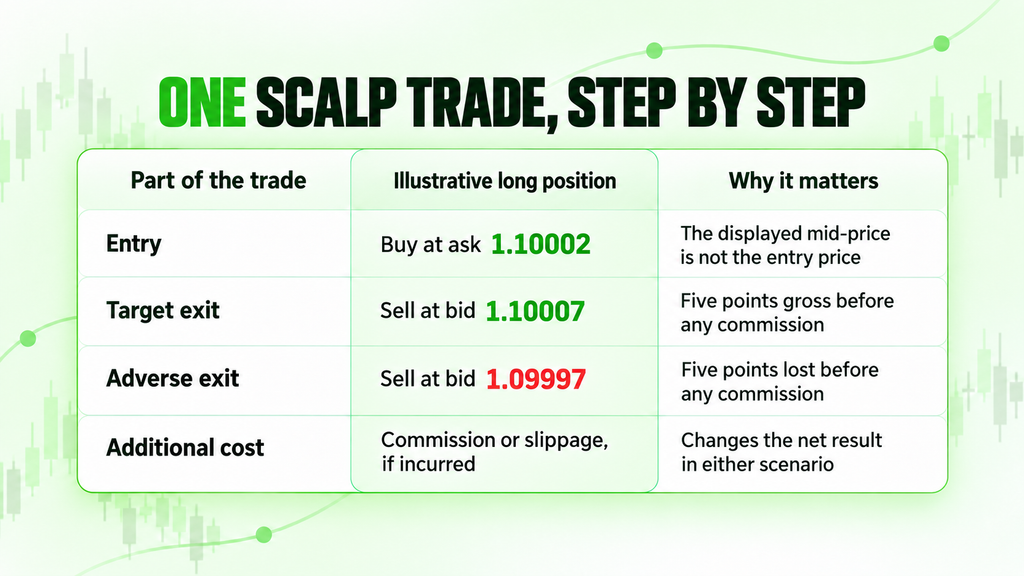
Consider these made-up EUR/USD quotes with example prices of 1.10000 bid and 1.10002 ask. Here a point means the fifth decimal place, or one-tenth of a pip. A long position bought at the ask needs to overcome that two-point gap. If the bid rises to 1.10007, the gross gain is five points, or 0.5 pip. If it falls to 1.09997, the loss is five points. Commission, if charged, changes both outcomes. These are invented prices, not live quotes.
Execution changes the result
Real-time data helps a trader follow price moves, but it can’t guarantee a fill. A limit order sets a price limit, but it may not fill. A market order prioritises getting filled without promising a price. That difference matters when you decide to buy or sell in a fast move. A stop-loss may fill beyond its trigger. Mobile Versus Trade MT5 access can help you monitor the market and an open position, subject to connection quality. Even capable trading platforms can’t remove the delay between sending an order and getting the execution back.
Forex scalping: liquidity in forex trading
In foreign exchange, forex scalpers tend to focus on active currency pairs. Liquidity and spreads vary by pair and by hour. Even when the spread is narrow, it can widen during a news release. A quiet stretch may offer little movement, while sudden market moves complicate the exit.
How a scalp plays out on the chart
Technical analysis helps organise a short chart, a higher timeframe, and predefined exits. An indicator summarises historical price behaviour. It doesn’t predict the next candle. Choppy price action can turn an apparently clear entry into a false signal.
Actual fills reveal if a fast idea works. After several quick trades, a winning chart pattern can still show a loss once execution and costs enter the record.
CEO and Co-Founder of Versus Trade—Vitalii Bulynin
Common scalping strategies
These scalping trading strategies spot different trading opportunities in the same market. You need more than a fast chart and a directional guess. The reasons to get in and out have to match the setup. A range strategy that works while prices stay contained can fall apart the moment the market starts trending.
Range scalping: trading the repeated turn
During a quiet session, a currency pair can bounce between two nearby levels. A range scalper watches for the price to drift toward one boundary, then looks for a turn back toward the middle. It works a bit like buying low and selling high inside a narrow band, except the exit usually gets planned before the opposite boundary. The full move may never arrive. A break beyond the original boundary kills the idea. Buying every dip without that failure point leaves you exposed when a new trend kicks in.
Momentum scalping: joining a move already under way
Momentum scalpers hunt for a burst of price movement backed by activity, maybe right after a market opens or a news release drops. They aim to capture a short slice of the move, not its entire length. Entry timing decides a lot here. Chasing the fastest candles can mean buying at the same moment early traders are selling. A fading move and a reversal at the opening level can both force an early exit. A widening spread adds the same pressure.
Breakout scalping: watching a level give way
This trade starts when the price pushes past a level it has tested several times. Some traders wait for the move to hold beyond that level before jumping in. Others act on the initial break and accept a higher chance of a false signal. The exit can come fast if the price falls back inside the old range. A breakout during thin trading can be little more than a brief gap in available orders.
Tick scalping: the narrowest target
What is tick scalping? A tick is an instrument’s minimum price increment. Tick scalpers want a move of only a few such increments, sometimes within seconds. A tick does not equal net profit. The spread and commission still come out of the trade, and slippage adds more cost. This style leaves the least room for an imperfect entry or a delayed exit, and it leans heavily on the instrument’s liquidity.
Scalping in crypto trading: a market that keeps moving
Digital assets trade around the clock on the underlying crypto venues. CFD hours may differ. Liquidations and headlines can suddenly change the pace and push a stop-loss beyond its intended fill.
Buying a token on an exchange differs from trading a crypto CFD, which tracks price without giving you ownership. Spread and leverage both shape the CFD result. Financing terms add their own weight. Even if the token gains value, the CFD account outcome depends on its own trading conditions. Holding positions beyond the intended minutes also brings financing terms into focus.
You can open a professional trading account for scalping within the Pro and Raw Spread range. Their starting spreads and commission structures differ. A lower starting spread does not automatically mean a lower all-in cost.
Scalping in stock trading: what stock scalping involves
Individual stocks can move sharply around an earnings release or at the start of their trading day. That initial rush attracts day traders looking for a quick entry and exit, but high trading volumes do not guarantee a narrow spread at every moment. A market order sent into a fast move can fill far from the price you saw right before submitting. Thinly traded shares get even trickier. A large number of shares may not be available at the quoted price.
Stock scalping through a securities account means buying and selling actual shares. Scalping a stock CFD means trading a contract tied to the share’s price. The differences cover ownership, fees, leverage, available hours, and the rights attached to a position. Stocks and forex can both be traded through CFDs, but the trading hours, liquidity, and underlying markets differ. Versus Trade describes its share instruments as CFDs, so talking about scalping shares on the platform should not imply ownership of the underlying stock.
Explore Versus Trade’s available markets and see which trading conditions fit your approach.
Trade XAUUSD with spreads from 2.4p and zero commission per lot. When gold moves, trading costs shouldn’t steal the spotlight.

Scalping in options trading: another layer of pricing
An option has its own premium and bid-ask spread. Its price also responds to the underlying security, expected volatility, and time remaining until expiry. A scalper can get the stock direction right yet see a disappointing option result because the option’s spread is wide or its premium responds less than expected.
This section explains options trading as a separate market. The Versus Trade instrument overview lists CFDs on several asset classes, but it does not confirm that exchange-traded options are available on the platform. The account and instrument specifications determine what you can trade. The same distinction applies when a commodity or share CFD gets discussed alongside its underlying market.
Account costs across markets
Forex traders can choose a trading account for forex scalping by comparing a complete round trip on Standard terms with the Pro and Raw Spread alternatives. A published “from” spread is a possible minimum, not a fixed cost on every trade.
How scalping fits in day trading
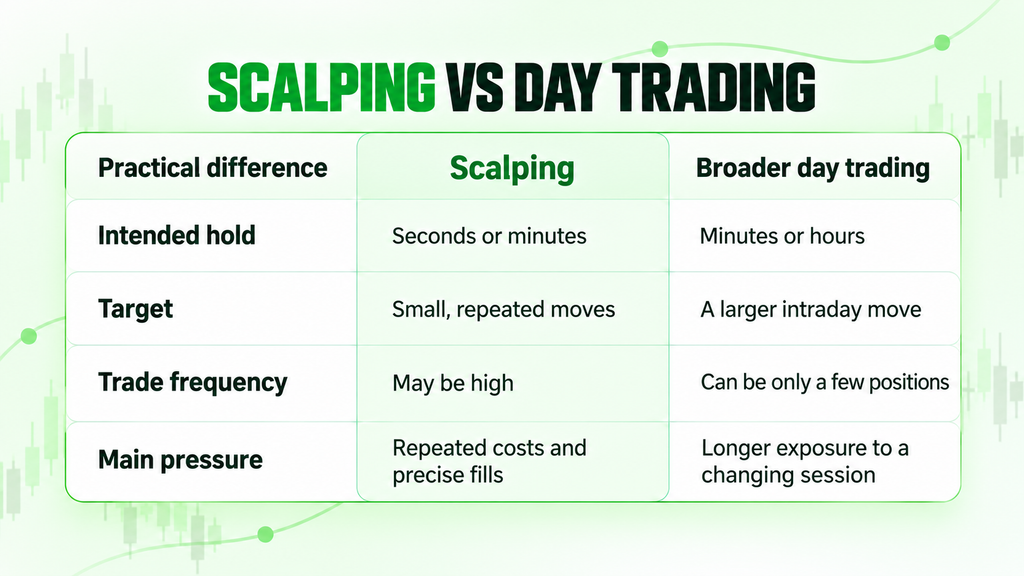
Both trading styles usually close positions the same day. A day trader may hold one trade for hours. A scalper targets a smaller move over seconds or minutes. Neither label implies profit.
The pluses and minuses of scalping
A scalping trading day looks nothing like a typical session. You hold positions for minutes, sometimes seconds, but you make far more decisions than a swing trader, and every one of those decisions carries a cost. Looked at together, the appeal and the drawbacks sit side by side.
Advantages
- Less time exposed to any single move. When you plan to be in and out within minutes, you avoid holding through overnight news or a broader market shift. But a fast intraday spike can still blow past your exit.
- More chances to trade in a single session. You don’t sit around waiting for a week-long trend. Ranges, opening bursts, and momentum spikes offer separate opportunities, as long as each one has a clear entry and a point where you know it failed.
- Every attempt ends with a clear outcome. A small profit target and a tight stop make each trade easy to log and compare. That clarity only pays off if you actually stick to the plan and check your fills.
Disadvantages
- Costs stack up quickly. Each new position pays the spread, and maybe commission too. A method built on many small wins can end up red once you subtract those costs.
- You have almost no time to react. The price you see on screen can move before your order reaches the market. In fast conditions, slippage and missed fills hurt more.
- A single loss can wipe out a string of wins. Small targets can tempt you to hold a loser and pray for a bounce. Add leverage, and that choice gets very expensive.
- You need to stay glued to the screen. Watching ticks for hours and making snap calls is exhausting. If you’re also doing other work, you’ll probably miss your exit.
When scalping, what is meant by an exit strategy is more than a price target on a chart. It covers the level where the setup breaks, the most you’re willing to lose, and what you’ll do if your order doesn’t get filled.
Risk management for a small scalp target
Scalping requires more than a high win rate. Successful scalping requires attention to losses: for scalp traders, one large loss can erase several gains. Leverage cuts both ways, and the number of trades you make keeps pushing costs up.
The urge to trade constantly can push you into a rushed entry after you miss a setup.
an American financier and trader—Linda Bradford Raschke
Source: An interview for MarketWatch, November 22, 2025
When a quick trade turns into an overnight position
If you want to open a swap-free trading account, keep in mind that the account type and the swap-free status aren’t the same thing. Versus Trade applies that status across an eligible client’s accounts, but the instruments covered depend on the terms. Swap-free terms concern eligible overnight positions. They do not, by themselves, lower the cost of a scalp closed within minutes.
A trading idea only works if you can execute it cleanly:
- Specify the market, session, price level, and trigger for the trade.
- Add up the full cost: live spread, commissions both ways, and a cushion for imperfect fills.
- Decide where the idea fails, and estimate the loss if the stop gets filled beyond that level. Then connect that to position size.
- Compare planned entry and exit levels with actual fills. Don’t grade the strategy from a chart after the fact.
A chart from the past can make a setup look better than it really was live. Demo trading helps establish a routine, but simulated fills may not reproduce live execution and liquidity.
The math behind scalping profits
Whether scalping works for you depends on how big your wins and losses are, not just how often you win. Ten trades that each gain 3 points give you 30 points before costs. One 20-point loss plus repeated spreads can eat most of that. A small profit on each winning trade says very little about your whole session. What counts is the net result across many trades after commissions, slippage, and losing trades. Even a pretty chart setup fails when its target is less than the round-trip cost of getting in and out.
Where scalping sits within Malaysia’s rules
Malaysia separates market conduct rules from product eligibility rules. There’s no blanket ban on closing a position after a few seconds or minutes. Frequent buying and selling is not the same as false trading, rigging, or manipulation. The Securities Commission Malaysia has taken enforcement action over false trading and stock market manipulation. Those bans target the behavior, no matter what label you put on it.
The instrument also changes things. Selling shares you already own is different from short-selling them. Bursa Malaysia has its own rules for regulated short selling, including an approved-securities list. The SC Investment Checker lets you check whether a firm is authorised to offer capital-market products and services in Malaysia.
The Securities Commission Malaysia states that CFDs in its domestic framework are only open to sophisticated investors. Being allowed to scalp does not get around the eligibility rules for the product or the provider.
What it takes to keep up with fast trades
When you start scalping, you run into a pace that demands full attention, fast execution, and the stomach to take a loss when the setup breaks. The smaller gains on offer come with repeated spread costs, shifting liquidity, and decisions made under time pressure. Without time to watch an active market, even a decent plan can be tough to execute.
Versus Trade provides various CFD markets and account types, subject to eligibility. The specifics of each instrument, including its costs, decide whether a fast idea can survive a move against you.
Check Versus Trade’s account options and trading costs before you trade.
- The mechanics of a scalp trade
- Forex scalping: liquidity in forex trading
- Common scalping strategies
- Scalping in crypto trading: a market that keeps moving
- Scalping in stock trading: what stock scalping involves
- Scalping in options trading: another layer of pricing
- How scalping fits in day trading
- The pluses and minuses of scalping