- The lifestyle genre
- The research: what actually happens when people day trade for a living
- Small-capital tutorials: a more honest starting point
- What is day trading (and scalping), really?
- Comparison content: day trading vs. the alternatives
- The honest takes
- What Indonesian traders are watching
- Common mistakes new day traders make
- How to day trade responsibly: 4 practical steps
- Is day trading worth it? Weighing it honestly
- Conclusion: trade the base rate, not the highlight reel
Search “day trader,” and the algorithm serves up two very different genres back to back: a 29-year-old showing off a Manhattan apartment funded by day trading, and, a few results down, someone asking, in a much smaller font, whether you can even do this with a normal job.
Both are real content categories with millions of views. Only one of them is backed by a large academic study of what actually happened when ordinary people tried to day trade for a living.
The lifestyle genre
“Day In The Life Of A 29 Year Old Millionaire Day Trader In NYC” (Craig Percoco, YouTube), “Day in the Life of the Richest DayTrader on YouTube” (OpTicBigTymeR, YouTube), and “The Oldest Daytrader Made Millions!!!” (Mike Ser Trader, YouTube) are all variations on the same format: day trading as an achieved lifestyle, presented after the fact.
It’s aspirational content, and it’s genuinely popular, but survivorship bias is built into the format. Nobody uploads “Day In The Life Of The Trader Who Lost Money,” even though the research below suggests that’s the far more common outcome.
The research: what actually happens when people day trade for a living
Some of the strongest large-sample evidence available doesn’t come from a testimonial. It comes from Brazil’s futures exchange.
Economists Fernando Chague, Rodrigo De-Losso, and Bruno Giovannetti tracked every individual who began day trading equity futures on the Brazilian exchange between 2013 and 2015, a genuinely large, unfiltered sample rather than a self-selected survey. Among those who persisted for more than 300 days, 97% lost money. Only 1.1% earned more than a Brazilian minimum wage from their trading, and just 0.5% out-earned the starting salary of a bank teller, while experiencing highly volatile daily results.
The study found no evidence that traders in its sample improved with more experience (Chague, De-Losso & Giovannetti, “Day Trading for a Living?”, FEA-USP working paper / SSRN, 2019, revised 2020). This is the number the lifestyle genre never puts in a thumbnail.
Small-capital tutorials: a more honest starting point
A more grounded corner of this niche starts small on purpose. “How To Start Day Trading With Only $50” (Scarface Trades, YouTube) and “How To Day Trade Using Only $20 Of Risk” (The Rumers, YouTube) both frame day trading as a skill to practice with money you can afford to lose rather than a shortcut to the lifestyle content above.
It’s a meaningfully different pitch and closer to the caution suggested by the Brazilian data than the millionaire-lifestyle pitch.
What is day trading (and scalping), really?
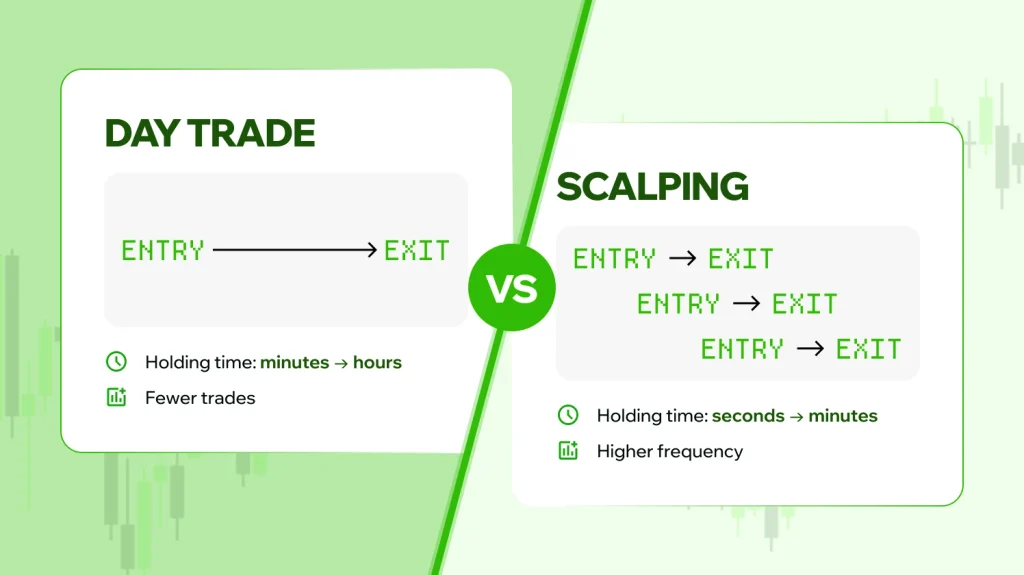
Stripped of the lifestyle branding, day trading just means opening and closing positions within the same session. No overnight risk, no multi-day thesis. “What is Day Trading? (really)” (Mind Math Money, YouTube) covers this plainly.
Scalping is day trading’s more extreme cousin: “Scalping Trading for Beginners” (Mind Math Money, YouTube) describes holding periods measured in seconds to minutes, chasing small, frequent moves rather than one large one, with higher trade frequency and typically greater sensitivity to spreads and commissions, which can eat into each small gain.
Whether a search leans toward “daytrading” as one word or “day trading” as two, or toward “what is scalping in trading” specifically, the underlying question is the same: how short is too short a holding period to trade profitably after costs?
Comparison content: day trading vs. the alternatives
“DAY TRADER vs SWING TRADER vs INDEX INVESTOR — THE REAL MATH” (Wealth Logic, YouTube) puts day trading side by side with slower alternatives rather than selling it in isolation, a useful format since the Brazilian study above establishes a harsh baseline for day trading, even though it does not directly compare the alternatives.
The honest takes
“Can You Actually Day Trade With a 9-5? (My Honest Take)” (Usman Ashraf, YouTube) and “How to Start Day Trading from ZERO” (Ross Cameron – Warrior Trading, YouTube) both address the time-commitment question directly rather than assuming unlimited screen time. Discretionary day trading often requires being present during active market hours, which is a genuine structural barrier the lifestyle genre tends to skip past.
What Indonesian traders are watching
“Tips Agar Trader Saham Pemula Jadi Naik Kelas,” part of Stockbit’s creator-interview series (Stockbit, YouTube), takes a mentorship angle aimed at beginner stock traders rather than the solo-lifestyle format common in English-language content.
On the broker side, “Top 10 Best Scalping Brokers in Indonesia for MAXIMUM Profits 2025” (TOP FOREX BROKERS REVIEW, YouTube) shows the local search intent is often less “what is scalping” and more “where do I do this,” which is worth keeping in mind because a high place in a listicle says little about whether a broker is properly regulated or how its withdrawal process works.
Common mistakes new day traders make
- Judging the strategy by lifestyle content instead of the base rate. The Brazilian study’s finding that 97% of persistent traders lost money is far more representative of its sample than any single highlight-reel upload.
- Scalping without accounting for costs. Spreads and commissions matter far more when the average target move is small; a strategy that looks profitable gross can be a loser net of costs.
- Treating day trading as compatible with a full-time job by default. Discretionary trading often requires being present during live market hours, which is a real scheduling constraint.
- Sizing positions to a dollar income target rather than a risk percentage. Сhasing “$1,000 a day” regardless of account size is how small accounts take outsized, avoidable risk.
How to day trade responsibly: 4 practical steps
- Step 1. Practice on a demo account or with genuinely small, at-risk capital (in the spirit of the $20–$50 tutorials above) before scaling up.
- Step 2. Pick one strategy style (trend, scalping, or momentum) and master it before adding more. Switching styles constantly is a common way to never build a repeatable edge.
- Step 3. Track results over hundreds of trades, not a handful of wins. The Brazilian study’s headline finding only shows up over long samples; a good week proves very little.
- Step 4. Reassess honestly at the 3–6 month mark against the base rate above, not against a single good month.
Is day trading worth it? Weighing it honestly
The advantages: No routine overnight exposure when positions are closed as planned, more frequent performance feedback, and the ability to finish each session without holding positions overnight. Markets like forex and, where legally permitted, crypto CFDs may be accessible with relatively small capital through a regulated broker.
The limitations: The Brazilian study found that only about 1 in 100 persistent traders earned more than the local minimum wage, while roughly 3% finished with a positive net result. Scalping compounds this with cost sensitivity. And the format that dominates search results, the lifestyle upload, is the least representative example of what day trading actually looks like for most people who try it.
CEO & Co-Founder, Versus Trade – Vitalii Bulynin
(paraphrased from FXStreet interview, July 15, 2026)
Conclusion: trade the base rate, not the highlight reel
Day trading and scalping are real, learnable skills, but the best available large-sample evidence says sustained profitability was rare in the Brazilian sample, and the researchers found no evidence of improvement with experience. The lifestyle genre shows a small successful minority; the small-capital tutorials and honest takes are a more grounded starting point for any day trader just getting started.
Practice small, track everything over a long enough sample to mean something, and measure your results against the documented base rate, not the highlight reel. If you’re serious about learning how to day trade, start with the data and work from there.
Risk disclaimer: CFDs are high-risk instruments, and leverage can rapidly amplify losses. Available protections depend on the broker and jurisdiction. This article is educational content, not financial advice.
Every pip counts. Trade with paper-thin spreads built to keep more of every market move in your hands.

Note on sourcing: citations appear inline next to the claim they support. Video citations are based on each video’s title and description, not verbatim transcripts. The day trading profitability statistic is drawn from Chague, De-Losso & Giovannetti, “Day Trading for a Living?” (Brazilian Review of Finance / SSRN, 2019), a peer-reviewed study of the full population of new day traders on Brazil’s BM&FBovespa exchange. The Versus Trade reference is paraphrased from a named, on-record interview (FXStreet, July 15, 2026), since the original remarks were reported in indirect speech.
- The lifestyle genre
- The research: what actually happens when people day trade for a living
- Small-capital tutorials: a more honest starting point
- What is day trading (and scalping), really?
- Comparison content: day trading vs. the alternatives
- The honest takes
- What Indonesian traders are watching
- Common mistakes new day traders make
- How to day trade responsibly: 4 practical steps
- Is day trading worth it? Weighing it honestly
- Conclusion: trade the base rate, not the highlight reel