- What is Microsoft vs Apple?
- Why trade Microsoft vs Apple instead of MSFT or AAPL on their own?
- How the Microsoft vs Apple price moves
- Microsoft vs Apple stock price
- Microsoft vs Apple market cap
- Market cap: Apple vs Microsoft
- Apple vs Microsoft: Which is better?
- Microsoft vs Apple: the two sides
- When to trade Microsoft vs Apple
- Trading conditions for Microsoft vs Apple
- Microsoft vs Apple FAQ
- Trade Apple vs Microsoft
Microsoft vs Apple is a Versus Pair, a single instrument built by Versus Trade that sets MSFT against AAPL and asks one question: which of the two climbs more? They have different customer focuses, Microsoft on businesses and Apple on consumers, and their shares have taken turns outperforming each other for years. Back the company you think comes out ahead and trade that view in one position. Two giants, one symbol, only at Versus Trade.
What is Microsoft vs Apple?
Microsoft vs Apple (symbol MSFTvsAAPL) is one CFD that holds two stocks in a single price. Microsoft sits as the base and Apple as the quote, so the symbol behaves like a currency pair: you buy or sell Microsoft, priced in Apple shares rather than dollars.
Buy the pair to back Microsoft rising more in percentage terms than Apple across your holding period. Sell it to back Apple, rising more than Microsoft. The order of the two names is fixed, so a search for AAPL vs MSFT lands on this same instrument seen from the Sell side, and no mirrored second product exists. Ticker shorthand points here too: MSFT vs AAPL, AAPL vs MSFT. You open and close it like any other CFD position, with its own live price and its own chart in MT5.
Why trade Microsoft vs Apple instead of MSFT or AAPL on their own?
Buying MSFT on its own, or AAPL on its own, is a bet on that one share price climbing against the dollar. With these two names there is a wrinkle. Both sit near the top of the Nasdaq, both get traded by the same index funds, and both answer to the same rate decisions. On plenty of sessions they rise and fall together, so a single-stock position remains exposed to broader Nasdaq market moves.
Microsoft vs Apple asks something narrower. Its price reflects which of the two performs better in percentage terms, so much of the shared move cancels out, and the gap between the two companies is what you hold. The call you need is on Microsoft against Apple, not on the direction of the sector. The pair gives you that Microsoft or Apple read without asking you to forecast the whole sector.
Placing that view without the pair takes two positions: long one stock and short the other, sized to match and margined separately. Versus Trade built it as one instrument, one order to place and one position to manage, and no other broker lists it. Leverage and relative moves cut both ways, so a wrong read costs you the same way a right one pays.
Microsoft vs Apple. Bitcoin vs Gold. Nasdaq 100 vs Oil. With Versus Pairs, you decide which side comes out stronger.

How the Microsoft vs Apple price moves
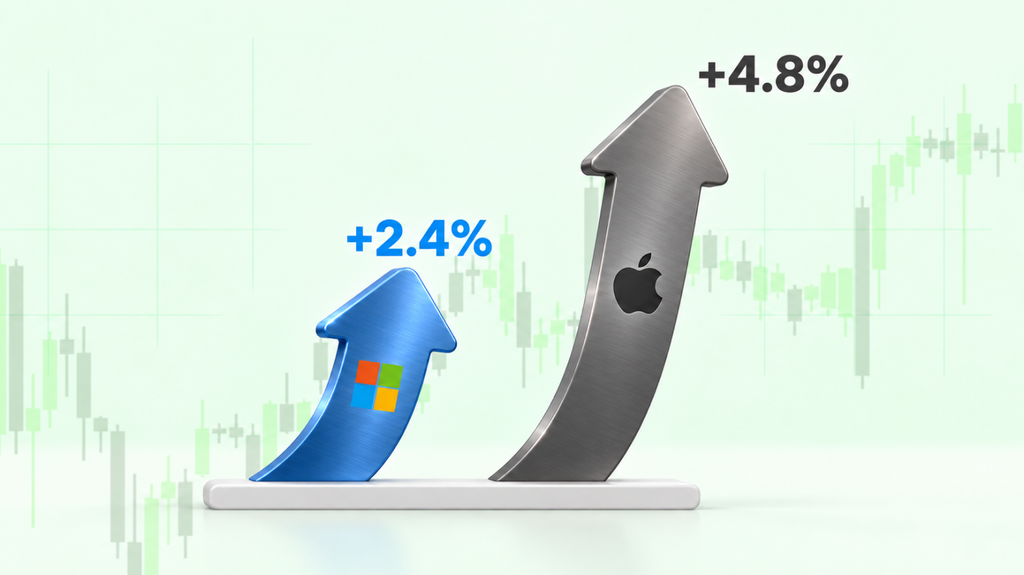
The quote is one number divided by another: the Microsoft share price divided by the Apple share price. Say Microsoft trades near 420 and Apple near 210. The pair prints around 2.0, meaning one Microsoft share is worth about two Apple shares at that moment. Percentage performance drives that number, and dollar amounts on their own tell you little.
A hypothetical example to show the calculation. These figures are illustrative, not a forecast. Suppose both stocks add 10 dollars in the same session. For Microsoft, 420 to 430 is a gain of about 2.4%. For Apple, 210 to 220 is a gain of about 4.8%. Same 10 dollars, double the percentage on Apple, so the pair slips from about 2.0 to about 1.95. Anyone holding a Buy is down on the day even though Microsoft closed higher, because the pair tracks relative performance.
Profit or loss is calculated in the quote asset first and then converted into your account currency for display in the terminal.
Microsoft vs Apple stock price
One habit worth dropping before you trade this pair: reading the two share prices as if the higher number belongs to the stronger company. The Microsoft vs Apple stock price ratio changes with relative percentage moves from wherever each stock starts, so a 400-dollar share and a 200-dollar share sit on level ground the moment a position opens. Any stock price comparison in raw dollars is arithmetic alone. What changes your P&L is the percentage gap. When you read stock prices side by side, the bigger number does not mean much.
Microsoft vs Apple market cap
The Microsoft vs Apple market cap comparison also depends on the number of shares outstanding. The two companies have swapped the title of most valuable company more than once.
Market cap: Apple vs Microsoft
The AAPL stock market cap and Microsoft’s valuation don’t stay static. The pair’s chart in MT5 shows the share-price ratio, not the market-cap gap. One line instead of two stock-price charts held side by side.
Apple vs Microsoft: Which is better?
Traders argue endlessly about which is better, and the argument never settles. The pair turns the opinion into a position: back your answer with a Buy or a Sell, set your risk, and let the percentage gap decide.
Try strategies, explore MT5 and get a feel for the markets with a demo account before putting real capital on the line.

Microsoft vs Apple: the two sides
That gap exists because the two companies run on different engines. Microsoft earns most of its money from businesses: cloud contracts, enterprise software, and licences that renew on a schedule. Its share price reacts to corporate IT budgets, cloud growth rates, and the spending cycle behind AI infrastructure. Traders following MSFT stock valuation are watching how much future enterprise growth already sits in the price. The Apple vs Microsoft revenue comparison highlights their different business mixes: enterprise software and cloud services on one side and hardware and consumer services on the other.
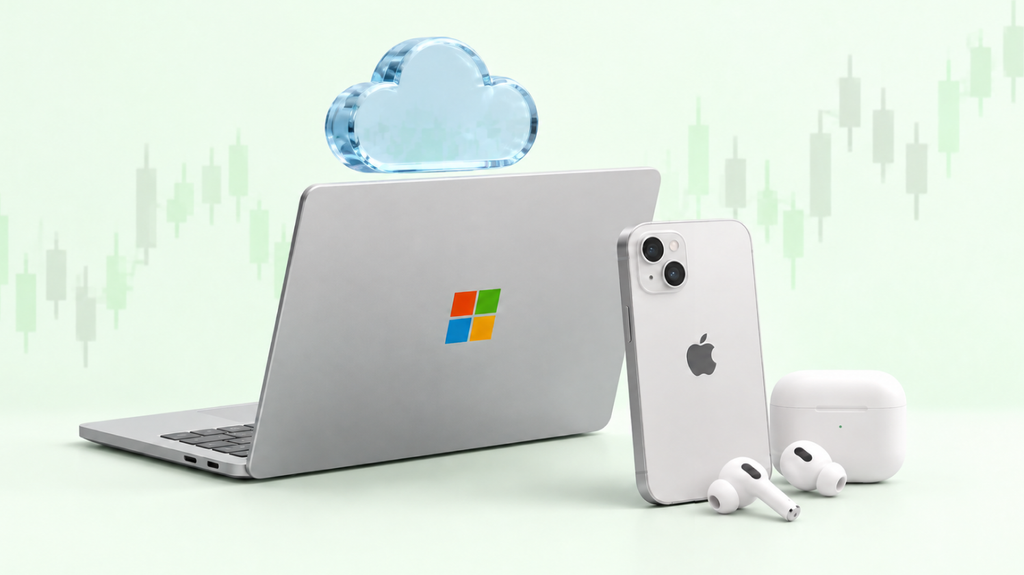
Apple sells to people. Its business depends on hardware cycles, launch events, upgrade rates, services attached to a billion-plus devices, and demand in China. The Apple stock price moves on consumer appetite and product news in a way Microsoft’s rarely does.
Two different business models pull their share prices apart often enough to trade, even though both are heavyweights in the same Nasdaq index. Buy Microsoft vs Apple when you think the enterprise and cloud engine leads over your window, and in that case you are betting MSFT stock performance outruns AAPL stock performance. Sell it when you back the consumer cycle and Apple’s services growth is running harder. Neither side is the quiet one. Both stocks move sharply on their own news.
When to trade Microsoft vs Apple
Earnings season, sector rotation, and valuation arguments give this pair most of its movement. Three setups, each ending in a side and a next step rather than a price call.
Scenario 1: The earnings split
- Situation: One company reports, the market likes the numbers, and the other disappoints or has not reported yet.
- The trade: Backing Microsoft to pull ahead in percentage terms over the sessions that follow is a Buy. Backing Apple is a Sell.
- Action: Open it on demo through the earnings window to see how wide the gap runs or go live with a stop-loss and take-profit set before the print.
Scenario 2: Rotation inside Big Tech
- Situation: Money moves between the enterprise and AI infrastructure names and the consumer-facing ones, often on rate expectations or a shift in spending data.
- The trade: Reading the rotation as favoring corporate software spend is a Buy. Reading it as favoring consumer demand is a Sell. Broad tech can rise or fall through the move, and the pair tracks only which of the two runs faster.
- Action: Place it on demo while both stocks travel the same way, then size a live position to your own risk limits.
Scenario 3: The valuation and market cap view
- Situation: You think one of the two carries a richer multiple than its growth supports, or you are watching the market cap lead change hands again.
- The trade: If you have been asking, “Should I invest in Apple or Microsoft for the longer term?” that view is a Buy or a Sell here, one order instead of two positions.
- Action: Run it on demo across a few weeks to see how slowly the gap grinds and then decide on a live position with your own stops.
Trading conditions for Microsoft vs Apple
- Platform: Versus Trade MT5 on desktop, WebTrader, Android, and iOS, with every MT5 indicator and drawing tool working on the pair.
- Leverage: 1:20, which means a 5% margin requirement for stock Versus Pairs.
- Swap-free: No overnight swaps on this pair or any other Versus Pair.
- Spreads: Floating, sitting roughly in proportion to the spreads of the two underlying stocks, with small differences possible by direction and volatility.
- Pricing: Taken from the real-time feeds of both stocks, so a move in either stock is immediately reflected in the pair’s price.
- Trading hours: 16:35 to 22:59 server time (GMT+3) on weekdays, and the pair trades only while both stocks are active in the market.
- Dividends: The Microsoft vs Apple dividend calendar is worth watching, because both the AAPL stock dividend and the MSFT stock dividend dates trigger adjustments on the pair, with the direction depending on whether your position is long or short.
- Demo: Available on a free demo account with real-time pricing.
- History: Price data since the April 2024 launch of Versus Trade.
Microsoft vs Apple FAQ
Is Microsoft vs Apple a tradable instrument or a comparison of two stocks?
A tradable instrument: a CFD listed by Versus Trade with a live bid and ask, traded in MT5 like any other symbol.
Do I own Apple or Microsoft shares when I trade this pair?
No. Versus Pairs are CFDs, so there is no ownership of either stock and no shareholder rights. You hold a contract on the price relationship.
Both stocks closed higher today, so why did my position lose?
The pair reads percentages rather than direction. If Apple gained 3% while Microsoft gained 1%, the pair fell even though both stocks rose, and a Buy lost value over the day.
Are there dividend adjustments on Microsoft vs Apple?
Yes. Both companies pay dividends, so the pair carries dividend adjustments applied according to the broker’s contract specifications and the direction of your position. As with other CFDs, an adjustment can land in your favor or against you.
Is the Microsoft vs Apple swap-free?
Yes. The whole Versus Pairs group carries no overnight swap charges.
How does 1:20 leverage work on this pair?
It means a 5% margin requirement, so a position is backed by a fraction of its full value. Leverage scales losses at the same rate as gains, so a small move against your side is magnified in your account.
Can I back Apple rather than Microsoft?
Yes, that is the Sell side of the same instrument. Both views can be traded through the same symbol.
Should I invest in Microsoft or Apple?
That call stays with you. The pair gives the view a home: Buy to back Microsoft and Sell to back Apple. Versus Trade publishes no forecast on which company leads, and the outcome is yours to manage. If you are deciding between Microsoft and Apple as a longer-term holding, the pair is the place to express that opinion without owning either stock.
Why can I only trade it during certain hours?
Trading in both underlying stocks must be open for the pair to be priced. Trading runs from 16:35 to 22:59 server time on weekdays, and if either stock is halted, the pair is unavailable until both are active.
Can I test it before risking money?
Yes. Every Versus Pair is available on a free demo account with real-time pricing, so you can test the setup, apply your own indicators, and see how the gap behaves before funding an account.
Trade Apple vs Microsoft
Two giants, one symbol, only at Versus Trade. Open Apple vs Microsoft in MetaTrader 5 and put your view on these two companies into a single position. If relative-percentage pricing is new to you, load the pair on a free demo and watch a few earnings days play out first.
Risk disclaimer: CFDs are complex instruments and carry a high risk of losing money rapidly through leverage. Versus Pairs track the relative percentage performance of two assets, and both leverage and relative moves work against a position as readily as for it. Nothing above is trading advice or a forecast of which company will lead. Trade only with money you can afford to lose.
- What is Microsoft vs Apple?
- Why trade Microsoft vs Apple instead of MSFT or AAPL on their own?
- How the Microsoft vs Apple price moves
- Microsoft vs Apple stock price
- Microsoft vs Apple market cap
- Market cap: Apple vs Microsoft
- Apple vs Microsoft: Which is better?
- Microsoft vs Apple: the two sides
- When to trade Microsoft vs Apple
- Trading conditions for Microsoft vs Apple
- Microsoft vs Apple FAQ
- Trade Apple vs Microsoft