
Cent Account in Forex and How It Works in Trading


A first live trade can feel disproportionately large. Real money changes how a trader reads price, follows a plan, and reacts to a loss. A cent account reduces that monetary scale by displaying the balance in cents.
That makes a cent account in forex a possible bridge between simulation and a conventional live account. It does not remove market risk or create a special trading strategy. Versus Trade provides a Cent account with a $10 minimum deposit, MetaTrader 5 access, and trading in forex and metals. The balance currency is USC, so the platform displays US cents rather than US dollars.
What is a cent account in forex?
A forex cent account is a live trading account in which monetary values are displayed in cents. On the Versus Trade Cent account, the currency code is USC. A $10 balance is therefore shown as 1,000 USC, while a deposit of 100 USD would appear as 10,000 USC. The conversion changes the display unit, not the purchasing power of the money.
The phrases “account cent” and “trading cent account” sometimes appear in translated broker menus. Cash retains its economic value, while the platform presents the account balance, equity, margin, and profit and loss in smaller units.
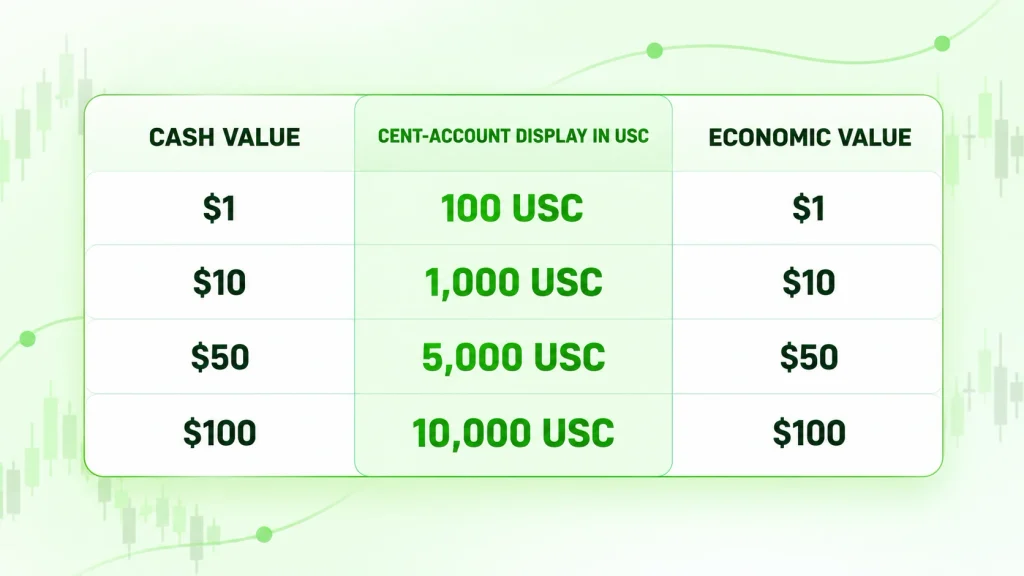
A balance of 10,000 USC is $100, not $10,000. Profit, loss, and margin figures use the same conversion.
A cent denomination does not define the contract
Account denomination and trade volume are separate. In retail forex, a standard lot generally represents 100,000 units of the base currency, but brokers can use smaller cent-lot conventions or different contract sizes for particular account types. The label 0.01 lot therefore has meaning only alongside the instrument specification.
The instrument specification shows contract size, volume step, tick value, and margin calculation. A position-size calculator can translate a stop distance and cash risk into volume, but its inputs must match those terms. Treating every 0.01 entry as identical can produce a sizing error.
Enter the market accessibly. Start a Standard Account from just $10 and take it from there.

How a cent trading account works
The Versus Trade Cent account uses market execution through MetaTrader 5. Spreads, swaps, slippage, and margin rules still affect results, although the account has no trading commission.
Versus Trade says the account supports micro-lot trading, with lot sizes from 0.01 to 200. The same range appears for its Standard account, making the symbol specification essential when translating volume into financial exposure. The Cent account requires $10 and lists spreads from 1.4 pips.
From deposit to first position in cent trading
The process usually follows five stages:
- The trader opens a cent account in the Versus Trade Personal Area and completes the required verification.
- A deposit is represented in USC. For example, $25 appears as 2,500 USC.
- The trader selects a forex or metals instrument and reviews its contract size, spread and margin requirements.
- A position is opened from 0.01 lot, subject to the relevant symbol specification. Orders are placed through MetaTrader 5 using market execution, while profit and loss appear in USC.
- USC remains a display denomination: 100 USC represents $1 in account value.
This is trading with real money. Unlike demo trading, a cent order encounters live execution, funding rules, and emotional pressure. Smaller position sizes may reduce the monetary consequence of an unfavorable move, but they cannot make a live trade harmless.
Who is a cent account for?
Beginner traders often use cent accounts after they have learned platform controls in a demo environment. The format allows a new trader to experience actual gains, potential losses, and execution without committing the capital normally associated with larger positions. It can also reveal if a plan that looked easy in simulation remains manageable when money is involved.
Founder and CEO, Versus Trade — Vitalii Bulynin
Desire To Trade, June 28,2026.
A small live account can expose decisions that simulation may not reveal: moving a stop, closing a winner early, increasing volume after a loss, or abandoning a tested entry rule.
Experienced traders also use cent accounts to test trading systems or expert advisors under live conditions. An automated strategy may behave differently once real spreads, execution speed and slippage enter the record. The Versus Trade Cent account operates on MetaTrader 5 rather than MT4.
Typical users include:
- New traders moving from simulation to live trading
- Traders testing strategies with limited financial exposure
- Developers observing expert advisors under live conditions
- Experienced traders checking execution before allocating more capital
The same account can also be used to practice established forex trading strategies at a smaller monetary scale. It does not turn an untested idea into a reliable method.
Cent accounts let you try new trading strategies in a small way and see how they work in real market conditions. Using a cent account does not in itself limit financial exposure, but the amount placed at risk per trade can be reduced by using smaller position sizes. The Versus Trade account combines a $10 minimum deposit with live trading conditions on MetaTrader 5, making it a great option for those looking to start trading with a reputable broker.
The rules about deposits, contract sizes, and trade size vary between brokers offering cent accounts. These particulars dictate the degree of market exposure a 0.01 lot position engenders on each forex trading account.
Cent accounts are useful for both beginners and experienced traders. They can be used to see how Expert Advisors (EAs) and trading systems behave when trades are executed with live spreads and slippage. This record can help you make better trading decisions before you invest more money in a strategy.
Go from registration to trading with Versus Trade in 5 minutes.

Cent Account vs Standard Account
Both account types have a $10 deposit and list the same lot size range. The real separation comes from account currency, available markets, and pricing.
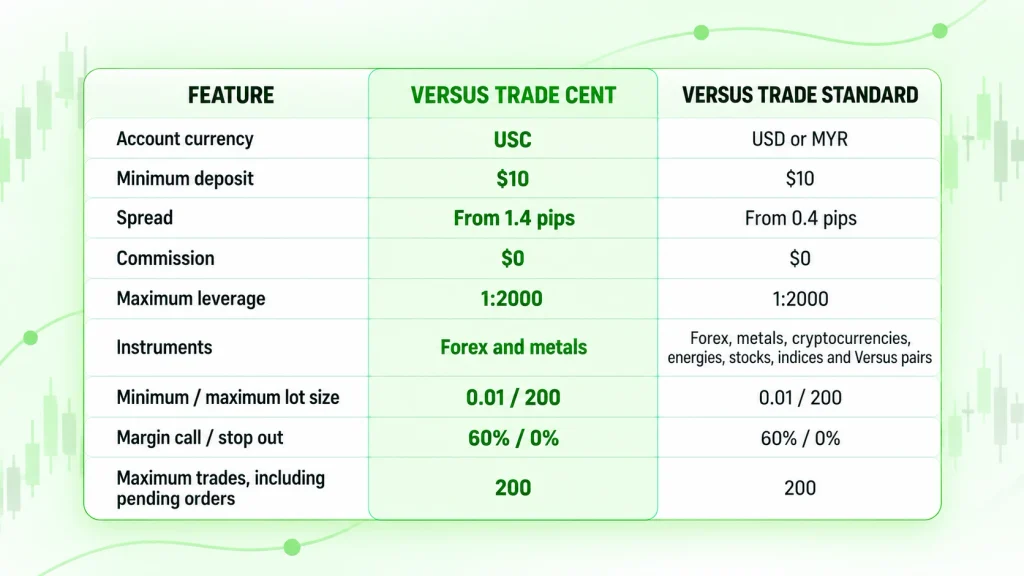
The Cent account narrows the market range and starts with a higher advertised spread. Its USC denomination shows changes in equity and profit in cents. This provides a more granular view of a small account balance. Clients may hold up to ten Cent accounts in one Personal Area. Islamic accounts and the swap-free programme are available subject to the relevant terms.
The requirement for either account is a defined entry, an invalidation point, a controlled position size, and a record of results. The account type affects the pricing and available markets, but not the discipline required to make trading decisions.
Comparing account figures
The account table settles headline numbers, while instrument specifications determine individual exposure:
- Contract size, minimum volume, and volume step, which together set your trade size
- Current spread and instrument-specific costs
- Swap or overnight financing terms
- Margin requirements and stop-out level
- The 200-order account limit
- Automated-trading permissions and client protections
The forex trading platform page provides a broader view of how currency instruments are accessed. Product specifications remain decisive because 0.01 lot is a platform volume, while its cash effect depends on the contract, currency pair, and price movement.
Risks and Limitations of Cent Accounts
Small deposits can create a false sense of safety. Leverage can control a position much larger than the margin, so a low balance does not prevent rapid losses. If you trade more than once, you might have to pay more money through spreads. You might also have to pay swap charges if you keep your position open overnight. Slippage may add to the cost of execution.
Losses do not always start with a wrong guess about the market. How you deal with things when you are under pressure can make a small price change into a big problem for your account. In The Fastest Way to Lose as a Trader Has Nothing to Do With Trading, Versus Trade explores this behavioural side of risk.
The founder and chairman, Caxton Associates — Bruce Kovne
quoted in Market Wizards: Interviews with Top Traders (John Wiley & Sons, 2012)
Kovner’s observation concerns position sizing, not cent accounts specifically. Large leverage, correlated positions, or an oversized trade can exhaust a small balance even when every figure is measured in cents.
The published Versus Trade terms reveal several practical limitations:
- Spreads on the Versus Trade Cent account start from 1.4 pips, compared with 0.4 pips on its Standard account
- Available markets are limited to forex and metals
- A combined account limit of 200 applies to open trades and pending orders.
- Cent-account results may not scale neatly to larger positions
Any reduction in financial risk depends on the position size you use. If you invest in smaller positions, you might be less affected by each market move, but you could still lose all your money. Trading capital remains money the trader can afford to lose. Versus Trade lists negative balance protection among the benefits of its accounts. What it covers depends on the rules, and it does not stop you from losing money up to the balance in your account.
Opening a Cent Account in Malaysia
The Versus Trade Cent account is available through the broker’s Personal Area after onboarding and client eligibility checks and subject to the terms presented during registration. It is denominated in USC, while MYR is listed as an available currency for the Standard account. Availability and promotion of such services is subject to separate regulatory scrutiny in Malaysia.
Before an application is completed, the broker’s legal name, regulator, client agreement, product disclosure, funding rules, and withdrawal process need to match the service being offered. The SC Investment Checker shows if a firm is authorised to offer capital-market products and services in Malaysia. The Investor Alert List is separate and non-exhaustive, so absence does not guarantee authorisation. CFDs and leveraged forex products also carry product-specific rules that are separate from the balance denomination.
Some traders first encounter an account through an educator, affiliate, or partner. An introducing broker partnership is a commercial referral arrangement and does not alter the trading account’s contract terms or remove the need to verify the provider.
How to assess whether the account fits
Opening a cent account makes sense only when its specifications support the intended use. A beginner may value the USC denomination and $10 entry point. A strategy tester may care more about MT5 execution data, expert-advisor support, and whether the same symbol specifications apply to the account intended for later use.
The $10 minimum deposit lets you start trading right away with a cent account. You don’t need a big balance to start testing strategies in real market conditions. The trading environment is real even when you’re trading with cent accounts.
Deposit and trade size requirements vary between forex accounts. Versus Trade’s Cent and Standard accounts have a margin call of 60% and stop-out level of 0%, but differ in currencies, spreads, and available markets. These conditions must be considered when comparing and testing account types.
Cent accounts do not eliminate the need to control risk per trade. Position size, leverage and market conditions still determine potential losses. Informed trading decisions are based on contract specifications, showing if the account fits the intended approach.
A Smaller Unit, Not a Different Market
A cent account changes how the balance is denominated and may also use a different contract structure, depending on the product specification. It does not change the direction of the forex market, eliminate trading costs or guarantee that a strategy will work. The balance is measured in cents, while the outcome still depends on price movement, position size, leverage and execution.
For traders looking for a step between demo accounts and standard trading accounts, that smaller-scale cent account offer can be useful. Its value lies in providing live trading experience while allowing the trader to test new trading strategies, keeping the initial allocation limited. For many traders, a cent account is an early step to real trading. Accurate contract reading and disciplined risk control remain more important than the number of digits shown in the account balance.