
How to Trade in Crude Oil When Headlines Move the Market


- How to trade in crude oil: three decisions before you place an order
- WTI and Brent crude respond to different pressures
- What an oil trading platform should show you clearly
- Oil trading hours in Malaysia
- Oil trading strategies depend on the market condition
- A barrel-based risk calculation
- From a demo record to live trading decisions
Tanker trouble could cause Brent to rise before breakfast in Kuala Lumpur. A surprise build in US crude inventories can send WTI sliding later that evening. Both moves have an effect on oil, but the drivers differ. The rules of your contract show you how a dollar move affects your position.
How to trade in crude oil: three decisions before you place an order
First, pick a benchmark, then choose your instrument, and set your position size to trade crude oil. On Versus Trade, oil sits within the broader commodities offering, but the real starting point is the specification attached to each symbol.
Crude oil trading starts with the contract
Three details will give shape to your position:
- The reference: WTI or Brent, with the contract month.
- The exposure: the number of barrels the order represents.
- Exit terms: trading breaks, expiry, rollover, and stop execution.
Directional trading involves speculating on price movements through instruments such as oil CFDs or oil futures. Producers and refiners also use derivatives. They use them to hedge their exposure. Buying and selling these financial tools does not mean owning physical oil. A contract for difference settles the change between your opening and closing values, subject to the terms and costs set by your broker.
Oil CFDs, futures, and funds
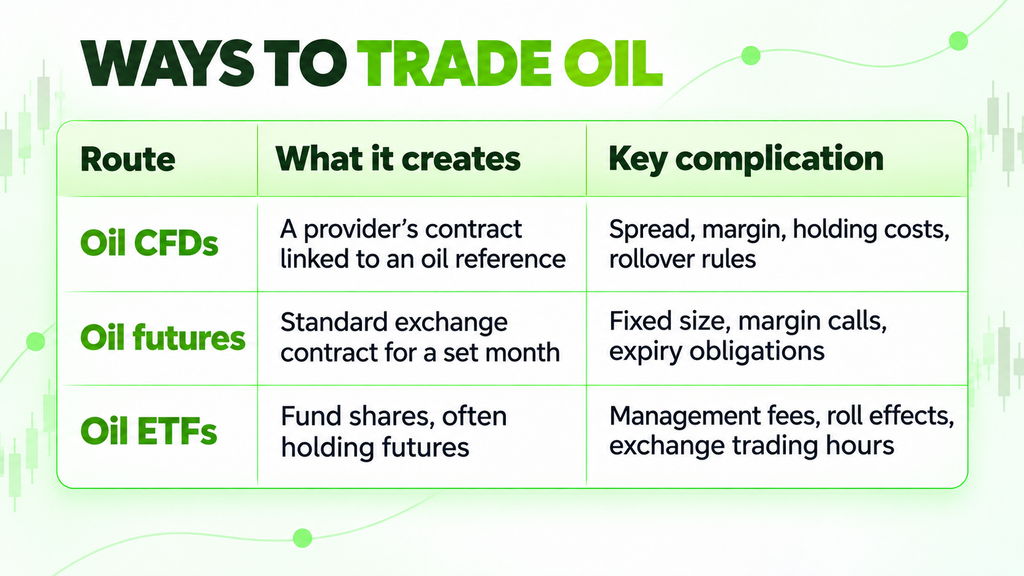
Unless you close out before expiry, holding a futures contract means you are on the hook for physical or cash settlement down the line. Delivery terms matter a lot if you’re trading oil futures. Take NYMEX WTI crude oil futures (1,000 barrels of oil per contract), for instance. A tiny one-cent tick per barrel moves your position value by $10 right away. Physical delivery happens at Cushing, Oklahoma. That contract follows CME’s specifications, not a similarly named CFD.
An oil ETF may gain exposure to oil through a chain of futures positions. Returns don’t always track the crude oil spot price. The price of shares in oil companies moves on debt, operating costs, and management decisions—not just the price of oil.
Go from registration to trading with Versus Trade in 5 minutes.

WTI and Brent crude respond to different pressures
West Texas Intermediate is a US light, sweet crude standard. Brent crude oil is a mix of North Sea grades and US WTI Midland, which was added in 2023. Not one of them provides coverage of every barrel that is traded across the global oil markets.
US inventory updates and refinery outages tend to drive WTI crude. On the flip side, shipping delays and ocean freight shortages hit Brent straight away. Spreads widen or shrink on shipping costs, export demand, and local supply – just make sure you match delivery months so contract date gaps don’t warp your comparison.
That same relative-price logic shows up in pairs trading on Versus Trade. But a Brent-versus-WTI idea doesn’t guarantee that specific oil pair is listed. The live instrument list decides which comparisons you can trade at all.
ICE’s standard Brent crude futures contract covers 1,000 barrels and allows exchange delivery alongside the option to settle against the ICE Brent Index. Calling all Brent futures purely cash-settled isn’t correct. The official exchange specification spells out the terms.
Why crude oil prices move beyond the headline
Supply and demand lay the groundwork for oil prices. Actual market swings, though, usually happen when headline news runs counter to what traders priced in. For example, if oil production goes up, the market has usually priced that move in well before the official release. Even a smaller rise than forecast can trigger a rally.
Refineries are responsible for a lot of the demand for crude oil. Maintenance can decrease their purchases while demand for heating oil remains strong. Natural gas has its own problems with storage and transport, so one trade cannot cover every part of the oil and gas sector.
It takes extra time for higher oil prices to encourage an increase in output from oil fields. A slowdown in industrial activity naturally cuts demand for oil. But since crude keeps moving from drillers to refiners and end-users, relying on just one inventory report will never give you the whole picture of the global oil market.
What an oil trading platform should show you clearly
The same chart can lead to very different exposures. On MT5, the symbol specification lists the contract size, minimum volume, volume step, trading sessions, and more. Margin requirements and any extra charges also determine whether an order fits in your trading account.
Discussing the copy-trading launch, Vitalii Bulynin said:
Co-Founder, Versus Trade—Vitalii Bulynin, Brokeree Solutions
The published statement concerns copy trading, not an oil forecast. So any platform help leaves the responsibility for exposure with you as the trader.
Take a look at our trading tools and account conditions with a contract and risk budget in mind.
Markets move fast. Get the flexibility to adjust your exposure and trade opportunities your way with leverage up to 1:2000.

Why costs can turn a right call into a losing trade
You can get the direction right and still lose money after costs. Short-term trading is especially sensitive to the bid-ask spread. Holding a position longer may add financing charges or other account-specific fees, and oil contracts linked to futures may need rollover treatment.
A quote labelled ‘cash’ is not necessarily the physical spot price. Providers often build their prices from futures references. That methodology matters when a new contract month takes over, because a chart adjustment doesn’t equal actual market buying and selling. The crude oil spot price isn’t something every CFD matches.
Our commodities CFD page gives the product context for oil & gas exposure. But the current symbol and account terms set the real costs, including any broker charges. Forex experience alone won’t tell you the barrel value of an oil lot, and trading platforms don’t all use the same contract size.
Oil trading hours in Malaysia
Malaysia keeps MYT (UTC+8) all year round. When the US shifts to daylight saving, the local times for American trading sessions and data releases change.
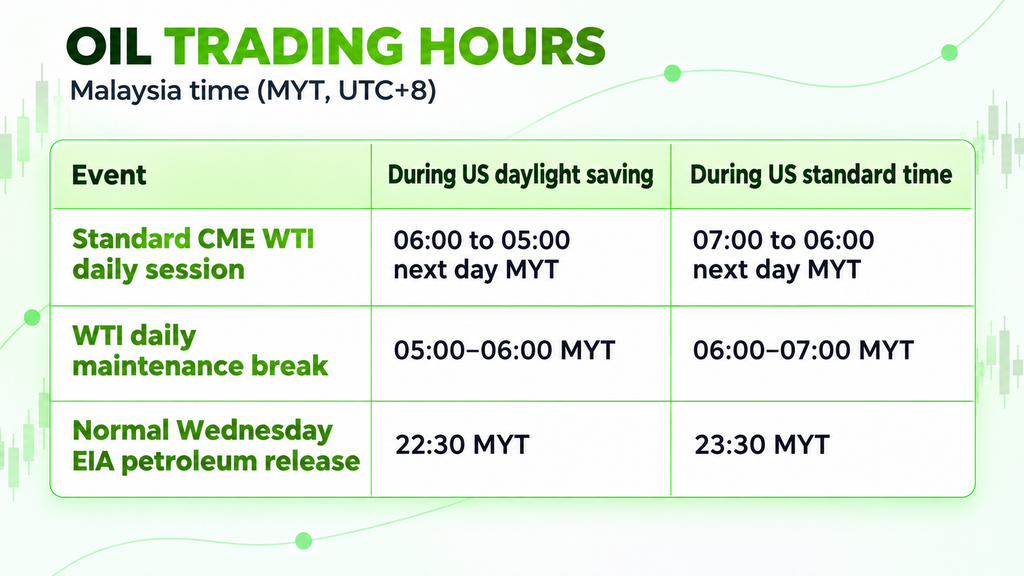
The WTI rows come from CME’s Sunday to Friday schedule of 17:00 to 16:00 Chicago time. In Malaysia, the week opens Monday morning and closes Saturday morning. Public holidays can shorten sessions. CFD trading hours depend on the provider’s published schedule, which can differ from the underlying exchange.
The EIA release calendar customarily publishes its petroleum report at 10:30 US Eastern on Wednesdays, with schedule alterations during certain holiday weeks. During US daylight saving, that means 22:30 MYT for the normal Wednesday release. After daylight saving ends on 1 November 2026, the regular Wednesday release moves to 23:30 MYT.
An Asia-based trader can end up facing the week’s largest data reaction right before bedtime. Day trading routines based on local office hours may miss that price movement. Brent follows its own ICE timetable, so you’ll need to convert it for the relevant date as well.
Oil trading strategies depend on the market condition
A market trending after a supply shock moves differently from one holding still before inventory data. An indicator may be the best tool you have for one setup and nearly worthless for the next. Technical indicators bring order to what you see on a chart, but they won’t tell you whether a shipping disruption will spiral out of control.
Trend and breakout rules
Moving averages show the trend direction; ATR shows how wide the price swings are. A breakout strategy might demand that price close outside a clearly drawn range, and it may pass on any setup where the distance to the stop would blow past your risk limit. You can backtest these rules, but that doesn’t guarantee a trading edge.
When a breakout falls apart
Rallies tend to stall if volume dries up after the first wave. If you write down your entry price, execution spread, and the underlying trigger, you can tell right away if your oil market thesis was flawed or your entry timing was off.
Range and event-driven setups
Range trading revolves around price repeatedly rejecting clear zones. That structure works less well when unexpected news shifts the outlook for global oil supply. Potential trading opportunities near support can vanish before your stop order fills.
Options add a different set of trade-offs. Our options trading glossary covers rights, premiums, and expiry. An oil option works differently than a CFD, and basic glossary definitions will not show which specific financial instruments your broker actually offers. Also, keep in mind that exercising an option can automatically open a new futures position, depending on the contract rules. Selling options also brings different obligations than buying them.
A barrel-based risk calculation
A $1 move means little until you know the position size. This hypothetical example uses a long position in a USD account and measures exposure directly in barrels. It doesn’t reflect our lot sizes, margin rates, or the current oil price.
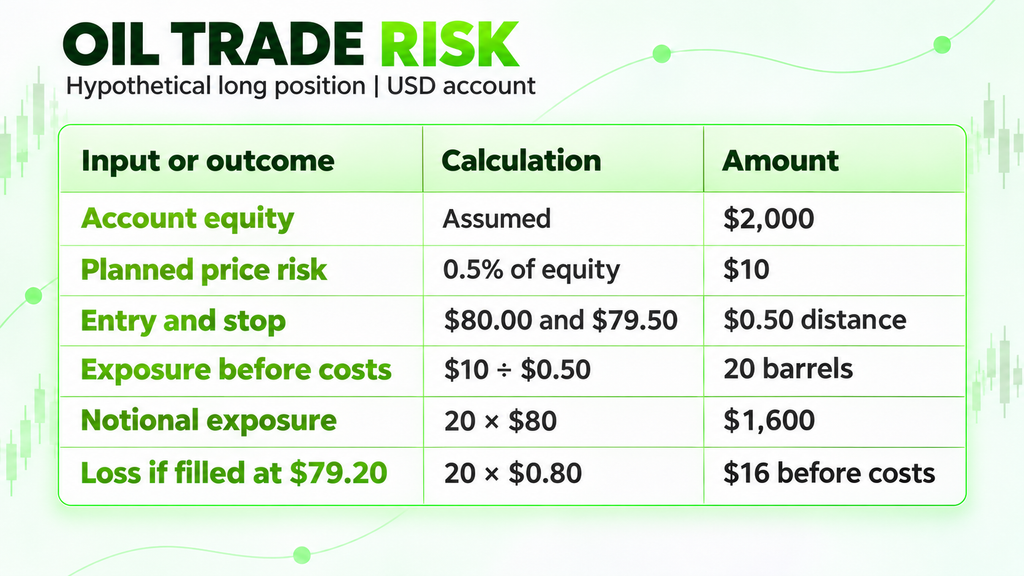
The last row shows that a stop price doesn’t guarantee your maximum loss. The calculation also makes no allowance for spread or commission. A fixed total risk budget would force you to use a smaller exposure to cover those costs, subject to minimum order sizes.
Investor—Howard Marks, Oaktree.
Margin is collateral, and your maximum loss can exceed it. Leverage cuts the margin you need to hold a position, but the dollar gain or loss per tick stays identical. If your equity drops too far, account rules will liquidate your position long before it hits your target exit.
Access and MYR balances in Malaysia
Access in Malaysia also depends on the contracting entity and the rules that apply. Under the SC’s CFD framework, any provider offering CFDs inside the Malaysian framework needs the relevant Capital Markets Services Licence, and CFDs can only be offered to sophisticated investors. An overseas licence doesn’t by itself create Malaysian authorisation.
Our Versus Trade Quarterly Digest—Q3 2026 notes the launch of MYR trading accounts. A ringgit account changes the reporting currency, but a USD-quoted oil position can still require currency conversion. The conversion method that applies changes the MYR value of oil profits, losses, and margin.
From a demo record to live trading decisions
A demo record becomes more useful when it captures the same conditions that would govern a live order:
- The benchmark, contract reference, and number of barrels involved.
- The catalyst and entry condition, written down before you execute.
- The planned exit, spread, charges, and which MYT session you’re trading in.
- The actual fill and why it differed, if it did.
Demo trading lets you practise without risking real money. Simulated fills still can’t reproduce every live condition. Trading experience becomes more useful when you keep losses, rejected setups, and skipped sessions in your record.
Talk to the team about our available oil instruments and account terms before you switch from a demo plan to live exposure.
Risk Notice: High-risk products like CFDs and leveraged trades aren’t suitable for all traders, and you could lose funds quickly. Leverage magnifies losses just like it does profits. Also, market gaps mean your stop orders might fill at a worse price, taking your losses past what you intended. We share this material purely to educate, not as trading advice or an offer. Features and local protections will vary based on your region and entity.
- How to trade in crude oil: three decisions before you place an order
- WTI and Brent crude respond to different pressures
- What an oil trading platform should show you clearly
- Oil trading hours in Malaysia
- Oil trading strategies depend on the market condition
- A barrel-based risk calculation
- From a demo record to live trading decisions