Tesla vs Ford is a Versus Pair, a tradable CFD built by Versus Trade that puts Tesla against Ford in a single instrument. Electric future against the classic carmaker: you back the side you believe in, in one order, at Versus Trade.
What is Tesla vs Ford?
Tesla vs Ford is one CFD symbol holding two stocks: Tesla is the base, and Ford is the quote. Buy it to back Tesla to rise more than Ford in percentage terms. Sell it to back Ford to rise more than Tesla. You trade the symbol without owning Tesla or Ford shares, and there is no need to cross-reference two separate stock charts. The pair carries its own price that you act on.
The order is fixed, Tesla first and Ford second. A search for TSLA vs Ford points to this same instrument. If you have seen it written as ‘Ford vs Tesla,’ that points to the same symbol. Backing Ford here is the Sell side of Tesla vs Ford.
Why trade Tesla vs Ford instead of TSLA or Ford on its own?
So why hold the pair rather than trade TSLA or Ford separately? Trading TSLA alone is a bet on Tesla’s absolute move against the dollar. A Ford position rises or falls with that one company’s price. Tesla vs Ford asks a different question: ‘Which of the two is the stronger performer in percentage terms?’ Your position turns on the gap between them rather than a set price on either stock.
That relative view is awkward to place with single stocks. The manual route is two positions, long one carmaker and short the other, sized to match, with margin managed on both. Tesla vs Ford packs the same idea into one order, built in-house by Versus Trade and not sold by other brokers. Both sides carry risk: leverage and the percentage gap work for and against you, so a Buy or a Sell can lose as easily as it gains.
Enter the market accessibly. Start a Standard Account from just $10 and take it from there.

How the Tesla vs Ford price moves
The pricing mechanism is worth explaining because the pair does not move like a single stock. Its price is a fraction: Tesla’s price divided by Ford’s. If Tesla trades near 400 and Ford near 12, the pair sits around 33.3, meaning it takes about 33 Ford shares to match one Tesla share in value. The percentage performance of each leg drives that number.
Here is a hypothetical example to show the calculation. Suppose both stocks gain the same 2 dollars on the day.
| Asset | Price (old) | Change in USD | Change in % | Price (new) |
| Tesla | 400.00 | +2.00 | +0.50% | 402.00 |
| Ford | 12.00 | +2.00 | +16.67% | 14.00 |
| Tesla vs Ford | 33.33 | N/A | -13.86% | 28.71 |
Both stocks rose by 2 dollars, but that was a small move for Tesla and a large one for Ford in percentage terms. Because Ford gained far more in percentage terms, the Tesla vs Ford price fell by roughly 14%, even though the raw dollar move looked even. Percentage outperformance sets the direction. Your profit or loss is worked out in the quote leg first, then shown in your account currency. You can follow it on the Tesla vs Ford chart in MT5, with the same indicators you run on any symbol.
Tesla vs Ford: the two sides
With the pricing mechanism clear, the choice comes down to which side of the story you back. Tesla is the electric-future name: a high-valuation growth stock that moves fast, reacts to delivery figures and margins, and can swing on a single post from Elon Musk. Ford is the established carmaker: a lower-priced share tied to production volumes, legacy auto cycles, and the dividend it pays to shareholders. The two share an industry but run on different logic, which gives the pair something to react to.
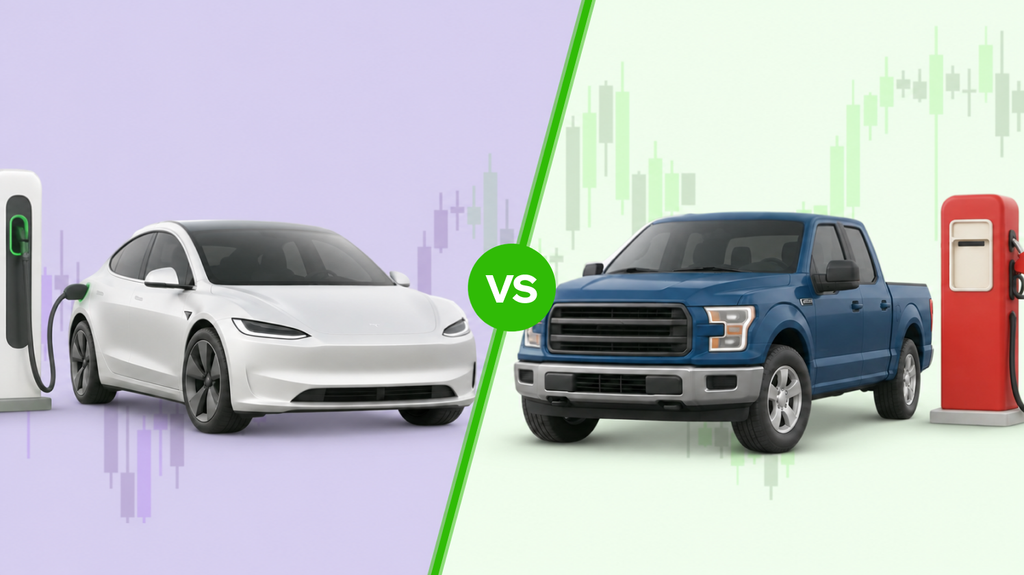
Buy Tesla vs Ford when your read is that Tesla outpaces Ford in percentage terms, say on EV momentum or a strong delivery quarter. Sell it when you think Ford holds up better, for example, in a rotation toward value and steady cash flow, or when Tesla’s premium cools. You are picking a side you probably already lean toward, since most traders hold an opinion on these two long before they open a position.
When to trade Tesla vs Ford
Those two sides show up in a few recurring setups. None is a signal or a prediction. Each turns a view into a Buy or a Sell.
Scenario 1: After earnings
Situation: Tesla reports delivery numbers or earnings, and you expect the market to reward it more than it rewards Ford’s results.
The trade: A Buy expresses that view since it gains when Tesla outperforms Ford in percentage terms. If you read the results the other way, with Ford performing better relative to expectations, the same view becomes a Sell.
Action: Open it on demo to watch how it behaves around the print, or go live with a stop-loss and take-profit set before the release.
Microsoft vs Apple. Bitcoin vs Gold. Nasdaq 100 vs Oil. With Versus Pairs, you decide which side comes out stronger.

Scenario 2: Sector rotation
Situation: Money rotates between high-growth names and legacy industrials, and you have a view on which way the flow runs for autos.
The trade: Back Tesla to lead while growth is in favor, and that view is a Buy. Back Ford as the flow runs toward established, cash-generating carmakers, and that view is a Sell.
Action: Size the position for the leverage on this pair, place your SL and TP, and test it on demo first if the setup is new.
Scenario 3: The valuation gap
Situation: You are looking at the valuation gap between the two companies and have a view on where it goes next. If you find yourself asking, “Should I invest in Tesla or Ford at these levels?” that question maps straight onto this instrument.
The trade: Expect the gap to widen in Tesla’s favor, and that view is a Buy. Expect it to narrow as Ford closes the gap, and that view is a Sell. You trade the relative move, so you do not need to call an exact price on either stock.
Action: Set your entry, stop, and target, and start on demo if you want to watch a full cycle before committing capital.
Tesla vs Ford at a glance
A few practical facts before you set one up:
Platform: Versus Trade on MT5 desktop, WebTrader, and the MT5 apps for Android and iOS, with the full set of MT5 charting tools and indicators.
Swap-free: The entire Versus Pairs group carries no swaps, so holding overnight adds no swap charge.
Leverage: 1:20, which is a 5% margin requirement, the standard for stock Versus Pairs. Leverage cuts both ways.
Spreads: Floating, sitting roughly in line with the spreads of Tesla and Ford underneath, with small differences by direction or volatility.
Trading hours: Open when both stocks trade, on weekdays from 16:35 to 22:59 server time (GMT+3) and paused when either market is closed.
Dividends: Ford pays a dividend, so the pair carries a dividend adjustment on Ford’s payout dates, with direction set by the side you hold, Buy or Sell. Tesla pays no dividend.
Demo and history: A free demo with real-time pricing, with price history since the April 2024 launch.
Tesla vs Ford market cap and volatility
Two properties shape how the pair trades. The first is the market-cap gap: Tesla and Ford sit far apart on valuation, and that difference is a big part of the market cap Ford vs Tesla story traders track. A comparison of Ford vs Tesla market caps shows their relative equity market values, not their valuation premiums. The pair moves when the ratio of Tesla’s share price to Ford’s changes. The second is volatility: Tesla can move sharply on company news while Ford tends to be steadier, so the pair’s swings often come from the Tesla side. Differences in the stocks’ percentage moves give Tesla vs Ford performance its character, and it is why some traders express an auto view through the pair instead of one stock alone.
FAQ
Can I back Ford instead of Tesla?
Yes. The name and order are fixed: Tesla as the base and Ford as the quote, so backing Ford is the Sell side of Tesla vs Ford. A Sell covers that view. There is no separate Ford vs Tesla symbol.
Should I invest in Tesla or Ford?
That call is yours, and this page does not point you to one side. If you hold the view that one outperforms the other, that view becomes a Buy or a Sell on Tesla vs Ford, so you act on the opinion you already have without committing to a single stock.
Does Tesla vs Ford involve dividends?
Ford pays a dividend, so the pair carries a dividend adjustment on Ford’s payout dates, with direction set by the side you hold, Buy or Sell. Tesla pays no dividend, so its leg adds no adjustment.
Is Tesla vs Ford swap-free?
Yes. The whole Versus Pairs group carries no swaps, so an overnight position adds no swap charge.
Can I try Tesla vs Ford before risking money?
Yes. The pair is available on a free demo account with real-time pricing and full functionality, so you can test a Buy or a Sell and watch how it behaves before going live.
How does leverage work on Tesla vs Ford?
It is a stock Versus Pair at 1:20, or a 5% margin. Leverage magnifies both gains and losses from changes in the pair price, so a position can lose quickly. Set a stop-loss and take-profit as you would on any CFD.
Trade Tesla vs Ford
Tesla vs Ford turns a view you probably already hold into a single position you can act on. Back Tesla to outrun Ford, or back Ford to hold its ground, in one instrument, one order, at Versus Trade. Open it on MT5, or test it on a free demo first and go live when the setup feels right.
Related Versus Pairs: Microsoft vs Apple, Amazon vs Alibaba, Bitcoin vs Gold.
Risk disclaimer: CFD trading carries significant risk and can result in the loss of your capital. Leverage magnifies gains and losses alike. Nothing above is trading advice, a recommendation, or a forecast of which side will win. Versus Pairs are swap-free. Pairs with a stock or index leg, including Tesla vs Ford, carry dividend adjustments on payout dates.